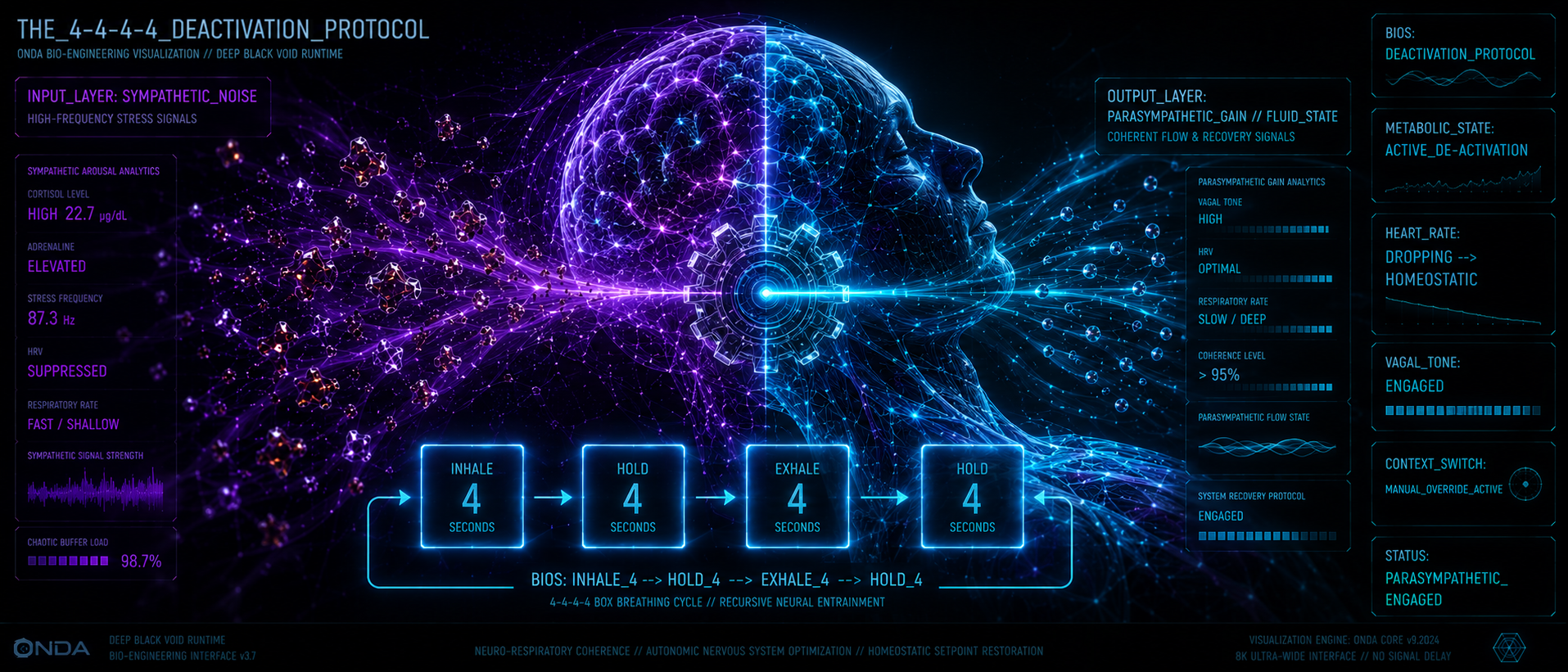
[ PROTOCOL: BOX_BREATHING // 4-4-4-4 ]
"Box breathing is the simplest down-regulation tool there is: inhale 4, hold 4, exhale 4, hold 4 — a square you trace with your breath. The US military teaches it to operators who need to stay calm and think clearly while everything around them is loud. In the ONDA Biocomputer model, it's a manual override on the autonomic nervous system: when you can't change the situation, you can change the breath, and the body follows."
Section 1: How does box breathing work?
Box breathing works by slowing your breath toward about six breaths per minute, which shifts you out of fight-or-flight. You can't consciously command your heart rate or your stress chemistry — but breathing is the one autonomic function you can drive manually, and it back-propagates to the rest of the system. Slow, paced breathing at around six breaths per minute shifts the balance toward the parasympathetic ("rest-and-digest") branch, raises heart-rate variability and lowers arousal (Zaccaro 2018; Lehrer & Gevirtz 2014).
Box breathing's equal 4-4-4-4 rhythm lands you near that rate, and the breath-holds add a deliberate, almost meditative structure that gives a busy mind something simple to track. The result: a fast, portable way to step out of fight-or-flight.
Section 2: Should you use box breathing or 4-7-8?
Use box breathing for steady focus under pressure and 4-7-8 as a stronger off-switch for sleep.
- •Box (4-4-4-4) — steady focus under pressure. Best before a stressful event, or to settle without making yourself sleepy. The held breaths build composure.
- •4-7-8 — a stronger off-switch for sleep. The long hold and even longer exhale push your breathing rate right down and emphasise the calming out-breath.
- •Extended exhale (4-6) — fastest everyday calm. A longer exhale than inhale slows the heart within each breath; an RCT found brief exhale-focused breathing improved mood and lowered arousal more than mindfulness (Balban 2023).
Don't count in your head — let the Breathing Pacer run the rhythm so you can just follow the circle. For the personalised HRV sweet spot, see resonance breathing.
Section 3: Box-Breathing Protocols
PROTOCOL 1: The Pre-Stress Box
The Hack: Run 4–6 rounds of 4-4-4-4 in the two minutes before anything that spikes you — a meeting, a lift, a hard conversation.
The Science: Slowing the breath pre-emptively raises parasympathetic tone, so you enter the event already down-shifted instead of trying to claw back calm mid-spike.
PROTOCOL 2: Nasal, Diaphragmatic, Quiet
The Hack: Breathe through the nose into the belly (the diaphragm), not the chest, and keep it silent and smooth.
The Logic: Nasal, diaphragmatic breathing slows the rate naturally, and slow breathing is associated with higher vagally mediated HRV than shallow chest breathing. If you're audibly straining, ease off the counts.
PROTOCOL 3: Shorten the Box if You're Light-Headed
The Hack: If 4-4-4-4 makes you dizzy, drop to 3-3-3-3 or skip the holds. Never force it.
The Logic: The holds can feel like too much at first. Comfort beats heroics — the calming effect comes from the slow rhythm, not from enduring long holds.
[ HARDWARE_VALIDATION ]EXAMPLE_DEVICE: HRV / resting-HR tracker, or just the felt senseMETRIC: Heart rate and tension drop within a few roundsSTATUS: PARASYMPATHETIC_ENGAGEDIllustration — not a measurement