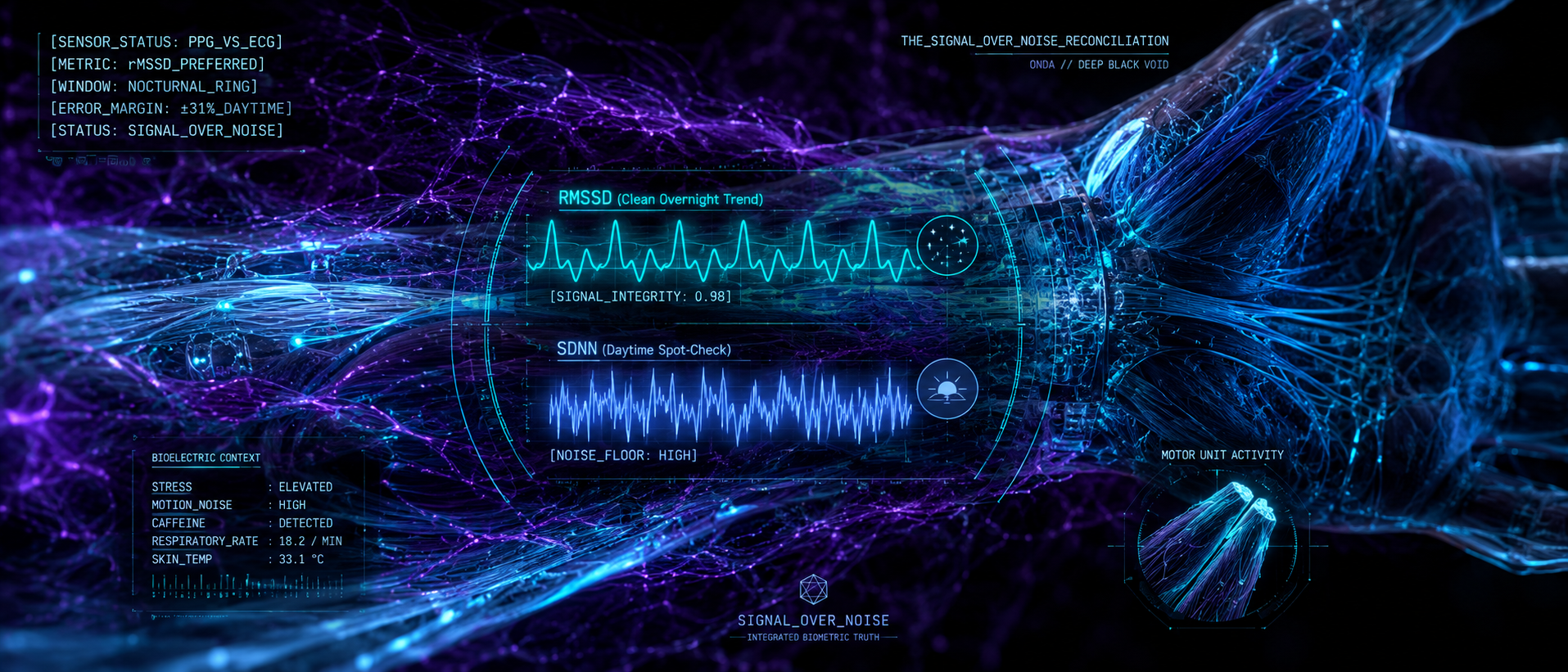
[ RECONCILING THE SENSOR LOG ]
"Your Oura ring says your HRV was 48 last night. Your Apple Watch flashed 22 this afternoon. Your friend's Whoop says she's at 90 and clearly winning at life. Same biology, three different numbers — so which one is lying?
None of them, mostly. In the ONDA Biocomputer model, HRV isn't one reading; it's a family of measurements taken by different sensors, over different windows, using different math. Comparing them directly is like comparing a thermometer in Celsius to one in Fahrenheit and panicking at the gap. Here is how to read the sensor log correctly — and which value actually deserves your trust."
Section 1: They measure different things
"HRV" is not a single number. It's a family of metrics derived from the tiny variations between heartbeats, and devices surface different ones (Shaffer & Ginsberg, 2017):
- •RMSSD — the beat-to-beat metric most consumer devices report as "HRV." It tracks fast, parasympathetic (vagal) activity. This is the number Oura, Whoop, Garmin and the others usually mean.
- •SDNN — a broader metric reflecting total variability over a window; larger and not interchangeable with RMSSD.
- •Time window — 24-hour, short-term (~5 min) and ultra-short (<1 min) recordings all produce different values for the same person. A 30-second spot check and an 8-hour overnight average are simply not the same measurement.
So before blaming a device, check you're even comparing the same metric over the same window. Usually you aren't.
Section 2: Overnight vs spot — the window is everything
This is the single biggest source of confusion:
- •Oura, Whoop, Garmin compute HRV mostly from your night, averaging across hours of still, warm, motionless sleep — steadier conditions for detecting beats. That's why overnight RMSSD from a ring validates well against medical ECG (the Oura ring's nocturnal RMSSD shows very high agreement with ECG; Cao et al., 2022).
- •Apple Watch historically takes sporadic spot readings through the day (often during the Breathe/Mindfulness app or at random). Daytime readings — sitting, talking, moving, caffeinated — are inherently noisier and swing wildly. A 22 at 3 p.m. after coffee and a meeting is not comparable to a 48 measured overnight.
Same heart, different window, different number. Neither is wrong; they're answering different questions.
Section 3: PPG vs ECG — why the wrist struggles with HRV
Most wearables use PPG (photoplethysmography): green LEDs reading blood-volume pulses under the skin. A chest strap or a medical ECG reads the heart's electrical signal directly.
Here's the catch. PPG is excellent at average heart rate — but HRV needs the exact gap between consecutive beats, and small timing errors that don't matter for HR wreck the beat-to-beat math. In one validation, the Apple Watch Series 6 hit near-perfect agreement with ECG for heart rate (≈1% error at rest) but only moderate agreement for the beat-interval measure HRV depends on (≈31% error at rest; 2025 Sensors validation). Motion, cold hands, loose fit and skin differences all add noise — and the wrist moves far more than a ring or strap.
The takeaway: HR is easy, HRV is hard, and readings taken while you are still (overnight or at rest) give cleaner beat-to-beat data than readings taken on the move.
2026 update: wrist hardware is closing the gap. Apple narrowed its HRV measurement-design disadvantage in 2026; in overnight recordings from 13 people (Dial 2025), the Oura Ring was among the closest to ECG — see the ranking below.
Section 4: So which should you trust?
Ranked, roughly, for HRV specifically:
- •Chest strap (e.g. Polar H10) — ECG electrodes; close to lab ECG at rest in young healthy adults. Best if you want one trustworthy reading.
- •Overnight ring or band (Oura, Whoop, Garmin) — very good for nightly trends, measured in ideal conditions.
- •Daytime wrist spot-checks (Apple Watch default HRV) — fine for a rough sense, noisy as an absolute; read the trend, never a single value.
This ranking is consistent with one independent study (Dial 2025: overnight recordings from 13 people): across nocturnal HR and HRV, the Oura Ring (Gen 3 and Gen 4) agreed most closely with the ECG reference, ahead of Whoop, Garmin and Polar's wrist devices — a small sample, so treat it as one data point. The pattern holds: still, overnight, well-fitted wins.
But the real answer is the one nobody selling a wearable will tell you: the absolute number barely matters. HRV is wildly individual — a "good" RMSSD for one person is another's bad night. What carries signal is your own value, on one device, measured the same way, trending over weeks.
Section 5: How to actually use HRV
The Hack: Pick one device. Measure under one condition (overnight, or first thing on waking — same posture, same time). Ignore every other device's number. Watch the multi-week trend, not the daily reading.
This is also the antidote to the new wellness trap: obsessively comparing trackers and spiralling over a low number is itself a stressor that lowers HRV. The point of the metric is calm self-knowledge, not a leaderboard. Compare your number with Fitbit users your age once to get oriented — then stop staring at the daily digit and watch the line over time.
When you're ready to choose hardware, our HRV tracker reviews rank devices on exactly this: how trustworthy their HRV actually is, not their marketing. Most people are deciding between two — see Oura Ring 4 vs Whoop 5.0 — and if you've ever wondered what your "recovery" number really means, the recovery score explainer decodes it.
[ HARDWARE_VALIDATION ]EXAMPLE_DEVICE: One device, one condition, measured consistentlyMETRIC: Your own 4-week RMSSD trend (not today's absolute number)STATUS: SIGNAL_OVER_NOISEIllustration — not a measurement