[ MASKING THE SLEEP SIGNAL ]
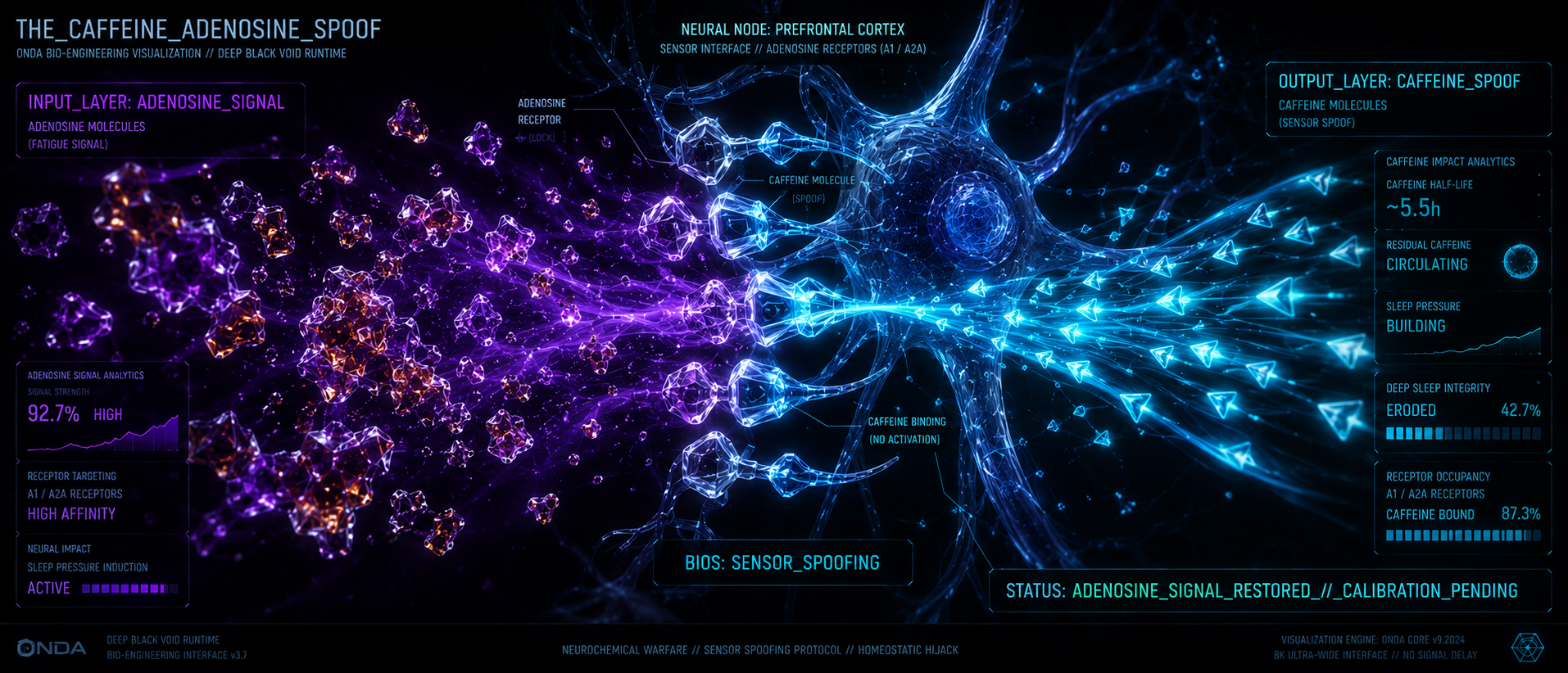
"Caffeine doesn't give you energy. It hides your tiredness. Throughout the day, a molecule called adenosine accumulates in your brain — it's the system's 'sleep pressure' gauge, rising the longer you're awake. Caffeine is shaped just enough like adenosine to plug into its receptors without activating them, masking the signal.
In the ONDA Biocomputer model, this is spoofing a sensor. The pressure is still building; you just can't read it. And when the caffeine clears, all that backed-up adenosine floods in at once — the afternoon crash. The cost isn't the crash, though. It's what an ill-timed dose does to tonight's sleep."
Section 1: How long does caffeine stay in your system?
Caffeine has a half-life of roughly 5–6 hours — meaning half the dose is still in your bloodstream that long after you drink it, and a quarter is still there 10–12 hours later. A 2 p.m. coffee can leave a meaningful dose circulating at bedtime.
That residual caffeine doesn't always stop you falling asleep — it quietly steals deep sleep (slow-wave sleep). You sleep the hours but wake unrefreshed, then reach for more caffeine, closing the loop. The fix is timing, not abstinence. The Caffeine Cut-Off Calculator finds your personal last-call from your bedtime and drink.
Section 2: When should you drink your first coffee of the day?
A popular tip is to delay your first cup 60–90 minutes after waking. Your natural cortisol wake-up rise peaks in the first hour after waking, and the idea is that caffeine works better once it dips — but this is popular advice without strong evidence. Where caffeine timing clearly matters for your circadian rhythm is the other end of the day: keep it well away from bedtime.
Section 3: Caffeine Firmware Protocols
PROTOCOL 1: Set a Hard Cut-Off
The Hack: Stop all caffeine 8–10 hours before bed — for most people, an early-afternoon line in the sand.
The Science: With a ~5.5-hour half-life, an 8–10 hour buffer drops the remaining dose low enough to stop eroding deep sleep. Use the calculator to get your exact time.
PROTOCOL 2: Delay the First Cup
The Hack: Optionally, wait 60–90 minutes after waking for your first coffee.
The Logic: Some people find a later first coffee gives a smoother lift; the idea that it works by letting your cortisol peak "go first" is popular advice without strong evidence.
PROTOCOL 3: Front-Load the Dose
The Hack: Keep the bulk of your intake in the morning. Treat any post-lunch coffee as a sleep debt you're choosing to take on.
The Logic: Total daily caffeine matters, but timing matters more for sleep. A big morning dose clears by night; a small afternoon one may not.
[ HARDWARE_VALIDATION ]EXAMPLE_DEVICE: Sleep tracker (deep-sleep %) + subjective morning energyMETRIC: Deep-sleep minutes ↑ after moving the cut-off earlierSTATUS: ADENOSINE_SIGNAL_RESTOREDIllustration — not a measurement