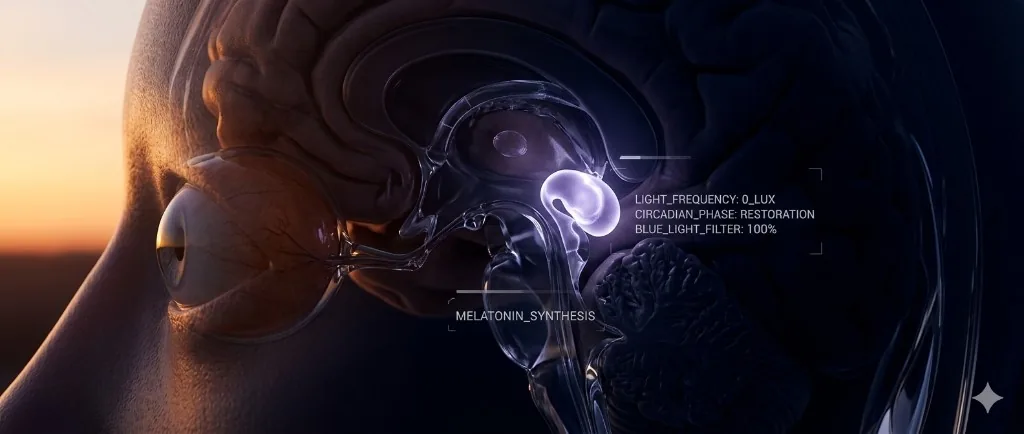
[ CALIBRATING OPTICAL INPUTS ]
"Light is the primary programming language for your biological clock. Your eyes are not just cameras for vision; they are data ports for photons that synchronize every cellular process in your body.
In the ONDA model, 'Signal Stability' is about managing the spectral quality of light. Modern environments are filled with 'Photonic Noise' (blue light at night), which corrupts your hormonal code. To restore system integrity, you must master the art of Circadian Lighting and Dark Therapy."
Which eye cells tell your body clock that it's daytime?
Inside your retina, a specialized set of receptors (mRGCs) detects blue light to signal the Suprachiasmatic Nucleus (SCN)—the master clock of your CPU. When these receptors are hit by high-frequency blue light after sunset, the system fails to initiate the MELATONIN_UPLOAD sequence. This leads to fragmented sleep and systemic 'Clock Drift.'
What is dark therapy?
Dark Therapy is the intentional restriction of short-wavelength light to allow for complete neural recovery. By creating a 'Photic Firewall' in the evening, you protect the brain's ability to clear metabolic waste through the Glymphatic System. Without a period of true biological darkness, the hardware never fully enters 'Deep Sleep' mode.
[ SECTION 3: LIGHTING PROTOCOLS ]
PROTOCOL_01 > The Photonic Anchor (Morning Lux)
The Hack: Exposure to 10,000+ LUX of natural sunlight within 30 minutes of waking.
The Logic: Morning light is the strongest daily signal for your body clock and helps time evening melatonin. The popular claim that a cortisol spike sets a precise melatonin "timer" is not strongly evidenced. It anchors your 'System Clock' to the local solar cycle, eliminating midday brain fog.
PROTOCOL_02 > Spectral Shift (Evening Calibration)
The Hack: Switch all environmental lighting to red/amber wavelengths (below 2000K) after 8:00 PM.
The Logic: Dim red light suppresses melatonin far less than blue-rich light. Red and near-infrared light also reach the mitochondria directly — see mitochondrial DNA & red light. By shifting the spectrum, you maintain visibility without sending an 'Emergency Wake' signal to the SCN.
PROTOCOL_03 > The Photic Firewall (Blue Light Blocking)
The Hack: Use 100% blue-blocking glasses (orange lenses) if digital screens are used after sunset.
The Logic: This filters out the specific 450-480nm frequencies that suppress melatonin. It allows for 'Digital Input' while maintaining 'Hormonal Integrity,' acting as a software bridge between the modern world and ancient biology.
[ HARDWARE_VALIDATION ]EXAMPLE_DEVICE: Lux Meter / SpectrometerMETRIC: Melanopic Lux < 10 (Post-Sunset)STATUS: SIGNAL_NOISE_REDUCEDIllustration — not a measurement
How light timing shows up in your body — sleep, mood and HRV
Because your circadian clock governs your autonomic nervous system, light timing leaves marks you can measure. Morning light is the anchor: bright light early — ideally outdoors, which is far brighter than any office, even on a cloudy day — advances and stabilizes your clock, so you fall asleep more easily that night and wake more alertly, and it lifts mood directly (the same mechanism behind light therapy for winter depression). Evening light is the disruptor: bright, blue-rich light late tells the clock it's still day, delays melatonin, and pushes your natural sleep later — the root of social jet lag. The lesson is that timing matters as much as amount.
It shows up in the numbers, too. Your resting heart rate and HRV follow the circadian clock, so a misaligned rhythm tends to read as a lower or less stable overnight HRV. ONDA reads your resting heart rate, HRV and breathing from Apple Health — from your Apple Watch or another tracker that syncs there — and holds your personal baseline, so as you fix your light habits you can watch whether your overnight numbers grow steadier — turning "get more morning light" into something you can actually track.
Recommended tools
Dark therapy works when the protocol survives contact with real life. A tracker confirms it.
- •Oura Ring 4 — overnight sleep model that reflects light timing
- •Sleep Cycle — phone-based smart-alarm tracking
- •Rise — sleep-debt model tied to circadian timing