[ TRACKING THE CLEARANCE ]
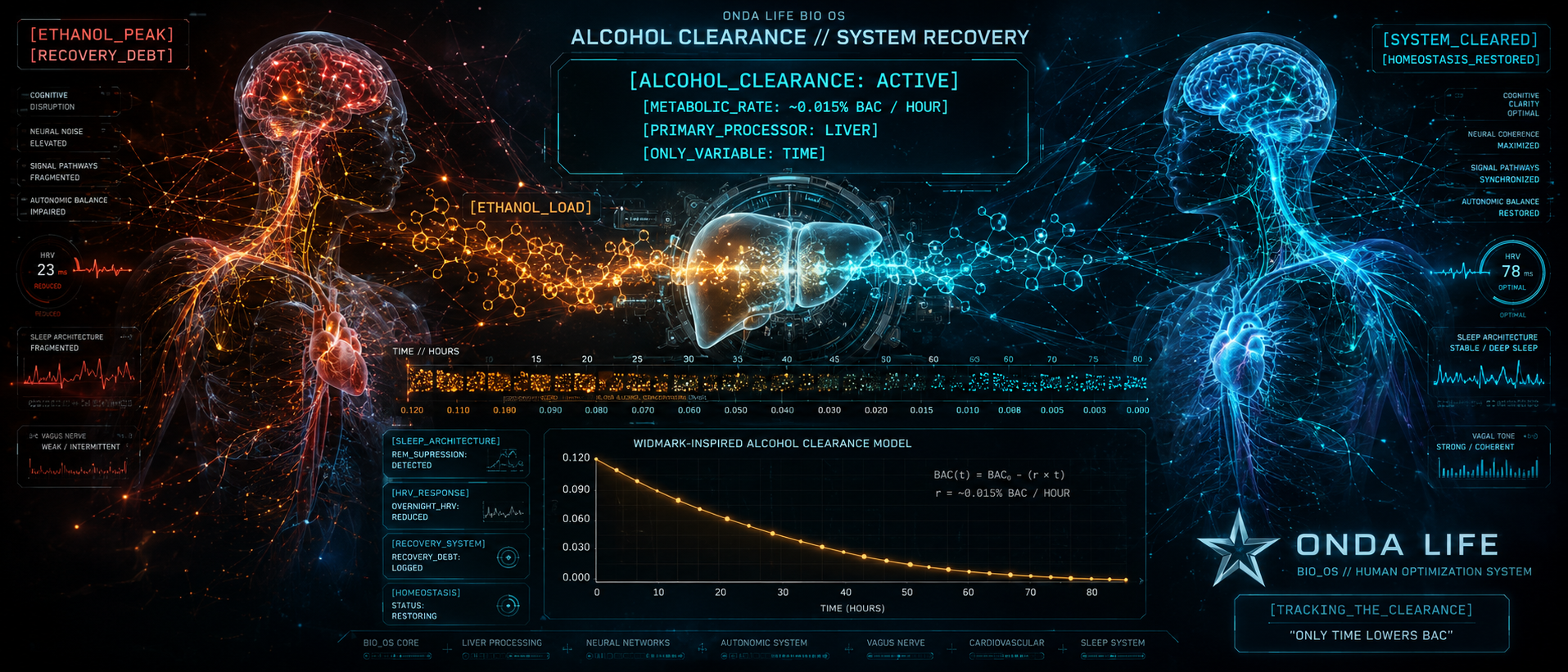
"‘How long does alcohol stay in your system?’ The blood answer is simpler than people hope: your liver clears alcohol at about one standard drink per hour on average — faster in some people, slower in others — and nothing you do speeds that up. Coffee, a cold shower, a big meal, ‘sweating it out’ — none of them sober you faster; they just make a drunk person a more alert drunk person. In the ONDA Biocomputer model, alcohol is a slow-draining buffer: only time empties it."
Section 1: How fast does alcohol leave your body?
Once it’s in your blood, alcohol is eliminated at approximately 0.015% BAC per hour on average — close to one standard drink (14 g) per hour. The real range is roughly 0.010–0.035% per hour: it tends to be faster in people who have eaten and in heavy drinkers, but nothing you do (coffee, a cold shower) speeds it up. So a blood-alcohol level of 0.08% takes about five hours to reach zero; four or five drinks in an evening can mean alcohol in your system past 4–6 hours, sometimes into the next morning.
The detectable traces linger far longer than the impairing level: alcohol shows in urine for up to ~12–24 hours, and in specialised tests (EtG) for days — but that’s detection, not intoxication. For how it actually clears from blood for your weight and drinks, use the Alcohol Clearance Calculator.
Section 2: Can you sober up faster?
No — the rate-limiting step is your liver’s enzymes (mainly alcohol dehydrogenase), which work at a near-constant pace you can’t hurry. Caffeine masks drowsiness but doesn’t change BAC; food slows absorption (lowering the peak) but not elimination; water helps the hangover, not the clearance. The only variable that matters once you’ve drunk is time.
It does vary between people — body size, sex, genetics, liver health and medication shift the numbers — which is exactly why a calculator gives an estimate, never a green light to drive.
Section 3: The real cost — your night
The Hack: Finish your last drink at least 3 hours before bed.
The Science: Alcohol helps you fall asleep but wrecks the back half of the night — it suppresses REM, increases awakenings, and lowers overnight heart-rate variability as your body works to metabolise it. That’s why a few drinks leave you unrested and show up as poor recovery the next morning. Front-load and stop early to protect deep sleep.
[ HARDWARE_VALIDATION ]EXAMPLE_DEVICE: Sleep / HRV tracker the morning afterMETRIC: Lower overnight HRV and less deep sleep after late drinksSTATUS: RECOVERY_DEBT_LOGGEDIllustration — not a measurement
Educational only, not medical or legal advice. Blood-alcohol estimates vary widely between individuals — never use them to decide whether it is safe or legal to drive. If you have been drinking, do not drive.