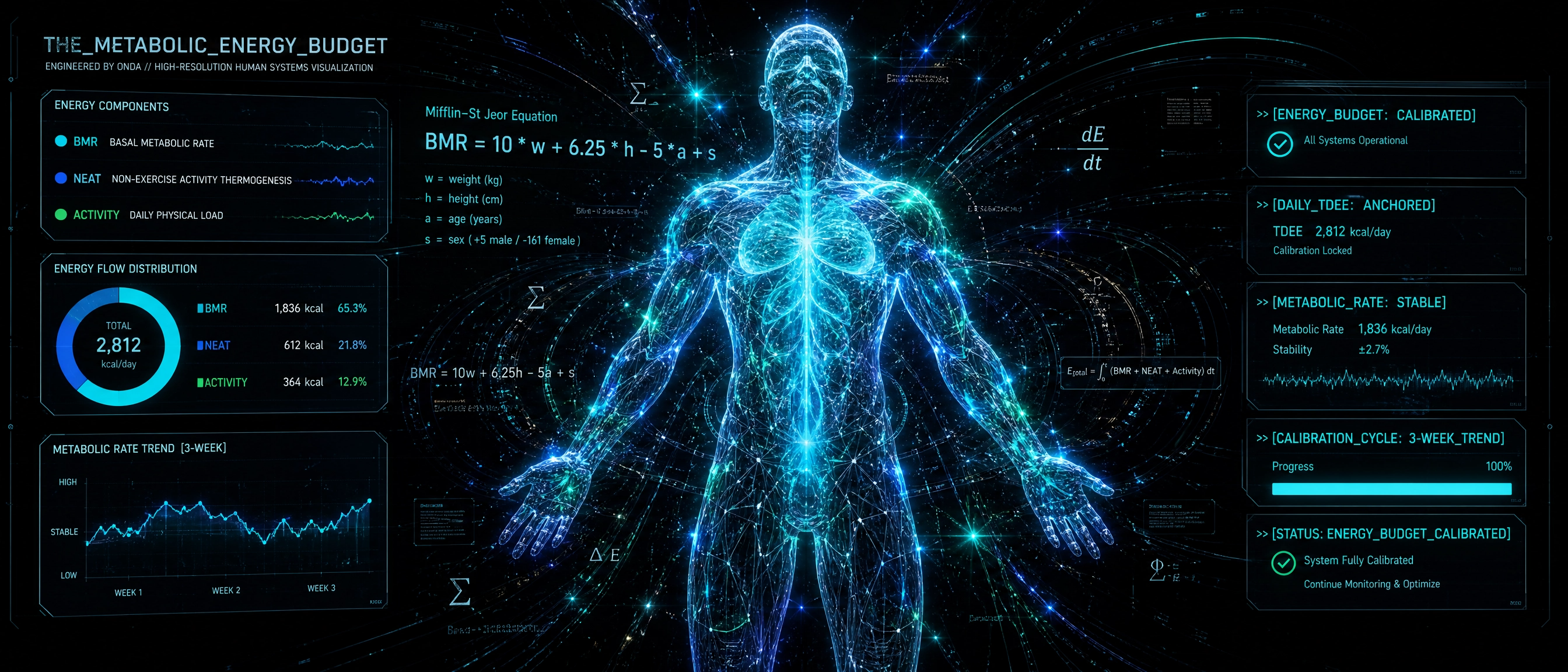
[ COMPUTING THE ENERGY BUDGET ]
"Maintenance calories — your Total Daily Energy Expenditure (TDEE) — is the number of calories that keeps your weight exactly where it is. It’s the anchor for every nutrition goal: eat below it to lose fat, above it to gain. In the ONDA Biocomputer model, it’s your daily energy budget — and like any budget, the printed estimate is a starting point you reconcile against reality."
Section 1: How do you calculate maintenance calories?
Step 1 — BMR. Your basal metabolic rate is what you’d burn lying in bed all day. The Mifflin–St Jeor equation is the most accurate common predictor (Frankenfield 2005):
- •Men: BMR = 10·weight(kg) + 6.25·height(cm) − 5·age + 5
- •Women: same, but − 161 instead of + 5
Step 2 — activity multiplier. Multiply BMR by a physical-activity level (PAL), from 1.2 (sedentary desk job) to 1.9 (physical job or twice-daily training), per the FAO/WHO/UNU energy-requirement bands. The result is your TDEE.
The TDEE Calculator does both and adds a macro split — but the equations matter less than what you do with the number.
Section 2: How accurate are maintenance calorie formulas?
Predictive equations are accurate to roughly ±10% for most people (Frankenfield 2005) — but real metabolism varies with body composition, genetics, and especially non-exercise activity (NEAT: fidgeting, walking, standing), which can swing daily burn by hundreds of calories. So treat your calculated TDEE as a hypothesis, not a fact.
The real test: eat at your estimated maintenance for 2–3 weeks and watch the trend. If weight is stable, that’s your true maintenance. If it’s drifting, adjust by ~100–150 calories and re-check. The scale is the calibration instrument; the formula just gets you close.
PROTOCOL: Set, Hold, Adjust
The Hack: Calculate TDEE, eat there (or at your goal offset) consistently for 2–3 weeks, then adjust based on the weekly average weight — not a single day.
The Logic: Daily weight swings are mostly water and gut contents. The multi-week average reveals the real energy balance and turns a population estimate into your personal number.
[ HARDWARE_VALIDATION ]EXAMPLE_DEVICE: Food log + weekly average weightMETRIC: Weight stable at maintenance, or trending at the target rateSTATUS: ENERGY_BUDGET_CALIBRATEDIllustration — not a measurement
Educational estimate, not dietetic or medical advice. Very low intakes, medical conditions or eating-disorder history warrant professional guidance.