I Move
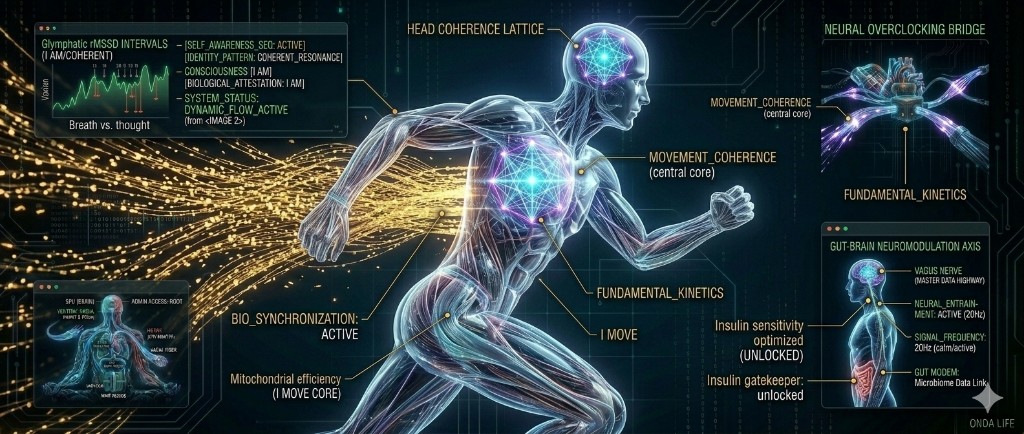
Protocol: Rhythmic Coherence and Primary Locomotion
The transition from the static state of “I Am” to the dynamic “I Flow.” At this stage, we awaken primary motor skills and master navigation within the flow. This is the engineering of the “fluid body,” where movement does not require exhausting effort but is born from resonance with the environment.
We descend to the level of “fish intelligence”—activating ancient brainstem structures and spinal cord circuits responsible for automatic grace and survival: activating CPGs (Central Pattern Generators), engaging primary motor circuits of the brainstem, working with spinal micro-movements, and learning to navigate through the flow of incoming stimuli.
Biological Protocol
This protocol transforms the “Fish” metaphor into a precise sequence for tuning neural fluidity:
Spinal Patterns (CPG)
Activating centers in the spinal cord to create natural, “autopilot” locomotion. Movement becomes as effortless as swimming.
Vestibulo-Ocular Reflex (VOR)
Stabilizing gaze while the head is in motion. This is the foundation for visual navigation and the feeling of stability within the flow.
Rhythmic Coherence
Increasing Heart Rate Variability (HRV) by synchronizing axial movements with the respiratory cycle.
Intermuscular Coordination and Energy Efficiency
Transferring force through fascial chains, allowing the whole body to move as a single vector. Training the brain to use the minimal electrical impulse to achieve the maximum biomechanical result.
Target Systems
The primary goal is to launch the body’s wave dynamics and radically reduce the coefficient of internal resistance.
- •The Spine: The axial skeleton as the primary waveguide for movement.
- •Spinal Neural Circuits and Cerebellum: Centers for rhythmic movement; modulating smoothness and smoothing out “noise.”
- •Vestibular System: The primary gyroscope for orientation within the flow.
Results & Benefits
The outcome of completing Part 2 is the attainment of “neural fluidity.” What people often notice with consistent practice:
- •The disappearance of “jerky” movements (micro-coordination).
- •Improved fascial gliding and synovial joint lubrication.
- •Synchronization of breath and movement into a single cycle.
You stop “pushing” yourself through space and begin to move within it, utilizing inertia, rhythm, and the natural curves of the spine. The body becomes responsive, and navigation becomes intuitive.