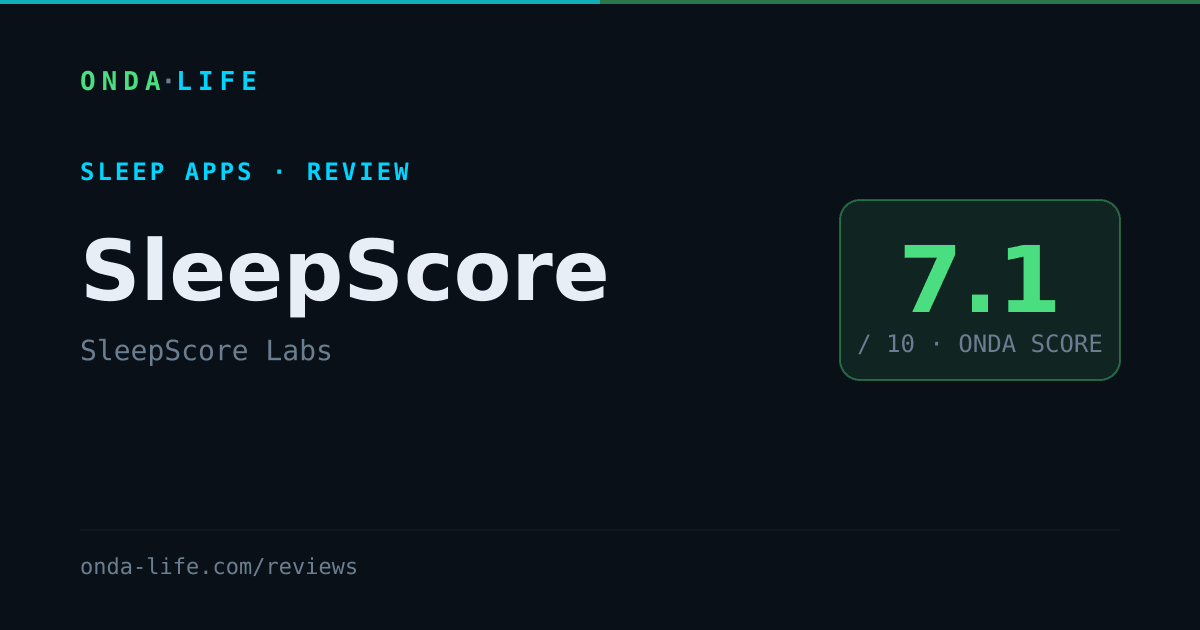
A research-led, contact-free tracker — the strongest here at turning your sleep data into something to actually act on.Best for a tracker that turns sleep data into concrete, science-led recommendations.
SleepScore comes from a research-oriented company and it shows. It tracks without contact, breaks the night into dozens of parameters, and turns that into personalised recommendations rather than just a number — the strongest mainstream tracker for telling you what to change.
How we tested: Evidence-based assessment — from public information, app-store data and independent 2026 reviews. Not based on a long hands-on trial by ONDA.
Contact-free sonar tracking through the phone speaker and microphone — a clever, well-regarded approach.
Wind-down content
5.5
Light — some content, but the focus is measurement and advice.
Sleep science
8.0
Built by a research-oriented company; the night is broken into dozens of measured parameters.
Insights and guidance
8.5
Its standout — personalised, science-led recommendations, not just a score.
App experience
7.0
Clear enough, if less polished than Sleep Cycle.
Free tier
6.0
A free tier exists, but the useful analysis and history need Premium.
Value
6.5
Around 50 USD a year for the full experience.
Pros
+Contact-free tracking — nothing to wear or charge
+The strongest, most actionable recommendations here
+Research-led, with dozens of measured parameters
+Solid tracking accuracy for a phone-based app
Cons
−Phone-based sonar is still an estimate, not wearable-grade
−Wind-down content is light
−The useful analysis sits behind Premium
−Less polished than Sleep Cycle
Price: $50 per year (Premium); a free tier available (as of 2026-05-16)
Where it leads
SleepScore comes from a research-oriented company, and it shows. It tracks without contact — using sonar through the phone speaker and microphone — breaks the night into dozens of parameters, and, crucially, turns that into personalised recommendations rather than just a number. Of the mainstream trackers here, it is the strongest at telling you what to actually change.
What are the downsides of SleepScore?
The contact-free sonar approach is clever but still a phone-based estimate, not wearable-grade. Wind-down content is light, and the genuinely useful analysis and history sit behind the paid plan.
Who should buy SleepScore?
Choose SleepScore if you want a tracker that does something with the data — concrete, science-led recommendations — and you would rather not wear anything to bed. If you want the deepest raw tracking, a wearable-paired app like Pillow or AutoSleep goes further.
Background reading
The sleep biology behind what these apps measure and the protocols they support.
SleepScore is worth it if you want sleep data turned into concrete, science-led recommendations. It tracks contact-free with nothing to wear or charge and gives the most actionable advice among the sleep apps reviewed. Its phone sonar is still an estimate, and the useful analysis requires Premium.
How much does SleepScore cost?
SleepScore Premium costs about $50 per year, and a free tier is available. The most useful analysis sits behind Premium, so budget for the subscription if the science-led recommendations are the reason you want the app.
What are the downsides of SleepScore?
SleepScore's phone-based sonar is an estimate, not wearable-grade tracking. Wind-down content is light, the useful analysis sits behind Premium, and the app is less polished than Sleep Cycle, its closest mainstream alternative.