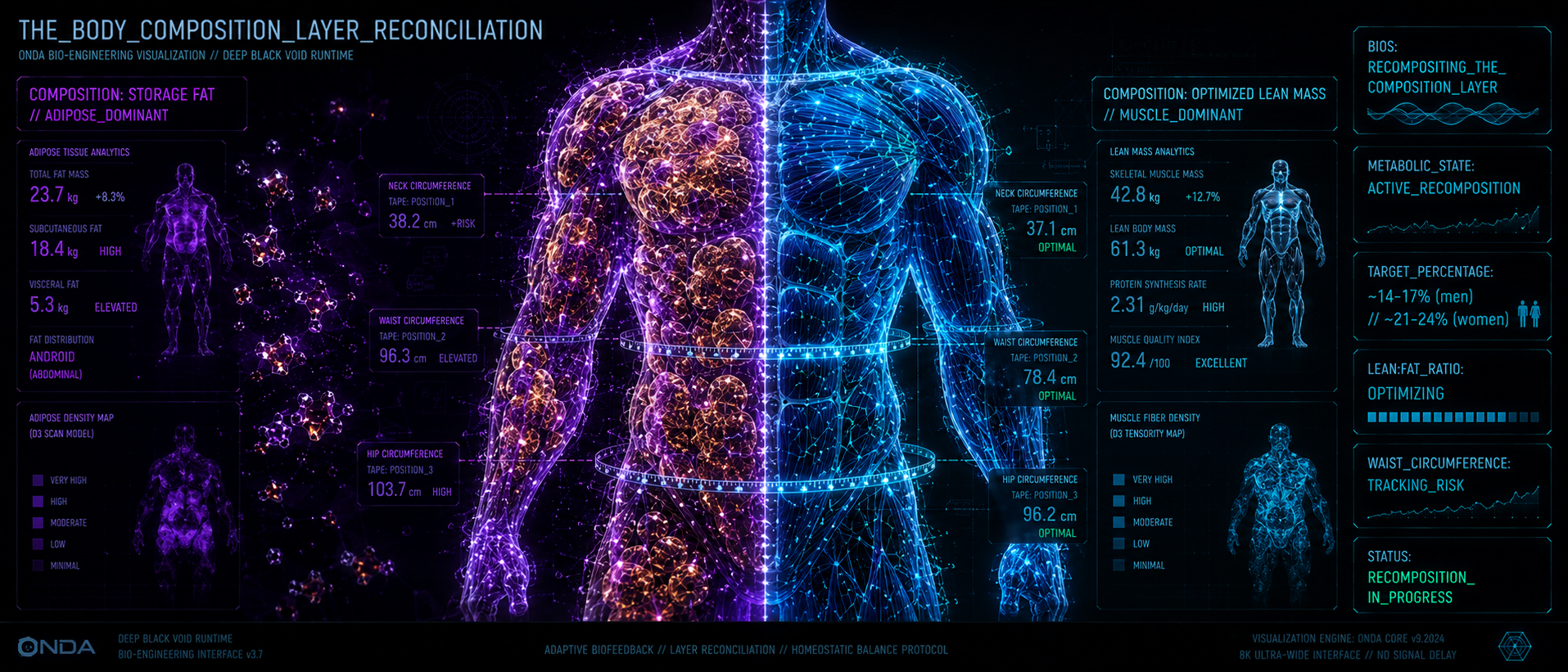
[ READING THE COMPOSITION LAYER ]
"The scale reports one number and hides the only one that matters. Two people at the same bodyweight can carry wildly different amounts of muscle and fat — different engines, different risk, different reflection in the mirror. In the ONDA Biocomputer model, bodyweight is a single noisy register; body composition is the actual state.
Body-fat percentage splits that register into its parts: lean mass (muscle, bone, organs, water) versus fat mass. Track this layer and you can tell whether a 'plateau' on the scale is actually recomposition — muscle up, fat down — in disguise."
Section 1: What is a healthy body-fat percentage?
A rough healthy range is ~14–17% for men and ~21–24% for women — and not all fat is surplus. Essential fat — the minimum for hormones, nerves, and organ protection — is about 2–5% in men and 10–13% in women (women's higher floor supports reproductive function). Everything above that is storage fat, the buffer you can actually move.
Rough healthy ("fitness") ranges: ~14–17% for men, ~21–24% for women, with athletic bands a notch lower. "Ideal" depends on age, genetics and goals — chasing essential-fat levels year-round is neither sustainable nor healthy.
Section 2: How do you measure body-fat percentage?
You can measure it with DEXA, a Bod Pod or cheaper methods — every method trades accuracy for access:
- •DEXA / Bod Pod — most accurate, but you pay and travel for them.
- •Skinfold calipers — good with a skilled tester; operator-dependent.
- •U.S. Navy tape method — circumference-based, ~3–4% standard error, free and repeatable at home. The Body Fat Calculator runs this Hodgdon–Beckett equation from your neck, waist (and hip) measurements.
- •Bioimpedance scales — convenient but swing with hydration; useful only for trends.
The lesson: pick one method, use it under the same conditions, and track the trend rather than obsessing over a single absolute number.
Section 3: Composition Firmware Protocols
PROTOCOL 1: Measure the Trend, Not the Day
The Hack: Take the same measurement weekly, same time of day, same conditions, and watch the multi-week direction.
The Science: Day-to-day shifts are mostly water and gut contents. A consistent method exposes the real signal — fat and muscle change slowly, over weeks.
PROTOCOL 2: Recompose, Don't Just Cut
The Hack: Pair a modest calorie deficit with resistance training and high protein.
The Logic: Dieting alone drops weight and muscle, raising the fat-to-lean ratio you don't want. Training plus protein tells the body to spend fat and keep muscle — body fat % falls even if the scale moves slowly.
PROTOCOL 3: Watch Waist for Risk
The Hack: Track waist circumference alongside body-fat %.
The Logic: Visceral (abdominal) fat drives metabolic and cardiovascular risk more than total fat. A shrinking waist is a strong health signal independent of the percentage itself.
[ HARDWARE_VALIDATION ]EXAMPLE_DEVICE: Tape measure (Navy method) + weekly logMETRIC: Body-fat % and waist trending down while strength holdsSTATUS: RECOMPOSITION_IN_PROGRESSIllustration — not a measurement