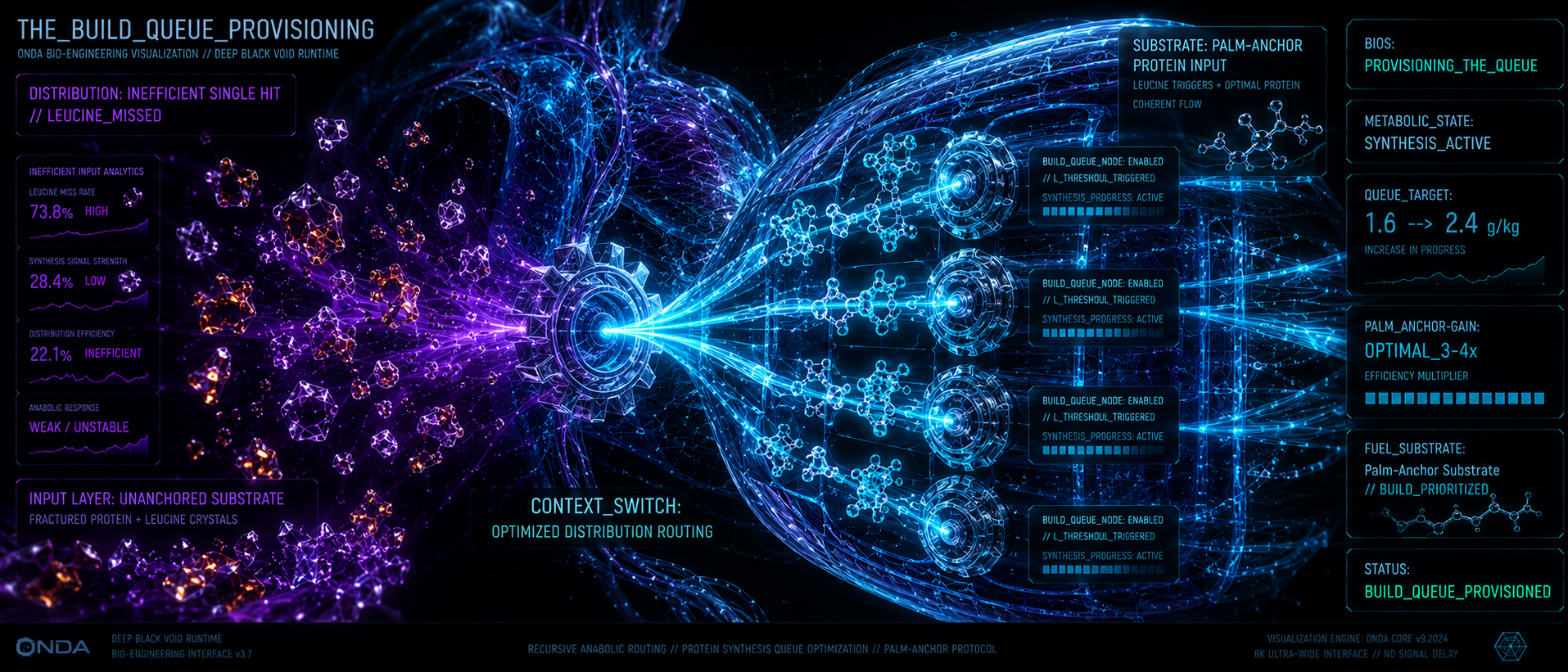
[ PROVISIONING THE BUILD QUEUE ]
"Protein is the only macronutrient your body can't improvise. Carbs and fat are interchangeable fuel; protein is structural substrate — the raw material for muscle, enzymes, and repair. In the ONDA Biocomputer model, it's the build queue: under-provision it and the system silently deprioritises maintenance, cannibalising muscle to cover the gap.
The internet has turned this into noise — 'more is always better', random shake counts, fear of 'too much'. The actual number is well-established. Let's set it correctly."
Section 1: How much protein do you need per day?
More than the RDA: 0.8 g/kg is a floor — the minimum to avoid deficiency in a sedentary person, not the level for performance or body composition. The evidence-based range for active people, from the ISSN and ACSM position stands, is 1.4–2.0 g/kg/day. A large meta-analysis (Morton 2018) put the plateau for maximising muscle gain at about 1.6 g/kg; in a calorie deficit, pushing to ~2.0–2.4 g/kg better protects lean mass.
Run your number against your bodyweight and goal in the Protein Intake Calculator — it also splits the target across meals.
Section 2: Does protein timing matter, or only the daily total?
Total daily protein matters most, but how you spread it matters too. Muscle protein synthesis is triggered when a meal crosses a leucine threshold — roughly 0.4 g of protein per kg of bodyweight per meal. One giant dinner can overshoot what a single session of synthesis can use; 3–4 evenly spaced feedings keep the build queue running all day.
This becomes critical when you compress eating (see intermittent fasting) or are protecting muscle during fat loss or on GLP-1 medications.
Section 3: Protein Firmware Protocols
PROTOCOL 1: Anchor Every Meal With Protein
The Hack: Build each meal around a palm-to-two-palms protein source first, then add carbs and fat.
The Science: Hitting the ~0.4 g/kg per-meal leucine threshold 3–4 times reliably maximises daily synthesis — more effective than the same total in one or two meals.
PROTOCOL 2: Target by Bodyweight, Not Guesswork
The Hack: Set 1.6 g/kg as a default for building or maintaining muscle; 2.0–2.4 g/kg when cutting.
The Science: These are the ranges the position stands and meta-analyses converge on. Below them you leave gains on the table; far above them adds cost without extra benefit for most people.
PROTOCOL 3: Protect Protein in a Deficit
The Hack: When losing weight, raise protein and keep training hard.
The Logic: A deficit signals the body to break down tissue for energy. High protein plus a resistance stimulus tells it to keep the muscle and burn fat instead.
[ HARDWARE_VALIDATION ]EXAMPLE_DEVICE: Food log + strength/measurement trendMETRIC: Daily protein ≥ target on most days; strength maintained in a deficitSTATUS: BUILD_QUEUE_PROVISIONEDIllustration — not a measurement