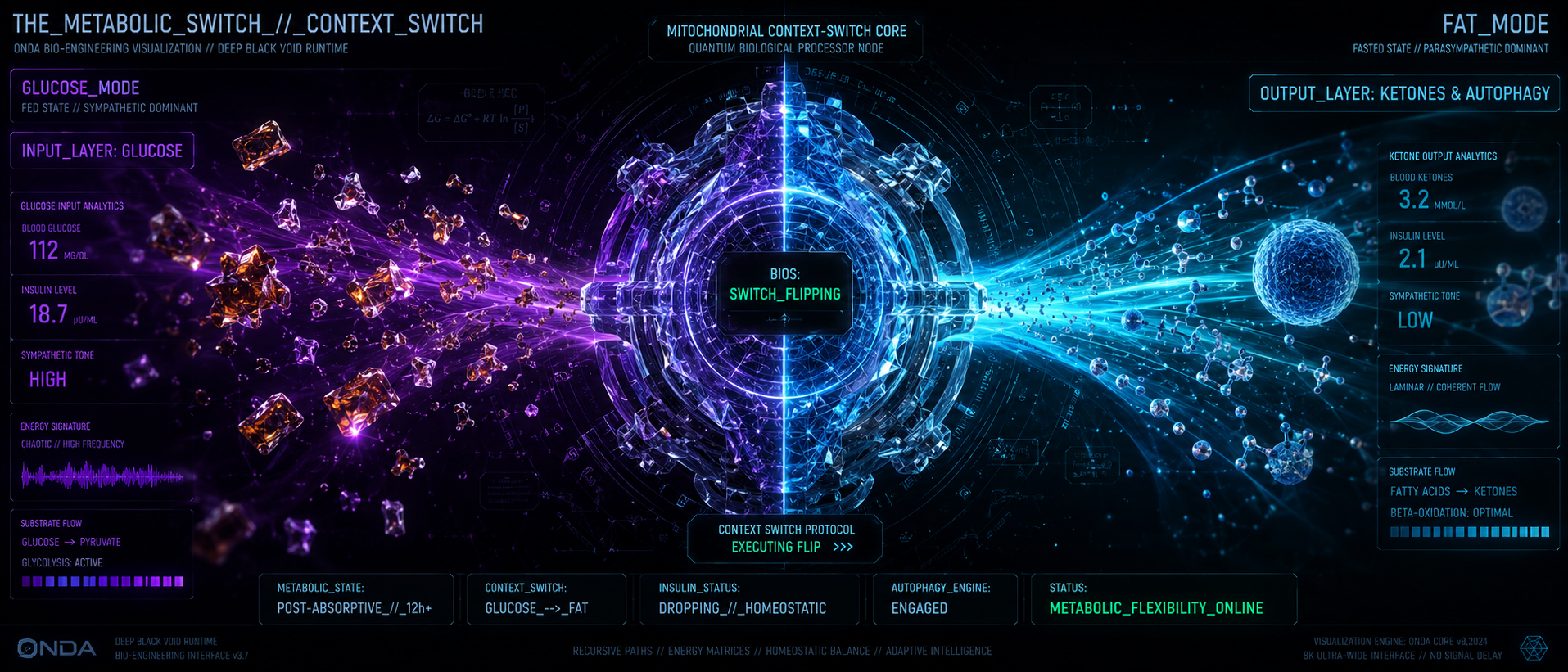
[ FLIPPING THE FUEL SWITCH ]
"Intermittent fasting is widely misunderstood as a starvation diet. It is not. It is a scheduling protocol — you eat the same fuel, but you change when, and that timing flips a metabolic switch.
In the ONDA Biocomputer model, constant grazing keeps the system pinned in 'glucose mode': insulin always slightly elevated, fat-burning machinery idle. Fasting forces a controlled context-switch into 'fat mode', unlocking ketones, cellular clean-up, and improved insulin sensitivity. The benefit isn't the hunger. It's the switch."
Section 1: What is the metabolic switch in intermittent fasting?
The metabolic switch is the pivot from burning stored glucose to burning fat. A few hours after your last meal, insulin falls and the body works through stored glucose (glycogen). Around the 12-hour mark, glycogen runs low and the system pivots to burning fat, producing ketones for fuel. This shift — and the metabolic flexibility it trains — is the real point of fasting.
Want to see it on a timeline? The Intermittent Fasting Calculator maps your eating/fasting windows against the metabolic phases for any protocol (16:8, 18:6, 20:4, OMAD).
Section 2: What happens to your body during a fast, hour by hour?
- •0–4 h (fed): Insulin rises, the last meal is absorbed.
- •4–12 h (post-absorptive): Insulin drops; the body draws on glycogen.
- •~12 h (fat-burning begins): Glycogen runs low; lipolysis and ketosis ramp up.
- •~16 h+ (ketosis & autophagy): Ketones become a major fuel and autophagy — cellular recycling of damaged components — increases.
This is why 16:8 is the popular entry point: a 16-hour fast reaches the start of the more interesting metabolic territory while remaining easy to sustain around sleep.
Section 3: Fasting Firmware Protocols
PROTOCOL 1: Start at 14:10, Earn 16:8
The Hack: Begin by simply delaying breakfast and not snacking after dinner — a 14-hour fast. Extend to 16 hours once it feels effortless.
The Science: Most of the metabolic-flexibility benefit comes from consistently entering the fasted state, not from extreme windows. A sustainable 16:8 beats an unsustainable OMAD.
PROTOCOL 2: Protect the Fast with Zero-Calorie Inputs
The Hack: Water, black coffee and plain tea are fine and don't break the fast. Anything with calories raises insulin and ends it.
The Logic: The fasted state is an insulin state, not a willpower state. Trace calories ("just a splash of milk") quietly flip the switch back to glucose mode.
PROTOCOL 3: Front-Load Protein in the Window
The Hack: When the window opens, prioritise protein — aim for your daily target across 2–3 meals.
The Logic: A shorter eating window makes it easy to under-eat protein and lose muscle. Hit your number; the Protein Intake Calculator sets the target.
Section 4: Who should not do intermittent fasting?
Skip fasting during pregnancy or breastfeeding, with a history of disordered eating, with type 1 diabetes or on glucose-lowering medication without medical supervision, or if you have certain other conditions — it is a tool, not a mandate. If you take regular medication or have a health condition, check with a clinician first. Done wrong, chronic under-eating tanks sleep, hormones and homeostasis — the opposite of the goal.
[ HARDWARE_VALIDATION ]EXAMPLE_DEVICE: Continuous glucose monitor / morning energy logMETRIC: Flatter glucose curve + stable energy across the fastSTATUS: METABOLIC_FLEXIBILITY_ONLINEIllustration — not a measurement