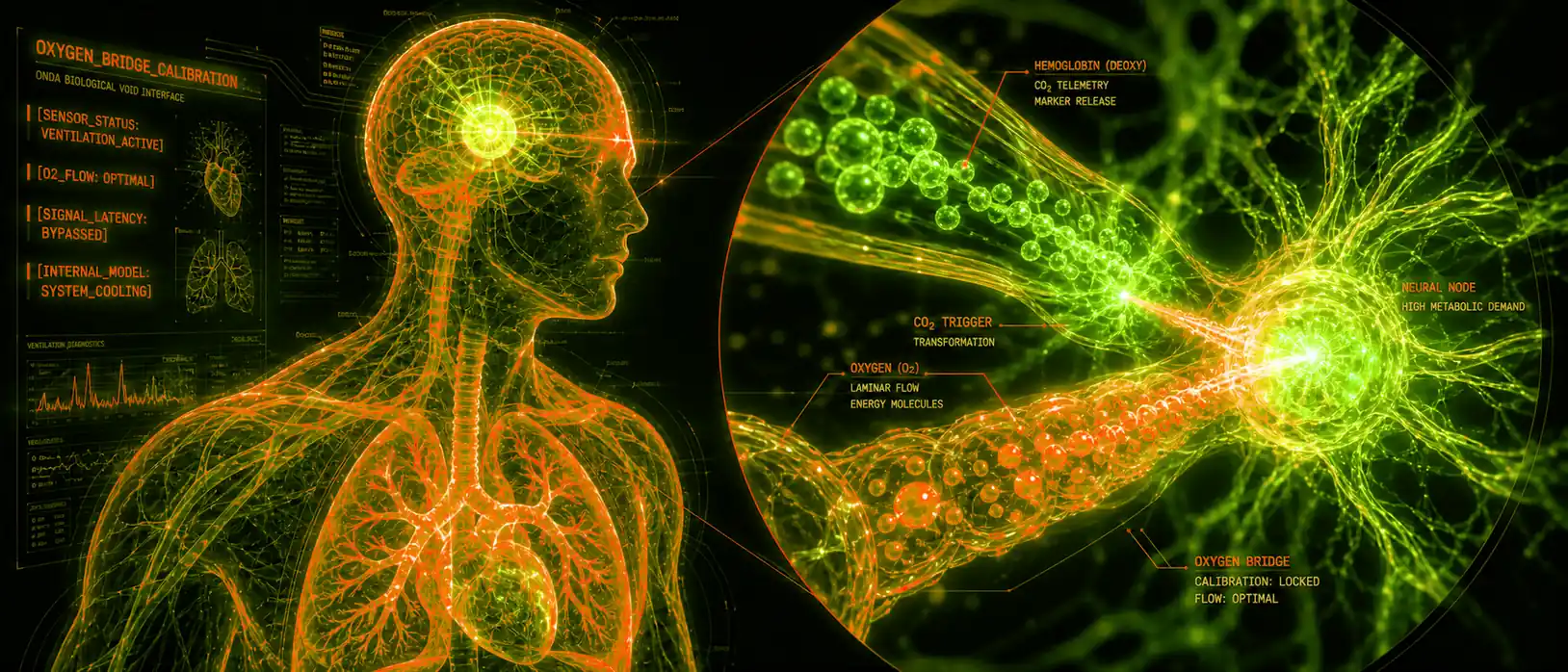
[ STATUS: VENTILATION_ACTIVE ]
"The Bohr Effect and Oxygen Telemetry"
In technical terms, the Bohr Effect describes the relationship between the binding affinity of hemoglobin and the surrounding concentration of carbon dioxide (CO2). The common misconception is that simply taking in more air increases oxygen supply to the tissues. The biological mechanism functions differently.
Section 1: The Bohr Effect — Mechanics of Oxygen Delivery
Two structural facts define the system.
Binding Affinity
Hemoglobin does not automatically release oxygen (O2) into tissues; it requires the presence of CO2 to trigger the release.
The Hypoxia Loop
When you experience stress, breathing becomes shallow and rapid (hyperventilation), washing out CO2. Without sufficient carbon dioxide, hemoglobin retains the oxygen molecules, creating cellular hypoxia (starvation for oxygen) despite high blood oxygen levels.
Section 2: The Architecture — Ventilation System
In the ONDA model, the respiratory system operates as an intake and cooling infrastructure.
System Intake
Air enters the lungs to load oxygen into the blood grid.
Telemetry Delivery
CO2 acts as a data marker, signaling the hemoglobin exactly where oxygen delivery is needed (areas of high metabolic activity).
Low-Impedance Cooling
Controlled and deep respiration removes metabolic heat and prevents the system from overheating during extended deep work. Local warmth also thins the blood — see hydraulic viscosity.
Section 3: The Critical Error — Shallow Data Buffers
When an operator relies on shallow respiration under heavy cognitive load, two system errors occur.
Internal Suffocation: The brain receives insufficient oxygen, dropping the processing speed of the prefrontal cortex.
Jitter Generation: The body misinterprets low CO2 as a stress signal, increasing the production of adrenaline and inducing micro-panic or a fog of confusion. Reading that signal accurately instead of misfiring is a matter of interoceptive precision.
Section 4: ONDA_PROTOCOL — Ventilation Calibration
To ensure uninterrupted processing performance, we recalibrate the ventilation layer.
PROTOCOL 1: CO2 Tolerance Calibration
The Hack: Increase carbon dioxide tolerance through slow, measured breathing — extend the exhale and hold patiently before the next inhale.
The Logic: Higher CO2 tolerance keeps the hemoglobin delivery system stable. The Bohr trigger fires reliably and oxygen unloads where the metabolic demand is.
PROTOCOL 2: Vasodilation Cycles
The Hack: Brief, controlled respiratory holds (post-exhale or post-inhale) repeated in cycles to gently spike CO2.
The Logic: Controlled CO2 elevation dilates cerebral blood vessels, ensuring a smooth, continuous flow of nutrients and oxygen to active neural networks.
[ HARDWARE_VALIDATION ]VALIDATION_DEVICE: BOLT score / pulse oximeter / breath cadenceMETRIC: CO2 tolerance, breath-hold duration, focus persistenceSTATUS: VENTILATION_STABLE
IMPACT_LOG: Stable Ventilation
Correctly managing the Bohr Effect yields the following.
High-Altitude Cognitive Output: Sustained mental focus for over 10 hours without cognitive fatigue.
Stable System Voltage: No physical sensation of brain fog or localized muscle tension.
ONDA_STATEMENT: "Your lung capacity is the hardware pipeline. Control the gas exchange, and your brain will process signals without lag."
Recommended tools
Watching the Bohr-effect shift in real time requires a wearable that resolves SpO₂ and HRV together.
- •Oura Ring 4 — overnight SpO₂ + HRV in one device
- •Apple Watch Series 11 — blood-oxygen spot-checks plus HRV
- •Whoop 5.0 — continuous HRV through breath-driven sessions