[ AUDITING THE REWARD LOGIC ]
"'Does a dopamine detox work?' Yes and no — and the gap between them is the whole point. No, you cannot 'detox' or 'reset' dopamine by abstaining for a day; screens don't deplete it and a fast doesn't flush it. But the practice hiding under the buzzword does work, because it isn't really about dopamine at all. It's stimulus control: deliberately removing intense, frictionless rewards so your motivation recalibrates toward slower, higher-effort ones. The name is wrong; the behaviour is sound."
Section 1: The myth and the mechanism
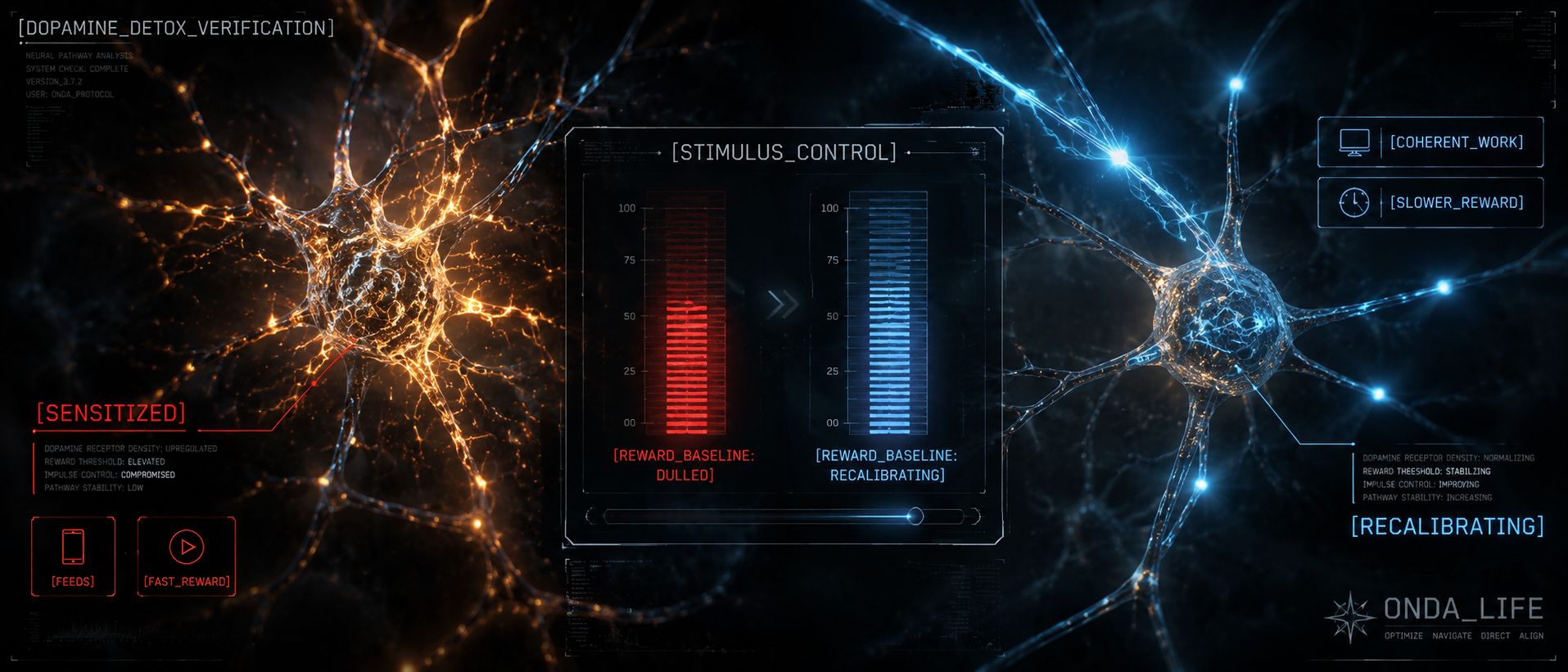
The pop version claims your brain is 'overloaded with dopamine' from phones and that a fast resets your baseline. That mechanism isn't real. What is real: a diet of intense, low-effort rewards (endless feeds, junk food, gambling-style loops) sensitises your motivation toward those things and dulls it toward ordinary effort (Volkow 2017). Coherent work, reading and exercise start to feel flat by comparison — not because dopamine is 'depleted', but because the bar has been raised.
A 'dopamine detox' helps by lowering that bar again. The clinically accurate description is time-based stimulus control, a cognitive-behavioural technique — which is exactly how researchers reframed 'dopamine fasting' once the hype outran the science (Fei 2022).
Section 2: So what does the evidence actually support?
- •The literal claims (resetting receptors, detoxing the molecule): not supported. Major clinical sources are clear the "detox" framing is a myth.
- •The behaviour (cutting high-stimulation loops for a defined period, then reintroducing deliberately): supported as stimulus control, and low-risk to try.
- •Best evidence-based version: not a heroic week of monk-like abstinence, but small, repeatable guardrails — a daily morning block off feeds, notifications trimmed, single-tasking restored.
The honest takeaway: do it, but for the right reason and in the right way. It's behaviour change, not a cleanse.
Section 3: How to do it properly
The full step-by-step is in the box on this page; in short — reframe it as stimulus control, pick the specific loops to cut, replace each with a slower reward, and reintroduce deliberately afterward. Forcing relaxation or going cold-turkey on everything tends to backfire; structure beats willpower.
Rather than wing it, the Dopamine Reset Planner builds the plan for you — choose a window (morning, 24-hour, weekend, 7-day) and the loops to cut, and it returns the tactics plus the stimulus-control rules that make it stick. For the deeper "why," see Dopamine Architecture.
[ HARDWARE_VALIDATION ]EXAMPLE_DEVICE: Screen-time analytics + subjective focusMETRIC: Longer focus spans and less reflexive reaching for the phoneSTATUS: REWARD_BASELINE_RECALIBRATINGIllustration — not a measurement
This is an educational behaviour-change guide, not medical advice or treatment for addiction. If a behaviour feels genuinely compulsive and is harming your life, that warrants support from a qualified clinician.