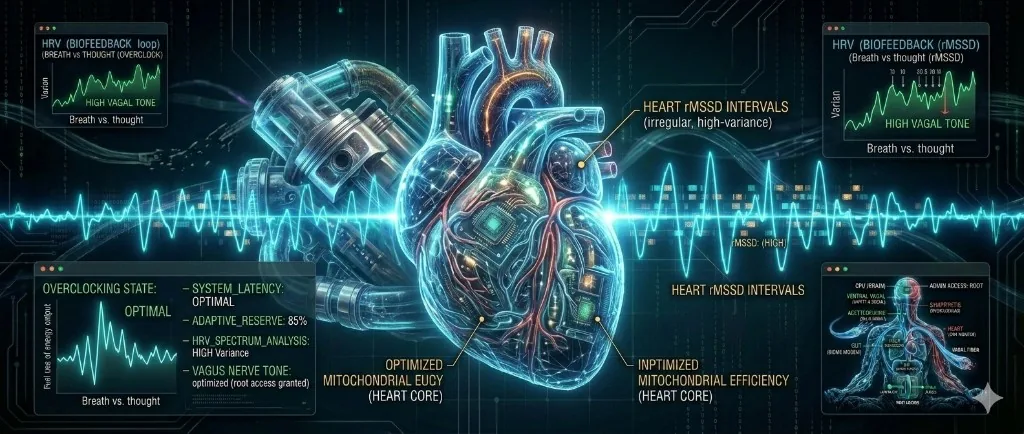
[ SYSTEM LATENCY DIAGNOSTICS ]
"Heart Rate Variability (HRV) is not just a number on your smartwatch; it is the real-time diagnostic report of your Autonomic Nervous System. While Heart Rate is your system's 'RPM', HRV is the 'Latency' between beats.
High HRV indicates a resilient, adaptive OS capable of switching between high-intensity processing and deep recovery. Low HRV is a 'System Warning'—it means your hardware is stuck in a stress loop. To optimize the human machine, you must learn to read the pulse of your own code."
[ SYSTEM STATUS: SCANNING HRV... ]
Your nervous system latency is being measured. High variability = adaptive OS. Low variability = stress loop. Calibrate your baseline.
Section 1: The Tug-of-War
Your heart rate is a constant negotiation between the Sympathetic (Gas pedal) and Parasympathetic (Brakes) branches. A healthy system never stays at a fixed rhythm; it is constantly oscillating. This 'jitter' in the timing is exactly what we measure to determine your Vagal Tone. When the two branches are in balance, your HRV is high, signaling that your Homeostasis is stable.
Section 2: HRV as a Recovery Indicator
Think of HRV as your 'Battery Health' percentage. If you wake up with an HRV significantly below your baseline, your Central Nervous System (CNS) has not finished clearing the 'Cache' from yesterday's stress. Training hard or making big decisions in this state is like trying to run 4K video on a 1% charge—it leads to a 'System Crash' (Burnout). A consistently high HRV baseline is what builds the fault-tolerant buffer — the operational headroom that absorbs stress spikes before they cascade into a crash.
Section 4: HRV Firmware Upgrades
PROTOCOL 1: The Morning Baseline Scan
The Hack: Use an HRV-compatible strap or sensor for 2 minutes every morning before getting out of bed.
The Logic: This establishes your 'Clean Boot' state. If your HRV is 20% below average, switch to 'Low Power Mode': prioritize sleep, reduce caffeine, and skip high-intensity training to allow the Vagus Nerve to recalibrate.
PROTOCOL 2: Biofeedback Resync
The Hack: Use a real-time HRV monitor while performing Resonant Breathing (5.5s inhale/exhale).
The Logic: You can see the 'Waveform' of your heart change in real-time. This creates Coherence, forcing the heart and brain into a synchronized loop, which instantly raises HRV and lowers systemic Cortisol.
PROTOCOL 3: The Cold Exposure Spike
The Hack: Face-only cold immersion (30 seconds) or a full cold shower.
The Logic: While the cold is an acute stressor that temporarily drops HRV, the 'Rebound Effect' afterwards is a massive surge in parasympathetic activity. It's like 'Spring Cleaning' for your neural pathways.
[ HARDWARE_VALIDATION ]VALIDATION_DEVICE: ECG-grade Chest StrapMETRIC: SDNN and rMSSD BaselineSTATUS: SYSTEM_LATENCY_LOW
Recommended tools
HRV training depends entirely on the device measuring it. Three consumer wearables pick up the signal cleanly enough to act on day-to-day.
- •Oura Ring 4 — passive ring with the consumer-reference sleep and HRV pipeline
- •Whoop 5.0 — continuous recovery-coaching band built for trained users
- •Polar H10 — ECG chest strap for reference-grade morning HRV