[ INITIALIZING ADMIN ACCESS ]
"Vagus Nerve: The Master Key to Your Biocomputer"
Most humans live on factory settings, unaware that their biological software is thousands of years out of date. While you read this, your Amygdala is scanning for threats in high-latency mode, while Cortisol slowly corrodes your cognitive circuits in the background. This is 'Survival Mode.' This is Legacy Hardware.
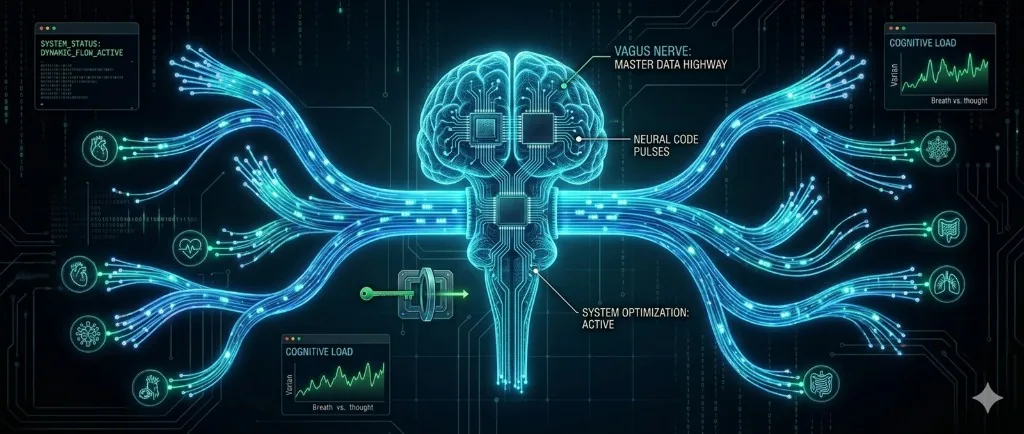
But inside your frame lies a hidden 'Admin Access.' It is the Vagus Nerve—the longest, highest-bandwidth data highway in your organism. This is the physical fiber-optic cable connecting your CPU (Brain) to every critical peripheral: heart, lungs, and gut.
While the Sympathetic Nervous System is an 'Overclocking' button that burns your resources under stress, the Vagus is the master controller of your Parasympathetic system. Working with its signals gives you a kind of root access to your state — from calming down faster under stress to settling into focus.
It is time to flash the firmware. Welcome to manual control of your biocomputer.
Section 1: The Biology of Calm
The parasympathetic branch of your autonomic nervous system is what allows you to recover. When activated, it slows your heart rate, deepens your breath, and turns on digestion. The primary neurotransmitter of this "calm" state is acetylcholine, released by vagal fibers. Unlike the sympathetic system's adrenaline rush, acetylcholine promotes rest, repair, and social engagement.
The parasympathetic nervous system doesn't just make you feel relaxed — it literally changes your physiology. Cortisol drops. Inflammation pathways quiet down. Your gut starts moving. Your face becomes more expressive. You can actually listen to another person instead of scanning for threats. This is the biological foundation of resilience. The same parasympathetic switch can also be reached through targeted electrical neuromodulation.
Section 2: Measuring the Signal
You can't optimize what you don't measure. The gold standard for vagal tone is Heart Rate Variability (HRV) — the variation in time between heartbeats. A healthy, resilient nervous system shows high HRV: the heart constantly adjusts its rhythm in response to breathing and environmental demands. Low HRV often indicates chronic stress, poor recovery, or a nervous system stuck in defensive mode.
Biofeedback devices — from smartwatches to dedicated HRV monitors — make this visible. You can see in real time how your breathing affects your heart rhythm. Extended exhales increase HRV. Stressful thoughts decrease it. This feedback loop is how you train your vagus nerve: observe, adjust, repeat.
Section 3: The Polyvagal Perspective
Stephen Porges' Polyvagal Theory reframes the autonomic nervous system as a three-state ladder, not a simple on/off switch. The ventral vagal state (safety, social engagement) sits at the top. The sympathetic state (mobilization, fight-or-flight) sits in the middle. The dorsal vagal state (freeze, shutdown) sits at the bottom. We move between these states constantly — often without conscious awareness.
Neuroception is Porges' term for the brain's unconscious detection of safety or threat. Your body "reads" the environment — faces, voices, body language — and shifts state before you consciously decide. This is why you can feel "off" in a room without knowing why, or suddenly relax when a trusted person enters. The vagus nerve is the conduit for this constant, below-awareness calibration.
Section 4: Physical Firmware Upgrades (Practical Protocols)
To move from theory to hardware optimization, initialize these three neural recalibration protocols. Each is designed to stimulate the Vagus Nerve and shift your system from Sympathetic (Stress) to Parasympathetic (Recovery).
PROTOCOL 1: Resonant Frequency (Breathing)
The Hack: Inhale for 5.5 seconds, then exhale for 5.5 seconds through the nose. Repeat for 3–5 minutes.
Status: Calibrating...
The Science: This specific timing (approx. 5.5 breaths per minute) creates Coherence between your respiratory and heart rate cycles. It maximizes Heart Rate Variability (HRV) and sends a "System Clear" signal to the brainstem, effectively lowering blood pressure and cortisol levels in real-time.
PROTOCOL 2: Thermal Shock Reset (Cold Exposure)
The Hack: Splash ice-cold water on your face for 30 seconds or finish your shower with 30 seconds of maximum cold. Focus on the chest and neck area.
The Logic: Cold exposure triggers the Mammalian Dive Reflex. This is a biological "hard reset" that instantly slows the heart rate and increases vagal tone. It forces the Autonomic Nervous System to recalibrate, building long-term stress resilience (hormesis).
PROTOCOL 3: Ocular-Vagal Re-centering (The Basic Exercise)
The Hack: Keep your head facing forward. Without moving your head, look as far right as possible using only your eyes. Hold until you feel a spontaneous sigh, swallow, or yawn (usually 30–60 seconds). Repeat on the left side.
The Logic: The Vagus nerve is anatomically linked to the cranial nerves controlling eye movement. By shifting your gaze to the periphery, you create a mild "stretch" in the neural circuitry, which often triggers a reflexive release from the Brainstem, signaling that the environment is safe.
[ HARDWARE_VALIDATION ]VALIDATION_DEVICE: Polar H10 / Oura RingMETRIC: rMSSDSTATUS: BIOMETRIC_VERIFIED
Recommended tools
Three consumer devices that actually target the vagus nerve — auricular electrical tVNS, cervical tVNS and vibrotactile modulation. Different mechanisms, all peer-reviewed in their own ways.
- •Nurosym — clinical-grade auricular tVNS with the deepest evidence base
- •Pulsetto — consumer-friendly neck collar with four guided programmes
- •Apollo Neuro — all-day vibrotactile vagal modulation