[ STATUS: PROPOSED ]
"Hydraulic Viscosity and the ONDA Transport Bus"
In classical fluid dynamics, resistance (Impedance) within microvessels is governed by equations where fluid viscosity is a critical parameter. Within the human body, the transport network operates on the same physics — and viscosity decides how much energy the heart and vascular tone must spend to push blood to the cortex.
Section 1: The Logic — Microcirculation and Resistance
Two structural variables define the bus.
The Medium (Fluid)
Water containing dissolved metabolites and proteins.
Viscosity (μ)
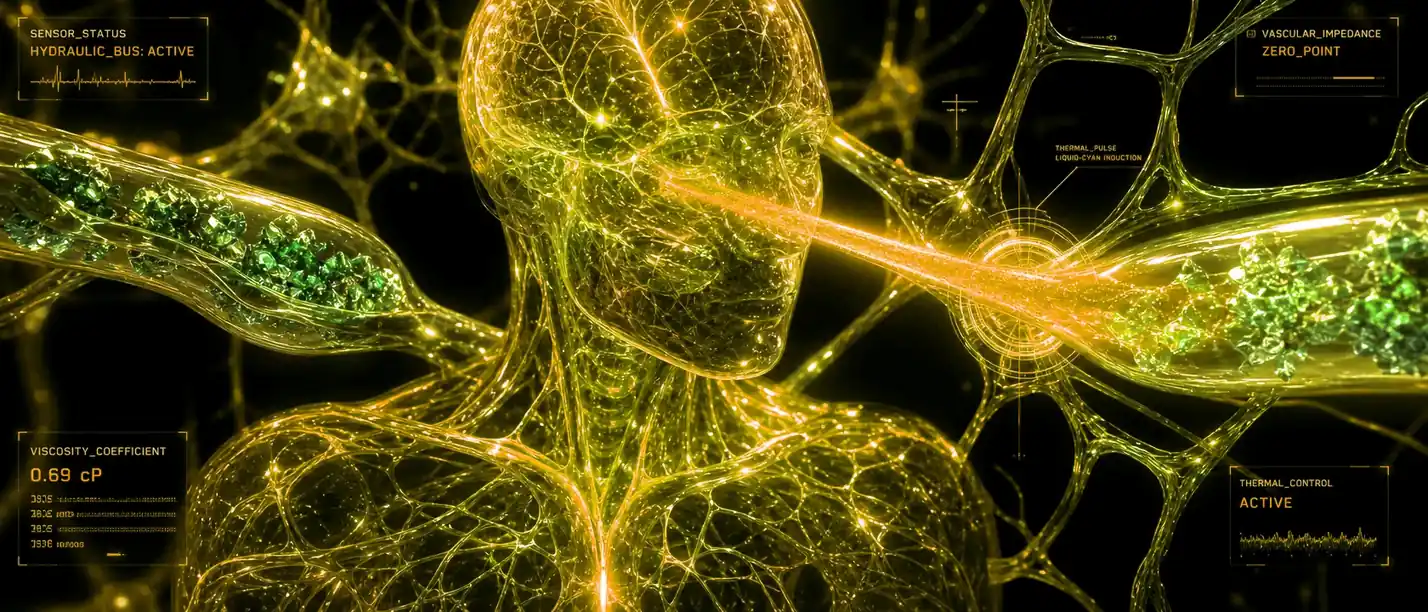
Internal friction, determining the amount of energy required by the heart and vascular tone to pump blood to the cortex. At standard human body temperature (37 °C), the dynamic viscosity of water is approximately 0.69 cP (centipoise) — significantly lower than its value at room temperature.
When myofascial tension develops in the neck and shoulder area, vessels become compressed, and local blood flow deceleration can cause an increase in apparent fluid viscosity. The result is an Impedance spike — the failure mode mapped in detail by vascular tensegrity.
Section 2: The Architecture — Thermodynamics and Hydraulics
Within the ONDA architecture, we treat the viscosity of water as a dynamically regulated system parameter.
Thermal Control
As local temperature rises (through increased metabolism and deep, controlled breathing), hydrogen bonds between water molecules weaken. Viscosity drops, facilitating the delivery of oxygen.
Energy Balance (Low Impedance)
Reducing viscosity by maintaining proper vascular tone and temperature lowers the energy required for nutrient delivery.
Hydraulic Resistance
According to the Hagen–Poiseuille law, resistance to flow is directly proportional to the fluid's viscosity. By minimizing viscosity, we maximize the efficiency of cerebral reactors.
Section 3: ONDA Insight — Managing Hydraulic Noise
When structural tension (such as spasms in the masticatory or trapezius muscles) compresses microvessels, the resulting decrease in blood velocity and local tissue cooling causes viscosity to rise. The result is delayed delivery of nutrients to the brain — increased latency.
[ HARDWARE_VALIDATION ]EXAMPLE_DEVICE: peripheral skin temperature, capillary refill, subjective head clarityMETRIC: cerebral perfusion latency, jaw/neck tension index, focus persistenceSTATUS: BUS_OPTIMIZEDIllustration — not a measurement
IMPACT_LOG: Optimizing the Transport Bus
Maintaining optimal viscosity yields the following.
Immediate Response: Essential metabolites are delivered to neural nodes without latency.
System Energy Efficiency: Minimizes the baseline energy required to maintain cerebral blood flow.
Signal Stability: Prevents system degradation, keeping the Acetylcholine Lens in sharp focus.
ONDA_STATEMENT: "Viscosity is the resistance of your transport bus. Maintain optimal thermal and muscular balance so that your signal propagates with zero impedance."