[ ARTICLE: MTDNA_PHOTONICS // THE_LIGHT_DRIVE ]
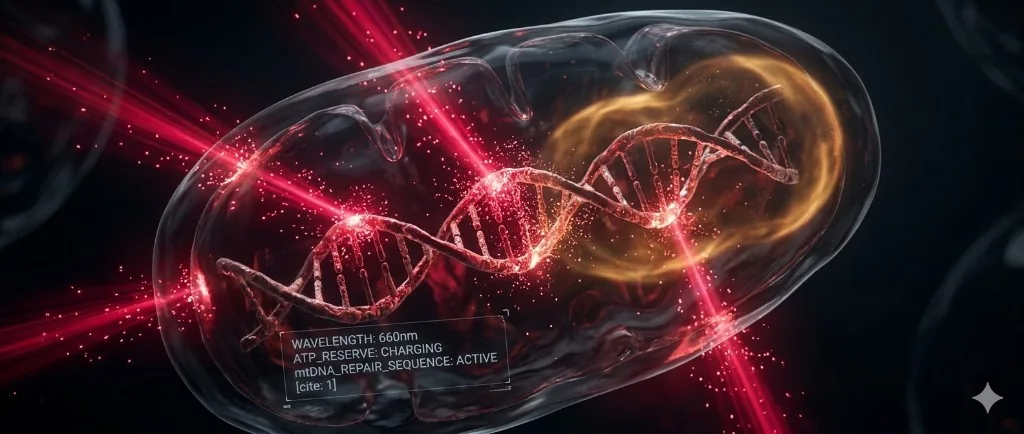
Mitochondria are more than mere "power plants." A key step in cellular energy production is the physical rotation of the ATP synthase protein. Near-infrared (NIR) light is absorbed by cytochrome c oxidase in the mitochondria, and there is real (if still-developing) evidence that this can support ATP production — the basis of photobiomodulation. A separate, more speculative idea — that NIR also lowers the viscosity of the water around the motor so it spins faster — is not established science; treat it as a hypothesis, not a fact.
The Hack: [ PROTOCOL_PHOTONIC_CHARGING ]
The Hack:
[ PROTOCOL_PHOTONIC_CHARGING ]NIR_Exposure (660nm/850nm): Conduct a 10–15 minute session in front of a red light panel, following the maker's distance and time (often 15–30 cm from bare skin). More power or a longer session is not better.
Eye_Protection: Wear the goggles supplied and never look into the LEDs. Near-infrared light is invisible and does not trigger the blink reflex, so a panel can look dim while its output is high. See the evidence and safety review.
Morning_Window: Execute the session within the first 2 hours of waking to synchronize mitochondrial circadian rhythms.
Hydration_Link: Be well hydrated before the session — general cellular function depends on it. (The idea of a special "structured" interfacial water layer is speculative; see below.)
Target_Areas: Focus on high-mitochondrial density zones: the prefrontal cortex (forehead), heart, liver, and major muscle groups.
How does red light affect mitochondrial energy?
Near-infrared light is absorbed in the mitochondria, where energy production depends on a spinning motor: within the mitochondria, ATP Synthase is a nanomotor that rotates at speeds up to 9,000 RPM. This motor is submerged in mitochondrial water.
Structured Water (EZ Water) — speculative: A fringe hypothesis (associated with Gerald Pollack) proposes that water near membranes can form a "fourth phase." This is not accepted mainstream biophysics; we include it only as a contested idea, not a mechanism we rely on.
Reduced Drag (if it held): If that hypothesis were true, lower viscosity might reduce drag on the ATP-synthase rotor. This is unproven — the dependable mechanism here is cytochrome c oxidase absorbing NIR, not water "structuring."
mtDNA Protection (hypothesis): In cell and animal studies, photobiomodulation (PBM) has been linked to changes in oxidative stress. Whether this protects the fragile, circular mitochondrial DNA (mtDNA) in people has not been shown.
[ HARDWARE_VALIDATION ]EXAMPLE_LIGHT_SOURCE: Red Light Rising / Joovv (consumer LED panels)SPECTRUM_CHECK: 660nm (Surface) + 850nm (Deep Tissue)METRIC: Grip Strength / Recovery Trend (via HRV)STATUS: TRACK_OVER_WEEKSIllustration — not a measurement
Recommended hardware
The panel is the variable. Most consumer red-light products inflate their irradiance figures and bury their EMF and flicker numbers behind the spec sheet — both matter when you are running 10–30 minute sessions daily. Independent verification is the single biggest filter when buying.
ONDA has scored the ten most credible panels of 2026 on irradiance, wavelength coverage, EMF/flicker discipline and value. The full ranked list lives at Best Red Light Therapy Panels (2026). The short version:
- •Joovv Solo 3.0 — a modular, widely used panel. Premium-priced.
- •Mito Red MitoPRO 1500 — biohacker favourite, six-wavelength coverage (1500X), $400 cheaper than Joovv.
- •PlatinumLED BIOMAX 600 — seven wavelengths and published third-party EMF testing.
- •Hooga HG500 — the budget entry at $359 with honest specs.