[ ARTICLE: NEURAL_ENTRAINMENT // BRAIN_FREQUENCY_TUNING ]
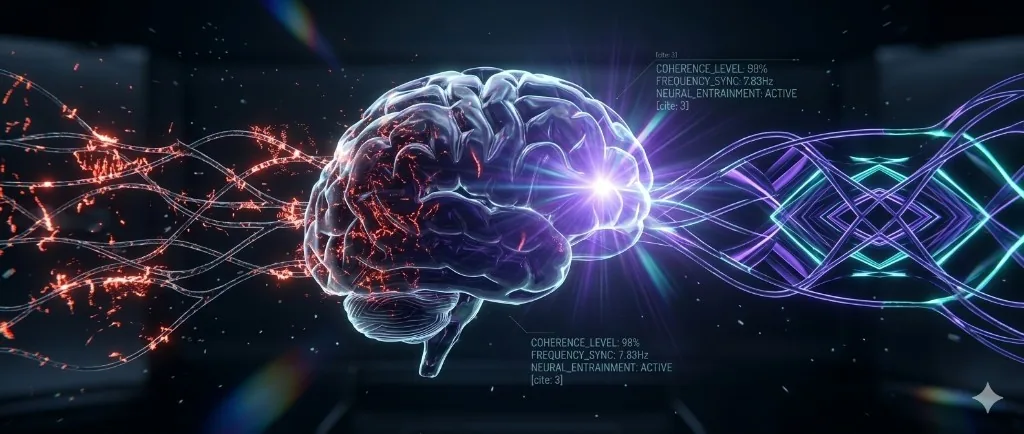
Traditional meditation has long been a "black box" operation—subjective, inconsistent, and difficult to quantify. Neural Entrainment 2.0 transforms this practice into a closed-loop engineering process. By utilizing real-time EEG (Electroencephalography) and AI-generated binaural audio, the aim is to nudge brainwave activity toward a target state through the Frequency Following Response (FFR). The evidence is mixed: EEG studies find inconsistent evidence that binaural beats actually shift brain rhythms, and no device replaces years of practice.
The Hack: [ PROTOCOL_CLOSED_LOOP_SYNC ]
The Hack:
[ PROTOCOL_CLOSED_LOOP_SYNC ]EEG Calibration: Connect a consumer-grade EEG (e.g., Muse 2, Flowtime) to get a rough estimate of your baseline Power Spectral Density (PSD); a few dry electrodes give coarse readings that blinks and jaw tension can distort.
AI-Generated Stimulus: The system generates an auditory "carrier frequency" embedded with a differential tone. If the goal is Deep Focus (Alpha), the differential is set to ~10 Hz.
Real-Time Modulation: As your brainwaves drift into high-beta (often linked with tension, though not a direct measure of stress), the AI dynamically shifts the audio's volume, texture, or frequency to "anchor" the brain back into the target Alpha or Theta zone.
Verification: The session concludes only once the cumulative "Time-in-State" metric meets the pre-programmed stability threshold.
How does neural entrainment work?
Neural entrainment works through a biological mechanism called the Frequency Following Response (FFR).
Oscillatory Coupling: When the brain is exposed to a rhythmic sensory stimulus (auditory or visual), the neurons in the auditory cortex begin to fire at the same frequency as the stimulus.
Network Synchronization: Some researchers propose that this local rhythm spreads across the cortex, "tuning" the whole system; EEG studies find inconsistent evidence that it does.
Neuroplasticity: Repeatedly practising a shift into Alpha (8–12 Hz) for focus or Theta (4–8 Hz) for creativity is associated, over time, with finding these states easier to reach on your own — the same "practice makes it familiar" principle behind any trained skill.
[ HARDWARE_VALIDATION ]EXAMPLE_DEVICE: Muse 2 / Flowtime EEG HeadbandMETRIC: Alpha-Theta Coherence & Time-in-State (min)STATUS: TRACK_OVER_WEEKSIllustration — not a measurement
Recommended tools
Neural entrainment via meditation is built on the practice. Three apps where the teaching is the value, not the marketing:
- •Insight Timer — largest free meditation library on the market
- •Waking Up — Sam Harris’ philosophical and non-dual practice
- •Healthy Minds Program — science-backed four-pillar framework, genuinely free