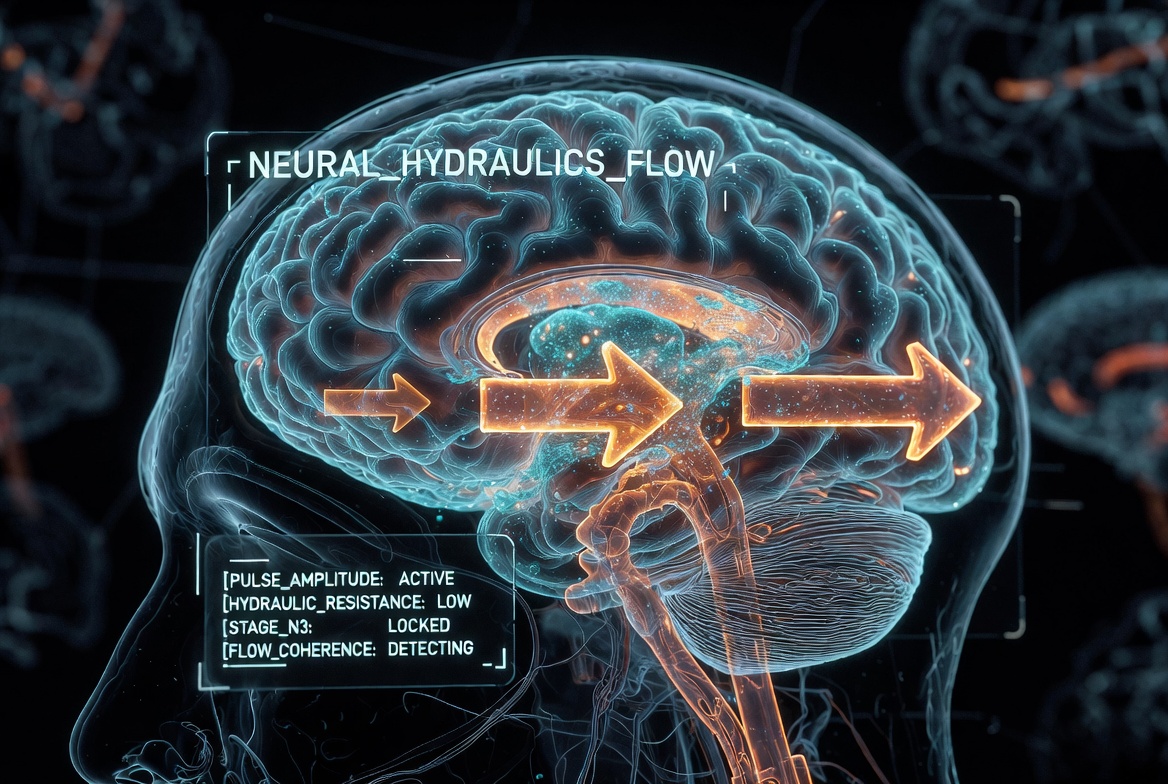
[ THE PUMP BEHIND THE THOUGHT ]
"In any closed-loop cooling or filtration system, efficiency is dictated by fluid dynamics. The brain is not a static object; it is a pulsating bio-computer submerged in Cerebrospinal Fluid (CSF).
Clearing metabolic waste from the brain is not a passive event. It is an active hydraulic purge. The Glymphatic system functions as a pump where your own arteries act as the pistons. With every heartbeat, your arteries expand, forcing CSF through brain tissue to wash away metabolic byproducts into drainage channels."
What drives cerebrospinal fluid flow in the brain?
Three technical parameters determine how efficiently CSF flows through your internal hydraulics:
Arterial Power (Pulsatility): Arterial pulsations are thought to help drive CSF flow, and stiff vessels may weaken them. HRV is a different thing — a marker of beat-to-beat heart rhythm, not of pulse strength — so "high HRV = maximum piston stroke" is an image, not physiology. See what HRV measures.
Vascular Space (Intercellular Gap): During Deep Sleep, brain cells (astrocytes) shrink via the AQP4 aquaporin channel system, opening the intercellular space by up to 60%. This expansion is the prerequisite for hydraulic flow — without it, resistance is too high for CSF to penetrate the tissue at clearance-effective velocity. Any factor that prevents Stage N3 entry (cortisol, alcohol, fragmented sleep) keeps this channel closed.
Hydrostatic Pressure: Physical orientation in space changes the pressure gradient across the entire cranial drainage system. The lateral position (sleeping on your side) creates the optimal hydrostatic head of pressure for CSF to exit the cranium via cervical lymphatic channels — reducing outflow resistance by 25–30% compared to supine position.
What happens when CSF flow slows down?
When flow slows — due to low HRV, poor sleep architecture, or suboptimal positioning — the system enters Hydraulic Stasis:
Pressure Spikes: Accumulation of fluid and uncleared toxins increases micro-intracranial pressure, manifesting as morning headaches, "heavy-headedness," and cognitive sluggishness on waking. The pressure spike is not pathological in the clinical sense — it is a warning readout that the overnight flush was incomplete.
Metabolic Silt: A buildup of proteins (beta-amyloid, tau, glutamate residues) settles across neuronal membranes, increasing electrical signal latency. The synaptic "noise floor" rises. Processing speed drops. The sensation is familiar: the same cognitive texture as jet lag or post-night-shift thinking.
Thermal Overheat: CSF also manages thermoregulation in brain tissue. Poor drainage leads to localized micro-overheating in metabolically active cortical regions — which in turn prevents the stable slow-wave oscillations required for restorative N3 sleep. A degraded flush creates conditions that prevent the next flush from occurring. A compounding failure loop.
ONDA Protocol: Tuning the Flow
Three engineering interventions for the pre-sleep window:
Intervention 1: Vascular Priming
Action: 10–15 minutes of evening contrast therapy (alternating warm/cool water, 30s/30s cycles, ending cold) or light aerobic movement (walking, 60–70% max HR) 2–3 hours before sleep.
Logic: Vascular elasticity determines arterial piston stroke amplitude. Contrast therapy triggers sequential vasodilation and vasoconstriction — "exercising" the arterial wall smooth muscle and improving compliance. More elastic arteries generate higher-amplitude pulsations per heartbeat, driving CSF deeper into brain tissue with each pump cycle. The effect persists through the night's sleep window, increasing total glymphatic throughput.
Intervention 2: The Gravity Hack
Action: Default to lateral sleep position (left or right side). Use a body pillow or knee pillow to prevent rollover. If using a wedge pillow, angle head 15–20° — avoid sharp neck flexion which increases jugular venous resistance and counteracts the hydrostatic benefit.
Logic: Gravity is a free hydraulic pump. Lateral positioning reduces outflow resistance in the cranial drainage pathways by aligning the glymphatic network with the gravitational pressure gradient. The cervical lymphatic ducts — the primary CSF drainage route — have geometrically lower resistance in lateral vs. supine position. The intervention costs zero metabolic energy and produces a 25–30% improvement in CSF clearance efficiency.
Intervention 3: Breath Modulation
Action: 10 minutes of slow diaphragmatic breathing before sleep (4s inhale expanding the belly, 6s exhale). Focus on full diaphragmatic descent — not chest breathing.
Logic: Deep diaphragmatic breathing creates negative intra-thoracic pressure on each inhale — a partial vacuum in the chest cavity. This pressure gradient assists venous return from the head, reducing cerebral venous congestion and lowering the baseline intracranial pressure entering the sleep window. Lower pre-sleep intracranial pressure = wider hydrostatic gradient for CSF outflow = faster flush initiation at N3 onset. Additionally, an extended exhale (6s) leans toward the parasympathetic branch, which may make it easier to wind down before sleep.
Impact Log: Operational Clarity
High Refresh Rate: Faster recovery from intense cognitive loads. The brain resumes full processing speed within minutes of waking — not hours. The "boot sequence" shortens proportionally to the completeness of the overnight hydraulic flush.
Structural Integrity: Significant reduction in long-term system clogging and tissue degradation. Consistent nightly hydraulic optimization is preventive engineering at the hardware level — the same pathway that, when chronically neglected, leads to pathological protein accumulation over decades.
Fluid Focus: The "flow state" during the day — effortless attention, high-speed information processing, minimal resistance to complex tasks — is a direct byproduct of the quality of your fluid flow at night. The hydraulic machine that ran a clean overnight cycle operates differently from one that didn't.
"Your brain is a hydraulic machine. If you don't manage the pressure and the flow, no software update can make your hardware run at peak performance."[ ONDA_STATEMENT ]
Recommended tools
CSF flow is a sleep-stage phenomenon. Watching the stage is watching the flow.
- •Oura Ring 4 — sleep-stage tracking for CSF clearance windows
- •Muse S Athena — EEG-based confirmation
- •Whoop 5.0 — continuous overnight HRV alongside sleep