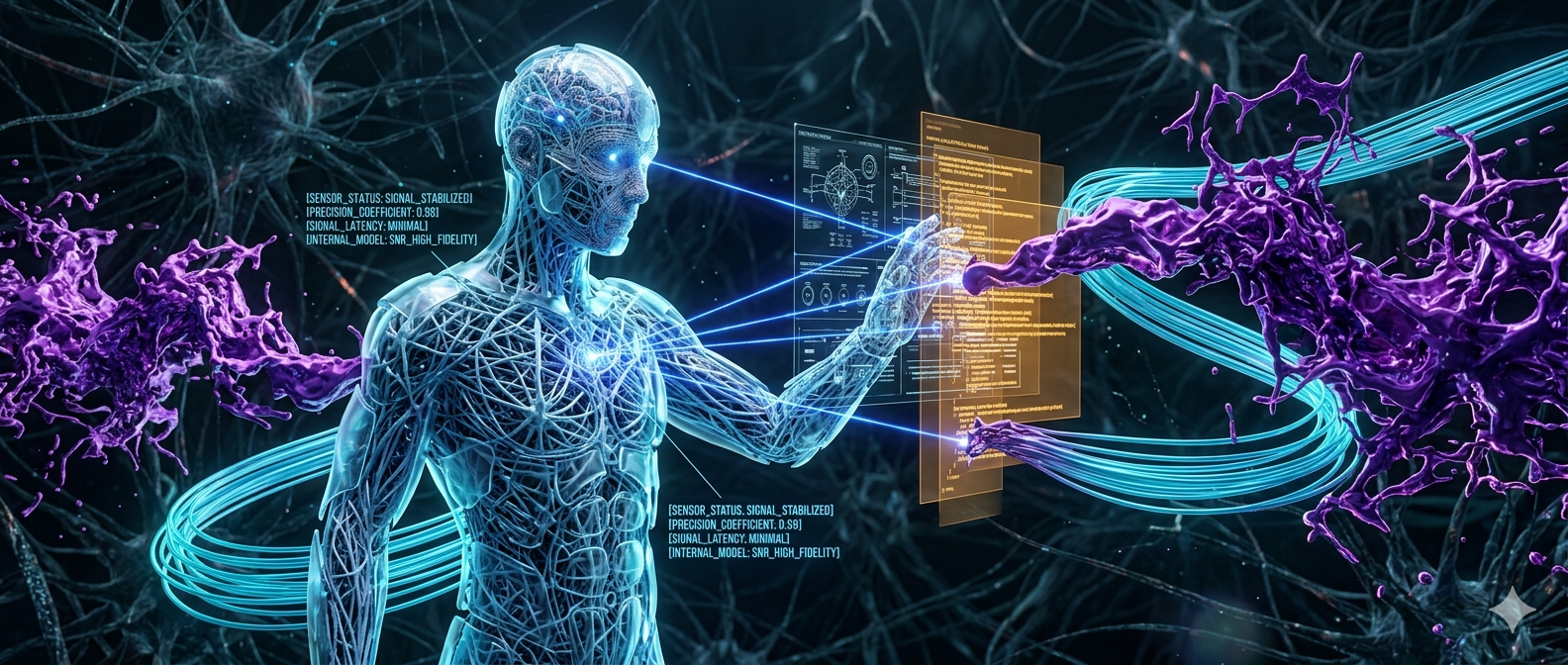
[ STATUS: SIGNAL_STABILIZED ]
"Neural Signal-to-Noise Ratio: Cleaning the System Channel"
In radio engineering and audio processing, Signal-to-Noise Ratio (SNR) determines the quality of data transmission. If background noise becomes too strong, useful information is buried and integrity is lost.
Your brain is a bio-electrical transceiver. A useful signal — thought, focus, or creative insight — constantly competes with neural white noise. That noise is generated by chaotic firing, neuroinflammation, electrolyte imbalance, and an excess of excitatory neurotransmitters. The lower your SNR, the more energy your brain wastes simply trying to hear itself.
Section 1: How does the brain filter out neural noise?
Within the ONDA architecture, the noise-suppression layer is a multi-stage filter.
The Inhibitory Buffer (GABA)
GABA is the primary inhibitory neurotransmitter — the system's noise canceller. It grounds excess electrical discharge before it becomes informational debris. When GABA tone is low, the channel fills with static.
The Thalamic Gate
The thalamus acts like a network gateway, deciding which signals are worthy of the cortex and which should be dropped as background static. A well-tuned gate preserves useful flow and blocks waste.
The Alpha-Shield
Alpha rhythm (8–12 Hz) acts as an idle frequency that actively inhibits irrelevant sensory activity. It creates a clean canvas for focus, allowing the cortex to spend computation only where it matters.
Section 2: What happens when noise overwhelms the neural signal?
When SNR drops to a critical level, the system enters Stochastic Resonance — noise begins to dominate control.
Cognitive Static
A state of brain fog where thoughts jump uncontrollably. Attempting to concentrate feels like tuning a radio during a lightning storm.
Jitter
Signal instability. You can hold attention for five seconds before the system resets due to a false trigger in an adjacent neural circuit.
Energy Leaking
The brain consumes up to 20% of the body's energy. At low SNR, most of that energy is wasted as heat — useless electrical activity that produces no computation.
: Low SNR does not mean low intelligence. It means the channel is overloaded with interference.[ SYSTEM_ALERT ]
Section 3: Active Noise Cancellation
ONDA works to improve that signal-to-noise — less static, clearer signal — through the practices in this guide.
Inhibitory Tuning
Slow breathing is associated with higher vagally mediated HRV; whether a longer exhale adds anything beyond slowing the breath is still debated. Slow breathing brings a calmer state in which neural noise tends to settle.
Sensory Gating
We limit inbound data streams. The system learns to close ports, reduce CPU load, and clear the channel for internal computation.
Frequency Locking
Shifting the brain into the Alpha state acts as a band-pass filter: target frequencies pass through while the high-frequency beta-noise of anxiety gets cut out.
[ HARDWARE_VALIDATION ]EXAMPLE_DEVICE: Apple Watch / HRV MonitorMETRIC: HRV, subjective focusSTATUS: TRACK_OVER_WEEKSIllustration — not a measurement
Section 4: High-Fidelity Cognition
Optimizing Neural SNR delivers measurable upgrades.
Deep Focus: Complex logical chains become easier to sustain because the signal travels through a clean channel.
Lower Cognitive Load: The same tasks are performed with less energy. The processor no longer overheats.
Creative Clarity: In the silence of a cleared channel, subtle intuitive signals become audible again.
ONDA_STATEMENT: "Genius is not the power of the signal. Genius is the silence in which the signal sounds. Clear the interference from your channel, and the true architecture of your thought will reveal itself."