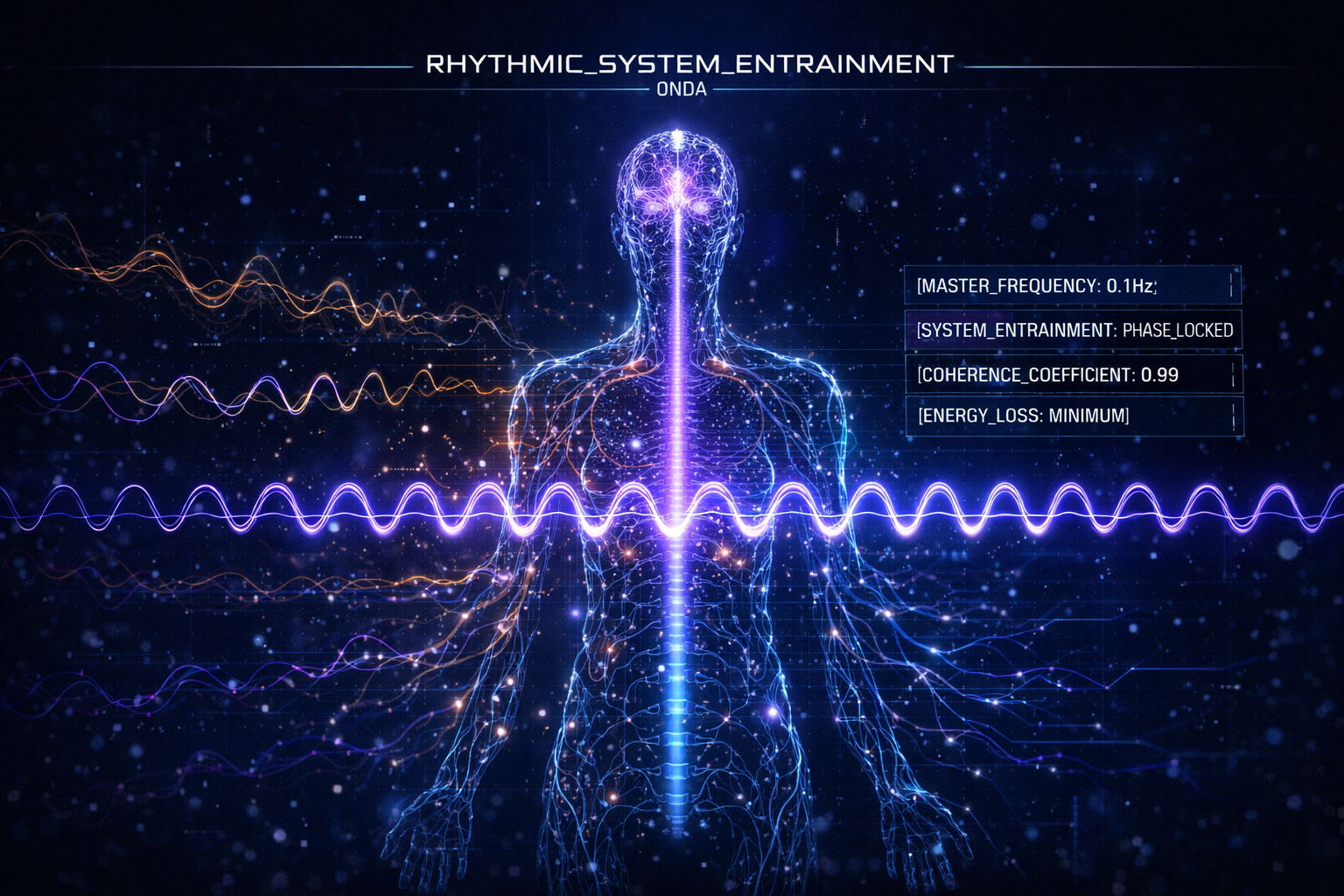
[ THE METRONOME EFFECT ]
"In physics, there is a phenomenon where multiple metronomes placed on a shared surface eventually begin to swing in perfect unison. This is Entrainment.
Your CPGs — in the spinal cord, the lungs, the heart — are biological oscillators. When they work out of sync, the system wastes energy overcoming internal resistance. Rhythmic Entrainment is the process of imposing a single 'clock speed' that unites movement, breath, and neural activity into a singular flow."
The metronome effect is not a metaphor. It is a direct physical principle: coupled oscillators with shared energy pathways synchronize spontaneously because synchronized oscillation is the energy-minimum state. Your biological oscillators — respiratory, cardiac, motor, neural — are coupled. The question is not whether they will entrain, but what they will entrain to. Without a deliberate master clock, they entrain to noise: notifications, stress spikes, arrhythmic movement, screen flicker. The ONDA protocol replaces noise with signal.
The Architecture: The Master Clock
How ONDA establishes the hierarchy of rhythms — four coupled oscillator layers organized around a single master frequency:
The Master Oscillator (Breath at 0.1 Hz): The most accessible and powerful lever of biological control. The 0.1 Hz rhythm — about 5.5–6 breaths per minute (the onda-life.com pacer default is 5.5 seconds in, 5.5 seconds out) — serves as the "Gold Standard" to which all other systems align. At this specific frequency, the respiratory oscillator resonates with the baroreflex loop (the feedback cycle between blood pressure, heart rate, and the vagus nerve) at its natural resonant frequency. This is not an arbitrary number. 0.1 Hz is the frequency at which the baroreflex achieves maximum gain — where each breath produces the largest possible swing in heart rate variability, and where the respiratory, cardiovascular, and autonomic systems reach peak coherence.
Heart-Brain Coupling (an ONDA model): The established part: through the baroreflex, slow breathing near 0.1 Hz makes heart-rate oscillations follow the breath, which shows up as a large, regular wave in Heart Rate Variability (HRV), and baroreceptors report each heartbeat to the brainstem. ONDA's model goes further and pictures a chain — respiratory → cardiac → thalamic → cortical — in which this steady rhythm becomes an anchor for the brain's Alpha rhythms. That last step is a hypothesis, not an established finding: studies of how heartbeats register in the brain show small, task-specific effects, and no study has shown that the heartbeat entrains Alpha rhythms. HRV coherence at 0.1 Hz is a measurable heart-rhythm pattern; in ONDA's language, it is the signature of the entrained system.
The Motor Loop (CPG): Spinal central pattern generators — the biological oscillators controlling rhythmic movement — pick up the global 0.1 Hz rhythm via descending reticulospinal pathways and proprioceptive feedback. Walking or running, when synchronized with the breath via Locomotor-Respiratory Coupling, becomes nearly "free" in terms of metabolic cost: the CPG timing aligns with the cardiac and respiratory phase, eliminating the micro-friction of asynchronous internal oscillation. Movement becomes resonant rather than effortful.
Neural Oscillator Alignment: Alpha rhythms (8–12 Hz), once anchored by the cardiac input chain, stabilize across brain regions and reduce inter-regional communication noise. The cognitive effect is immediate: reduced background anxiety, increased signal clarity, and the subjective sense that the mind has "quieted" — not through relaxation, but through synchronization.
What happens when your body rhythms fall out of sync?
Modern life forces the biological system into chronic Phase Desync — a state where the body's oscillators are all running, but none of them are talking to each other:
Arrhythmic Movement: Walking at one pace, breathing at another, and processing cognitive input at a third — with none of these rhythms phase-locked. The result is "cognitive tremors": a low-level interference pattern produced by the constructive and destructive interference of unsynchronized neural signals. This is experienced as the diffuse, sourceless cognitive discomfort of modern knowledge work — not a specific problem, but a background friction that accumulates across the day.
Systemic Friction: Disjointed rhythms force the cardiovascular, respiratory, and motor systems to operate against each other's timing rather than with it. Each system's output arrives slightly out of phase with what the next system expects, producing compensatory corrections that consume energy and generate micro-stress — measurable as elevated inflammatory markers (IL-6, CRP) in chronically desynchronized individuals.
Flow Inhibition: A state of flow — defined by maximum efficiency, minimum subjective effort, and complete task absorption — is neurologically impossible while internal oscillators are running in different time zones. Flow requires the brain to commit its full resources to a single coherent processing state. Phase Desync prevents this: part of the brain's processing budget is perpetually consumed by arbitrating between conflicting internal signals. Entrainment is not a prerequisite for flow because it feels nice. It is a prerequisite because it is the literal physiological definition of the flow state's hardware substrate.
ONDA Protocol: Tuning the System
Three techniques to force synchronization from noise to signal:
Technique 1: 0.1 Hz Audio/Visual Pacing (Master Clock Injection)
Action: Use a visual or auditory cue cycling at exactly 6 cycles per minute (0.1 Hz) as a breathing anchor for 5–10 minutes before a work session, exercise session, or any high-demand cognitive task. Inhale on the rising signal; exhale on the falling signal.
Logic: External 0.1 Hz pacing provides a phase-reference signal that the respiratory system entrains to via the auditory-autonomic pathway. Within 3–5 cycles, heart rate variability begins to mirror the respiratory rhythm at 0.1 Hz — the HRV coherence signature. In ONDA's model, the rest of the chain then organizes around this rhythm — an image, not a measured brain effect. The pacing cue does not "command" the heart to slow down. It provides a stable reference frequency that the entire coupled oscillator system organizes around. The system chooses the energy-minimum configuration — which is coherence.
Technique 2: Locomotor-Respiratory Coupling (LRC — Movement as Calibration)
Action: During walking or running, consciously lock your step rhythm to your breath phases. Inhale for 3–4 steps; exhale for 3–4 steps (or 4:6 for a 1:1.5 ratio). Maintain for the first 5–10 minutes of any movement session until the coupling becomes automatic.
Logic: Locomotor-Respiratory Coupling (LRC) is the technique of phase-locking CPG locomotor output to the respiratory cycle. LRC is the natural state of all trained endurance athletes — it is what distinguishes effortless-looking movement from visible struggle. When step rhythm and breath rhythm are phase-locked, the respiratory muscles contribute to the movement's force production (thoracic pressure changes assist core stabilization) and the CPG oscillators receive a consistent phase reference from the respiratory system — reducing the energy overhead of autonomous oscillator self-maintenance. A simple walk becomes a high-level neural calibration tool: every step reinforces the 0.1 Hz master clock.
Technique 3: Acoustic Entrainment (Resonant Soundscape)
Action: Use soundscapes with rhythmic structure calibrated to target CPG and neural oscillator states: slow percussion or binaural components near 0.1 Hz for respiratory entrainment, isochronic tones in the 8–12 Hz range (Alpha) for neural stabilization, or music with cadence matched to the target locomotor frequency. Apply during movement, focused work, or recovery sessions.
Logic: The auditory-motor system provides a direct pathway from sound to CPG output — used clinically in rhythmic auditory stimulation (RAS) for gait rehabilitation in neurological patients. Acoustic entrainment works by the same principle: the auditory cortex extracts the beat frequency of an incoming rhythmic signal and the motor system aligns its output timing to it. Soundscapes with beat frequencies that resonate with target CPG states lower the activation threshold for entrainment — the system achieves coherence faster and holds it with less voluntary effort. This is why structured music environments improve both physical performance and cognitive focus: they provide a continuous, low-cost entrainment signal that maintains the master clock without requiring active attention.
What are the benefits of rhythmic entrainment?
Effortless Power (an ONDA model): In ONDA's model, phase-locked oscillators let the body work without fighting itself — movement that feels lighter and more sustainable. This is an image, not an established finding. The claim that entrainment lowers the oxygen cost of movement is not established. The claim that force production, oxygen delivery and metabolic clearance all peak together has not been shown.
Neural Stability (an ONDA model, not established): In ONDA's model, the brain receives a steady, predictable signal from the entrained cardiovascular system — a 0.1 Hz input that anchors neural processing and eases background anxiety. This is a hypothesis: baroreceptors do report each heartbeat to the brainstem, but a steady 0.1 Hz input to the thalamus that calms the brain has not been demonstrated. ONDA's reading is that anxiety is, in part, the experience of unpredictable internal signals — the nervous system treating its own noise as possible threat data — and that a steadier rhythm may ease that low-level vigilance. Many people do feel calmer during slow, paced breathing; the brain mechanism is the open part.
Coherent Flow: A state where every movement feels like the logical, inevitable consequence of the one before it — the phenomenology of full-system resonance. This is not a subjective experience of relaxation. It is the perceptual signature of a system where no energy is being wasted on internal friction, oscillator arbitration, or compensatory correction. Effortlessness is what efficiency feels like from the inside.
"You cannot force a system to be efficient through willpower. But you can tune its rhythm. When frequencies align, efficiency becomes an inevitable byproduct of resonance."[ ONDA_STATEMENT ]
Recommended tools
Rhythmic entrainment pairs naturally with paced or generative audio. Three apps with credible content:
- •Endel — AI-generated soundscapes adaptive to context
- •Insight Timer — broadest free meditation and frequency library
- •Calm — curated rhythmic content