[ LOW-LEVEL DRIVERS ]
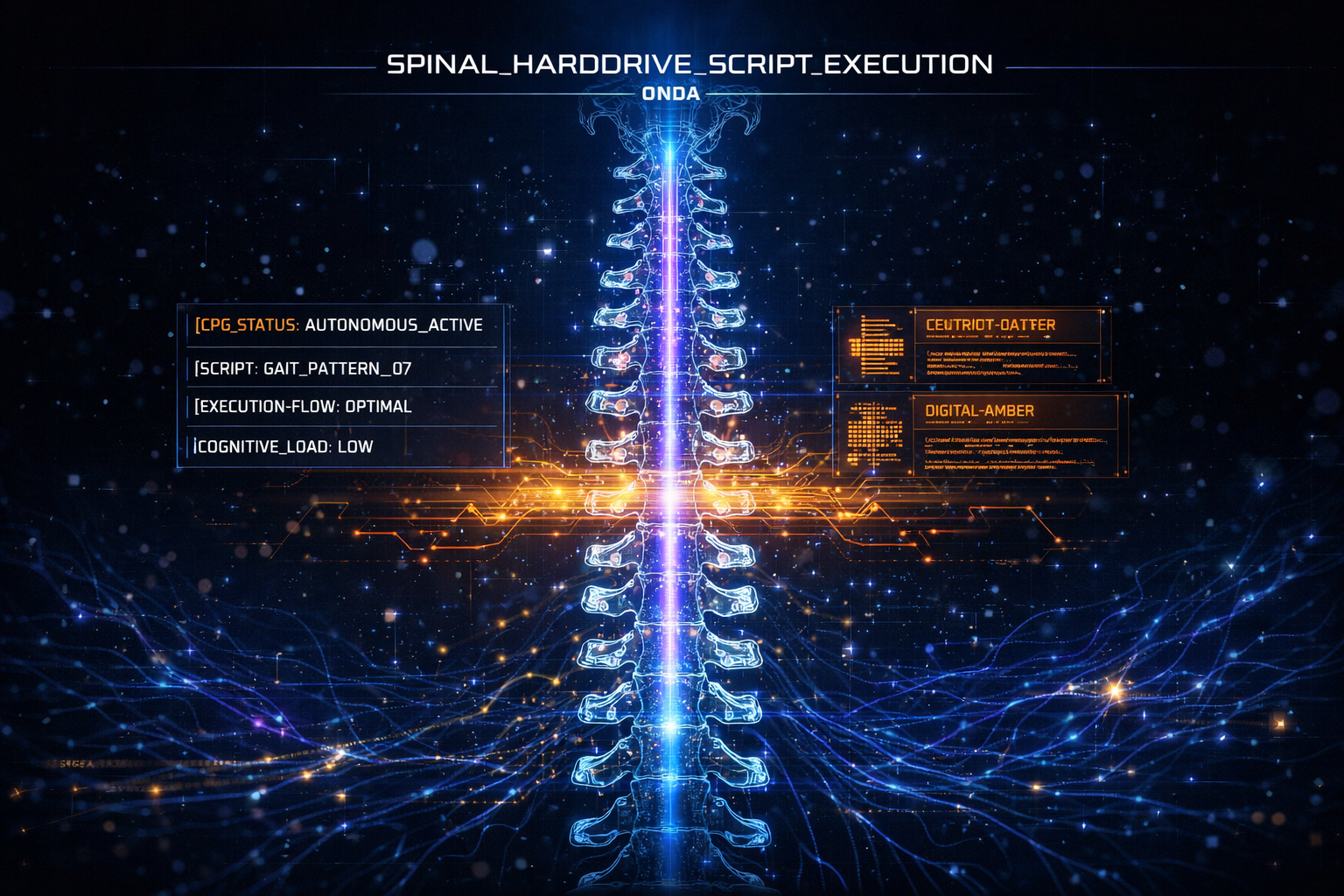
"In computing, the main CPU doesn't render every single pixel — that is the job of the GPU and specialized drivers. In your body, the spinal cord acts as this dedicated 'micro-controller.'
Central Pattern Generators (CPG) are biological neural networks capable of producing complex rhythmic movements — walking, running, breathing — without constant input from the brain. When you walk, your brain doesn't command every individual muscle; it simply hits the 'Execute' button, and the spinal 'harddrive' runs the corresponding script."
The Architecture: The Hierarchy of Movement
System efficiency depends on the proper delegation of authority across three distinct processing layers:
The Executive (Brain): Defines the strategy — "Where are we going?" and "Why?" Operates at high frequencies (Beta/Gamma). The prefrontal cortex sets the goal, selects the movement mode, and monitors whether the outcome matches intention. It does not — and should not — manage the execution sequence. When it does, efficiency collapses.
The Controller (CPG): Located primarily in the spinal cord (lumbar region for locomotion, cervical region for respiratory and arm coordination). Translates the strategic command into a perfect sequence of muscular contractions via half-center oscillator networks — pairs of inhibitory interneurons that alternate activity to produce rhythmic, coordinated output. CPGs operate autonomously: they do not require continuous descending input once the "Execute" command has been issued. They continue running until explicitly stopped or the context changes sufficiently to require re-planning.
The Feedback Loop (Proprioception): Sensors in muscles (muscle spindles), tendons (Golgi tendon organs), and joints (mechanoreceptors) transmit real-time state data directly to the CPG — not to the brain. The CPG adjusts its output in real-time based on terrain, load changes, and obstacle detection. This feedback-adjustment loop operates on timescales of 30–80 milliseconds — far faster than the conscious mind's 200–400ms reaction window. The spinal cord is not a passive relay; it is an active real-time controller that processes and responds to sensory data independently of cortical involvement.
Why does overthinking your movement make it worse?
The primary bug in modern biomechanics is Over-conscious Control — the prefrontal cortex attempting to directly manage motor sequences that are evolutionarily designed to run without it:
Processing Overload: When you try to "correctly" place your foot, "force" your breath through willpower, or consciously sequence a movement, you occupy the prefrontal cortex with routine execution tasks. The prefrontal cortex is your most metabolically expensive neural tissue — consuming 20% of the brain's energy budget while representing 2% of its mass. Using it to manage foot placement is the neurological equivalent of running enterprise software on a microcontroller.
System Jitter: Attempting to manually override CPGs introduces timing errors. CPG output is rhythmically synchronized via gap junctions and chemical synapses calibrated over millions of years of evolutionary refinement. Cortical override signals arrive asynchronously, disrupt the timing of the oscillator network, and produce discoordination, compensatory tension, and rapid fatigue. Skilled movers — dancers, elite athletes, martial artists — are characterized not by greater cortical control of their movement but by greater cortical withdrawal from it: they have better-calibrated CPGs and better-developed cortical inhibition of the micromanagement reflex.
Energy Drain: Moving "from the head" consumes massive amounts of glucose — not because movement is expensive, but because prefrontal cortex activation is expensive. Every minute of conscious motor micromanagement consumes resources that are finite and should be reserved for creativity, strategic thought, and high-level decision-making. The cortex is being taxed for work that the spinal cord can do for free.
ONDA Protocol: Calibrating the Harddrive
Three techniques to return control to where it belongs — the spinal cord:
Technique 1: Sensory Priming (Feedback Loop Initialization)
Action: 5 minutes of balance exercises on varied surfaces (uneven ground, balance board, foam pad) or manual texture exploration (feet on rough/smooth/uneven materials before movement sessions). Include single-leg stance, slow weight shifts, and small perturbations.
Logic: Proprioceptive input from muscle spindles and joint mechanoreceptors calibrates the CPG feedback loop. Sedentary modern environments — shoes, flat surfaces, chairs — chronically underload this feedback pathway, causing the CPGs to operate on low-quality terrain data. Sensory priming "wakes up" the afferent channels and re-establishes high-resolution proprioceptive input to the spinal circuits. The practical effect: CPG scripts become more precise, reactive, and capable of autonomous terrain adaptation. The brain can trust the harddrive because the harddrive has accurate sensors.
Technique 2: Rhythmic Entrainment (CPG Synchronization)
Action: Use an external rhythm source (metronome, slow paced breathing, music with clear rhythmic structure) to anchor movement during exercise, walking, or breathwork sessions. Match your movement cadence to the external rhythm for 10–20 minutes.
Logic: CPGs are oscillator networks — they entrain to external rhythmic inputs via the auditory-motor system (a direct neural pathway linking auditory cortex to spinal motor circuits, used clinically in gait rehabilitation). External rhythm provides a phase-locking signal that synchronizes the CPG oscillators and shifts them toward maximum efficiency mode — the state where energy consumption per unit of output is minimized. This is why music improves endurance: it is not motivational, it is a CPG synchronization tool.
Technique 3: Eyes-Closed Drills (Cortical Withdrawal Training)
Action: Perform familiar movements (slow walking, basic strength movements, balance holds) with eyes closed for 2–5 minutes per session. Begin in safe, controlled environments. Progress to eyes-closed dynamic movements only after proprioceptive priming.
Logic: Vision is the primary route through which the cortex hijacks motor control — the visual feedback loop bypasses the spinal proprioceptive system and routes everything through cortical processing. Eyes-closed training removes this bypass, forcing the cortex to relinquish visual micromanagement and requiring the spinal intelligence to take over. The CPGs, deprived of cortical interference via visual override, are forced to operate autonomously and strengthen their proprioceptive calibration. The brain learns — through repeated experience of successful autonomous movement — that it does not need to manage execution. This is the hardware training for cortical withdrawal.
What are the benefits of letting movement run on autopilot?
Cognitive Offloading: You can think deeply, problem-solve, or process information while moving — because the "processor" is free from body-management duties. The cognitive bandwidth freed by delegating movement to the spinal harddrive is available for the high-level tasks that only the prefrontal cortex can perform. Walking meetings, thinking walks, creative strolls: these are not procrastination. They are deliberate cognitive offloading via CPG delegation.
Fluid Movement: Motion becomes graceful, silent, and highly economical — not because of training volume, but because CPG output is intrinsically more efficient than cortical movement control. Efficiency, economy, and aesthetics in movement are not skills. They are the natural result of removing cortical micromanagement and allowing the biological architecture to execute the script it was designed to run.
Injury Prevention: Autonomous CPG scripts react to uneven ground, sudden load changes, and unexpected perturbations in 30–80 milliseconds — far faster than the visual processing timeline (150–200ms) or the conscious reaction window (200–400ms). The protective reflexes that prevent ankle sprains, falls, and joint injuries are spinal-level responses. They are degraded by the same sedentary environments that underload the proprioceptive feedback loop. Calibrating the harddrive via sensory priming directly enhances these protective scripts.
"Your spinal cord is smarter than you think. Stop managing your body like manual legacy software. Update the drivers, hit 'Play,' and let your biological architecture do the rest."[ ONDA_STATEMENT ]