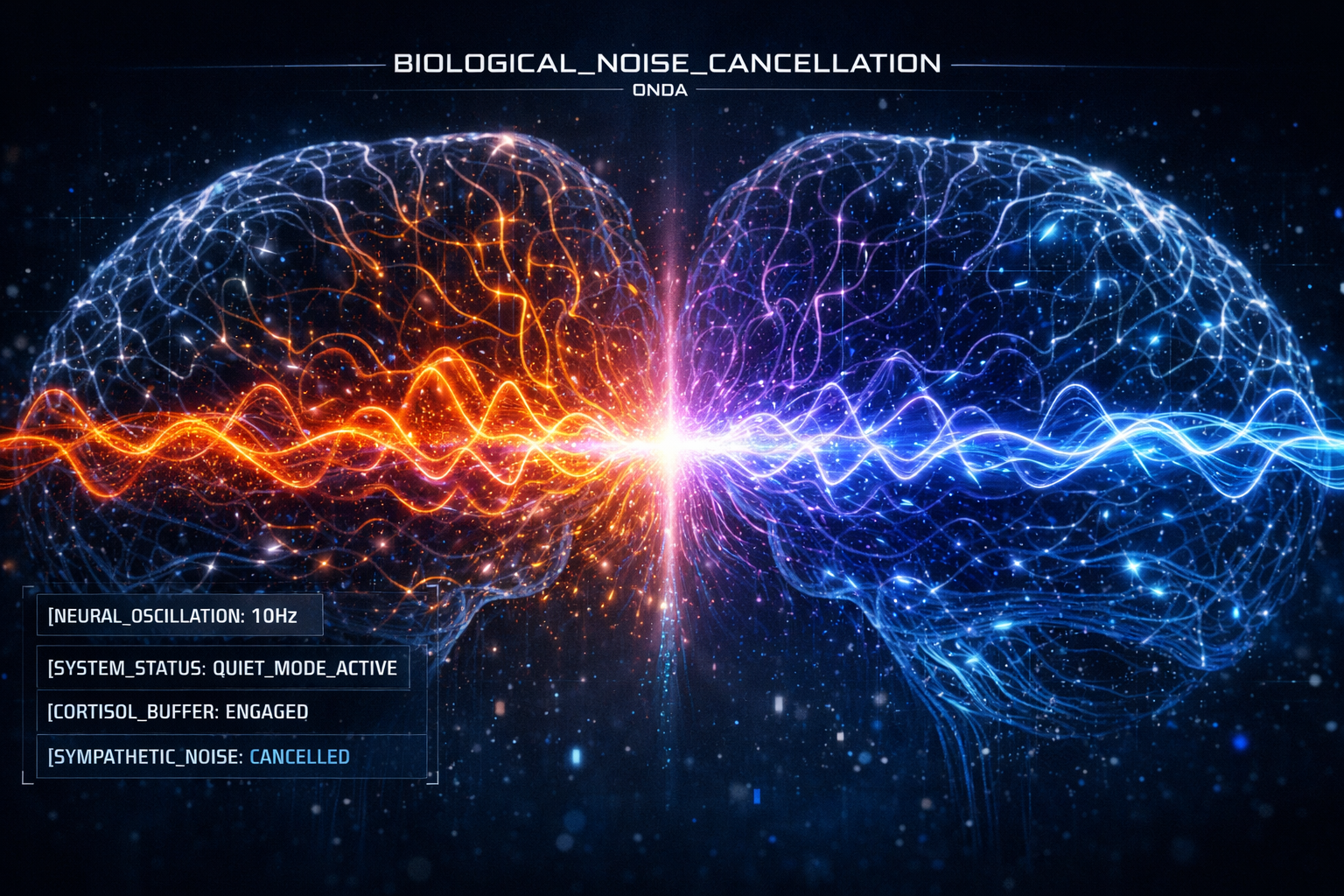
[ THE ACTIVE NOISE CANCELLING ]
"In audio engineering, active noise cancellation generates a wave that is the mirror image of external noise to create silence. The Quiet Mode Protocol does the same for your nervous system.
When you are under chronic stress, your neurons 'scream' at high Beta frequencies. Shifting into the Alpha range (8–12 Hz) creates a biological counter-wave. This isn't just passive relaxation — it is the active suppression of sympathetic arousal, allowing the system to 'cool down' in real-time."
The Architecture: The Cortisol Buffer
The Alpha rhythm functions as a protective layer between the external world and your internal state — not a wall, but an active filter that processes threat signals without triggering the full cascade:
Vagal Tone Enhancement: The generation of Alpha waves directly correlates with an increase in Vagal Tone — specifically, the high-frequency component of HRV driven by the myelinated vagus (Polyvagal Theory: ventral vagal complex). This correlation is bidirectional and self-reinforcing: Alpha generation increases vagal output, vagal output increases Alpha power. The practical consequence is that deliberately entering Alpha state flips the autonomic switch from sympathetic dominance ("Fight or Flight") to parasympathetic dominance ("Rest and Digest") within minutes. The body's resources — blood flow, hormonal priority, immune resources — reorient accordingly.
Cortisol Regulation: In the Alpha state, the HPA axis receives a reduced load signal via the prefrontal cortex. Sustained High-Beta and the threat-scanning loop it maintains drive tonic CRH release, which chronically elevates cortisol. Alpha dominance interrupts this loop: the prefrontal cortex, now in default-mode rather than task-positive mode, exerts inhibitory control over amygdala activation, which reduces the perceived threat signal being forwarded to the hypothalamus. The adrenal glands receive a deprioritized signal for stress hormone production. This creates a recovery window where tissues can begin cellular repair, protein synthesis, and immune restoration — processes that are actively suppressed under cortisol load.
Emotional Filtering: Alpha rhythms reduce the reactivity of the amygdala via top-down prefrontal inhibition — the same pathway targeted by established mindfulness-based interventions and confirmed via fMRI. In Alpha mode, you still process external stimuli, but the amygdala's threat response is buffered: the signal reaches awareness without triggering the full-cascade fight-or-flight response. Problems remain visible; they no longer trigger systemic shutdown. This is not emotional suppression — it is calibrated signal processing. The difference between a system running at 20% arousal and one running at 90%.
The Critical Error: Thermal Runaway
Without regular engagement of Quiet Mode, the nervous system enters a self-amplifying failure cascade — Thermal Runaway:
Hyper-Vigilance: You cannot relax even after work. The brain keeps scanning for threats that no longer exist — because the threat-detection loop has become structurally decoupled from actual threat input. High-Beta entrainment becomes the default state; transitioning out of it requires increasing effort that the depleted system cannot provide. The scanner runs on empty while continuing to consume full resources.
Immune Suppression: Chronically elevated cortisol and sustained High-Beta neural activity "unplug" the immune system via multiple pathways: cortisol directly suppresses lymphocyte proliferation and cytokine production; sympathetic nervous system activation redirects metabolic resources away from immune surveillance toward cardiovascular and musculoskeletal readiness. In the context of no actual physical threat requiring this reallocation, the immune system is simply deprioritized indefinitely — a sustained drain on longevity capital.
Sleep Latency: The brain's inability to shift from Beta to Alpha in the evening creates a cascade failure at the entry point of the sleep architecture. The transition from waking Beta to sleep Theta requires Alpha as the intermediate state — you cannot skip the bridge. A brain stuck in Beta at bedtime cannot reach Alpha, and therefore cannot reach Theta, and therefore cannot enter Delta (Deep Sleep). Sleep latency extends not because of insufficient "tiredness" but because of architectural blockage at the Beta/Alpha boundary. More exhaustion without more Alpha does not solve the problem — it worsens it.
ONDA Protocol: Activating Quiet Mode
Three physiological triggers to engage the silence protocol on demand:
Technique 1: Exhale Extension (The Baroreflex Lever)
Action: Breathe with a 1:2 inhale-to-exhale ratio — 4 seconds inhale, 8 seconds exhale (or 5:10 if comfortable). Sustain for 3–5 minutes.
Logic: The extended exhale activates the baroreflex via a specific mechanism: during exhalation, intrathoracic pressure rises, venous return decreases, heart rate slows, and baroreceptors in the aortic arch signal the vagal nucleus to increase parasympathetic output. The 1:2 ratio amplifies this signal beyond what normal breathing produces. The physiological result is a forced shift toward parasympathetic dominance — and with it, Alpha entrainment via the vagus-thalamus-cortex pathway. The exhale is not calming because it is slow. It is calming because it physically pulls the brake.
Technique 2: Peripheral Awareness (The Visual Beta Exit)
Action: Soften your gaze. Without moving your eyes, expand awareness to the edges of your visual field — notice what is visible peripherally without looking at it directly. Hold for 60–120 seconds while continuing to breathe with exhale extension.
Logic: Directed, narrow visual focus — the default posture for screen work — activates the dorsal attention network and frontal eye fields in High-Beta scanning mode. Peripheral, diffuse visual awareness deactivates this network and activates the ventral attention system, which is associated with Alpha dominance. It also directly reduces locus coeruleus firing (the brain's norepinephrine hub and primary Beta driver) via decreased visual arousal input. Combined with exhale extension, this produces a dual-axis suppression of sympathetic arousal — respiratory and visual.
Technique 3: The Alpha-Drop (The Hardware Reset)
Action: 3 minutes with eyes closed, seated, with a slight forward head tilt (chin lowered approximately 10–15°). Maintain exhale extension breathing. No agenda, no visualization, no deliberate mental activity.
Logic: The slight forward head tilt physically increases CSF pressure at the occipital pole and reduces cervical sympathetic chain activation — both of which facilitate Alpha generation in the occipital and parietal cortices, the primary Alpha generators. Eyes-closed state removes the primary source of sensory-driven Beta input (visual processing consumes approximately 30% of cortical resources). The combination — occipital positioning, reduced sensory load, parasympathetic breathing — is a hardware-level trigger for Alpha state that does not require willpower, concentration, or technique mastery. Three minutes is the minimum viable dose for measurable Alpha power increase.
Impact Log: Recovery Efficiency
Instant Decompression: Releasing muscular and mental tension within minutes — not hours. The Alpha-Drop protocol, when used after a high-stress work period, tends to bring stress down faster than passive rest because it actively engages the parasympathetic system rather than waiting for it to settle on its own.
Metabolic Preservation: Conserving bodily resources by lowering background stress levels. Every hour of chronic High-Beta neural activity and associated cortisol elevation consumes resources that would otherwise go toward cellular repair, immune function, and neuroplasticity consolidation. Quiet Mode is metabolic efficiency — the body stops burning emergency fuel on a non-emergency.
Emotional Stability: A higher threshold for irritation, anxiety, or reactive behavior — the direct result of sustained amygdala buffering via Alpha-mediated prefrontal inhibition. Emotional stability is not a personality trait. It is a physiological state that requires maintenance. Quiet Mode is the maintenance protocol.
"Silence is not the absence of sound; it is the absence of noise in your neural circuits. Quiet Mode is the reset button you must press before the system starts to smoke."[ ONDA_STATEMENT ]
Recommended tools
Pushing into the alpha-cortisol-buffer state benefits from a structured practice partner. Three apps that work:
- •Calm — sleep stories and ambient calming content
- •Healthy Minds Program — evidence-based meditation, free
- •Headspace — structured beginner curriculum