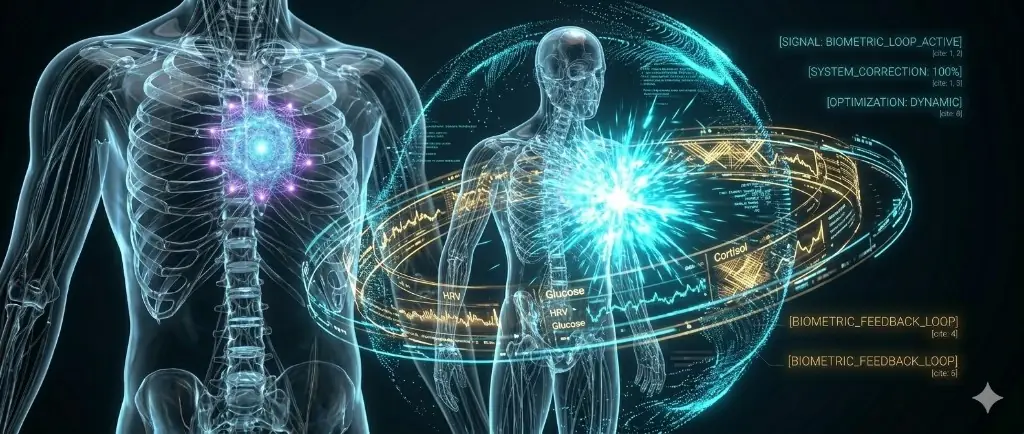
[ ANALYZING CAUSAL LOGIC ]
"Most users treat biometrics (HRV, Resting Heart Rate, Sleep Phases) as a passive report—a 'grade' the system gives them for the previous day. In the ONDA model, data is not a grade; it is an Input Signal for immediate Operating System adjustment.
We view the biometric cycle as a Feedback Loop. If your 'Hardware' signals high latency (Low HRV) or overheating (High RHR), continuing with a standard 'Daily Plan' is equivalent to intentionally writing errors into your code. Our objective: teach the system to adapt to current resource availability in real-time."
What does HRV tell you about your nervous system's readiness?
Heart Rate Variability (HRV) tells you how flexible and ready your nervous system is — it is our main signal for the "System Latency" image — an indirect, noisy marker, not a diagnostic tool. High HRV indicates that your nervous system is flexible and ready for high-bandwidth data processing. Low HRV signals that CPU resources are occupied by background processes (stress, inflammation, or under-recovery). In this state, any attempt to 'Overclock' the system will lead to thermal throttling.
Protocol: Dynamic Calibration
Instead of fixed schedules, we implement Adaptive Protocols. This is the 'IF-THEN' logic of programming applied to biology.
IF RECOVERY_SCORE < 40%, THEN the system automatically replaces the HIGH_INTENSITY protocol with VAGAL_TONE_RESET.
This curbs 'Human Error'—the tendency to ignore biological signals in favor of artificial performance goals.
[ EXECUTION_PROTOCOL: DYNAMIC_LOOP ]
STEP_01 > Data Ingest (System Boot)
Action: Sync data from your wearable device (Oura, Whoop, Apple Watch) immediately upon waking.
Goal: Determine the baseline readiness level for the current 24-hour cycle.
STEP_02 > Delta Analysis
Action: Compare current HRV and Body Temperature against your 14-day rolling average.
Logic: We are looking for the Delta (deviation), not an absolute number. Any drop in HRV more than 20% below baseline triggers the System Protection Protocol.
STEP_03 > Execution Protocol Selection
The Hack: Select a mode based on biometric input:
- •[ PERFORMANCE_MODE ] (High HRV) – The ideal window for learning, complex analytical tasks, and high physical load.
- •[ MAINTENANCE_MODE ] (Normal HRV) – Standard operational cycles; maintaining current progress.
- •[ RECOVERY_MODE ] (Low HRV) – Forced 'Digital Detox', CO2_TOLERANCE breathing, and an early GLYMPHATIC_FLUSH.
[ SYSTEM CORRECTION LOG ]
INPUT_SIGNAL: ↓ HRV / ↑ RHR
SYSTEM_STATE: System Overload / High Latency
ACTION: PROTOCOL: VAGAL_RESET
INPUT_SIGNAL: ↑ Body Temp
SYSTEM_STATE: Immune Alert / System Heat
ACTION: PROTOCOL: THERMAL_STASIS
INPUT_SIGNAL: ↓ Deep Sleep
SYSTEM_STATE: Cache Corrupted / Recovery Failure
ACTION: PROTOCOL: GLYMPHATIC_PURGE
INPUT_SIGNAL: ↑ Alpha Waves
SYSTEM_STATE: Peak Focus / Optimal Bandwidth
ACTION: PROTOCOL: DEEP_WORK_2.0
[ HARDWARE_VALIDATION ]
DEVICE: ONDA App (iPhone camera / Apple Watch / Apple Health). METRIC: Resting HR, HRV & Breathing Rate. STATUS: Feedback Loop Closed. Optimization Continuous.
The system no longer operates blindly. Every action is justified by a biometric request.[ FINALIZE_ANALYSIS ][ CYCLE COMPLETE ]