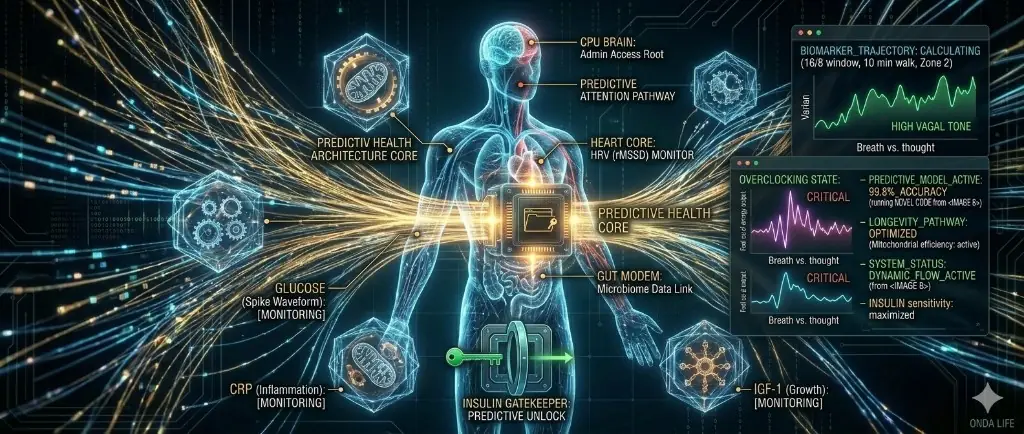
[ ARTICLE: PREDICTIVE_BIOMETRICS // SYSTEM_STABILITY ]
Most trackers tell you how you slept last night. Predictive Analytics tells you how you will perform three days from now. By feeding raw telemetry (HRV, RHR, Skin Temp, Respiratory Rate) into specialized AI models, we move beyond static data points into System Stability Forecasting. We don't just track the crash; we calculate the probability of the "Biological Reboot" before it happens — the signature of accumulating allostatic load drifting your biological signature out of homeostasis.
The Hack: [ PROTOCOL_PREDICTIVE_SYNC ]
The Hack:
[ PROTOCOL_PREDICTIVE_SYNC ]Baseline Calibration: Establish a 21-day "Clean Signal" period using high-fidelity wearables. The AI maps your unique Biological Signature and standard deviations.
Anomaly Detection: The system monitors for Micro-Drifts — minuscule shifts in Resting Heart Rate (RHR) or HRV latency that are invisible to the human eye but signal an incoming system failure (illness or burnout).
Stability Thresholds: Define your "Operational Redline." When the AI detects a 15% deviation from your baseline signature, it triggers a Soft Reboot Command (enforcing immediate recovery protocols).
Correlation Mapping: Tagging subjective inputs (stress, nutrition) to see how they impact your System Stability Score 48–72 hours later.
Can biomarkers predict illness or overtraining before symptoms?
The 3-Day Window: Physiological markers often begin to degrade 48–72 hours before clinical symptoms of illness or overtraining appear.
Signal vs. Noise: AI filters out "Normal Jitter" (random fluctuations) and focuses on "Trend Volatility."
Entropy Management: Biological systems naturally move toward entropy (disorder). Predictive tracking allows for "Anticipatory Correction," maintaining the system in a state of high-performance homeostasis.
[ HARDWARE_VALIDATION ]EXAMPLE_DEVICE: wearable with heart rate / HRV / sleep dataMETRIC: deviation from your own baseline (resting HR, HRV, sleep)STATUS: TRACK_OVER_WEEKSIllustration — not a measurement
Recommended tools
AI biomarker tracking starts with the signal. CGM is the highest-density consumer biomarker stream available.
- •Signos — AI-driven CGM that predicts glucose response
- •Levels — deepest insight engine for human-in-loop analysis
- •Ultrahuman M1 — cross-signal view (glucose + HRV + sleep)