Resting Respiratory Rate: What It Reflects and How It's Measured
Yakiv Bilenko — editor · Updated October 6, 2026
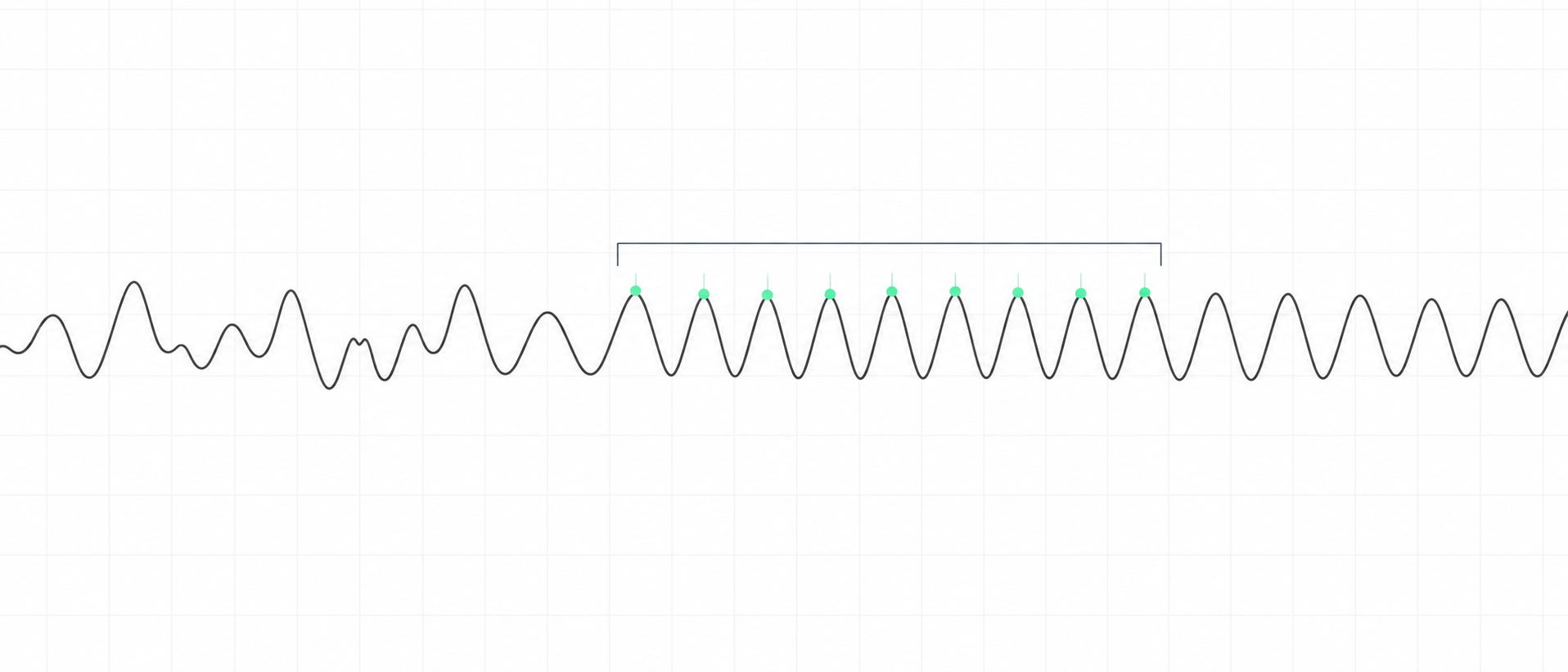
Resting respiratory rate is the number of breaths you take per minute while calm and still, or the rate a wearable estimates during sleep. It is used in hospitals as a vital sign and by wearables as a nightly trend. It is influenced by sleep, illness, fever, exercise, altitude, anxiety, medicines and simply paying attention to it. It does not by itself establish a diagnosis, and devices compute it differently.
Key points
- Respiratory rate is breaths per minute at rest; a wearable's sleeping value and a daytime count are related but not the same measurement.
- Breathing is the one automatic function you can easily take over, so being watched or counting your own breaths changes the daytime number.
- Counting breaths by hand is less accurate than it looks, and short counts tend to underestimate.
- Watches and rings estimate breathing during sleep from the pulse signal, each with its own algorithm; validation studies are few and small.
- In hospitals a raised respiratory rate is an important sign of deterioration, a finding about clinical settings and marked changes.
- In single wearable studies, a sustained rise in nightly breathing rate against a person's own baseline accompanied the onset of COVID in some people.
- Shortness of breath at rest, chest pain or severe breathlessness need medical care, whatever a wearable shows.
What is resting respiratory rate?
Resting respiratory rate is the number of breaths you take per minute when you are calm, still and not talking. With pulse, blood pressure and temperature it is one of the classic vital signs, and in hospitals it is the one most often left unrecorded [S1].
"Resting" covers two different measurements, and they do not give the same number:
- A daytime resting count — breaths counted while you sit or lie quietly and awake. This is what a clinic measures and what the usual reference range describes.
- A sleeping value — estimated by a watch, ring or band from the night's data. During sleep, breathing is no longer under any conscious influence, and its depth and rhythm change with the sleep stage (see What affects it?).
Breathing has one property no other vital sign shares: it runs automatically, but you can take it over at any moment. That makes the daytime number fragile. As soon as you notice you are being watched — or start counting your own breaths — breathing tends to change, and studies of manual counting find that awareness lowers the measured rate [S2]. A sleeping value avoids this, which is one reason wearables focus on the night.
How does it work?
Breathing is driven by the brainstem, which adjusts rate and depth to keep carbon dioxide and oxygen in balance and to match the body's needs. Effort, fever, pain, emotion and many illnesses push it up; some medicines and deep calm push it down. Because so many inputs converge on it, respiratory rate is a summary signal rather than a readout of one system. Breathing also shapes the heart rhythm from beat to beat — that link is explained on respiratory sinus arrhythmia and is not repeated here.
How is it measured?
Counting by hand. The traditional method is to watch the chest or listen, and count breaths. It looks simple but is surprisingly error-prone. A systematic review of manual counting in adults found five sources of inaccuracy: the awareness effect lowers the rate, short counts that are multiplied up underestimate it, two observers — or the same observer twice — can differ substantially, some values are guessed rather than counted, and many are not recorded at all [S2]. The review recommends counting rather than estimating, for a full minute, without the person knowing [S2]. If you count your own breaths, the awareness effect is built in; treat that number as rough.
Sensors on the chest. Chest bands measure the movement of the ribcage and abdomen, and bedside monitors often infer breathing from changes in electrical impedance across the chest. In sleep laboratories, chest and abdominal bands (inductance plethysmography) are the usual reference. Even electronic methods are not automatically accurate: in one emergency-department study, an impedance monitor agreed poorly with a careful full-minute count, as did routine nurse counts [S3] (context-dependent, one study).
Wearables during sleep. Watches and rings do not measure airflow. They estimate breathing from the optical pulse signal (photoplethysmography, PPG): each breath slightly changes the pulse wave's height, timing and baseline, and an algorithm turns these rhythmic changes into breaths per minute. Many such algorithms exist, and the methods for testing them differ [S4]. Each manufacturer uses its own algorithm, window and rules for discarding noisy data, and most do not publish them — so two devices can report different breathing rates for the same night, and neither is wrong. Follow one device's trend rather than comparing numbers across devices.
How accurate are watch and ring estimates? Published validation is thin. In one small study of healthy young adults, a wrist-worn strap's sleeping respiratory rate showed low bias and precision error against chest and abdominal bands during an overnight sleep study [S5]. That is a single study of one device, one night per person, funded by the manufacturer (emerging); it does not tell you how any other watch or ring performs. This page does not give accuracy figures for specific devices.
What does "normal" mean? For adults at rest, the usual range is 12–20 breaths per minute. That range describes a daytime count in a calm adult; it is not a sleeping reference, and it says nothing about what is normal for you. Your own nights, measured the same way, are the more useful comparison — how a personal baseline is built is explained on HRV baseline, and the same logic applies here.
What affects it?
- Sleep and sleep stage. During sleep, breathing becomes shallower and total ventilation falls compared with wakefulness. Whether the rate itself rises is less clear: one laboratory study found breathing during sleep more rapid and shallow [S6], another found ventilation fell through smaller breaths without a significant change in rate [S7] (context-dependent). REM sleep is the least regular stage: bursts of eye movements come with faster, shallower breathing [S8]. A nightly average smooths these swings out.
- Attention. Noticing your breathing tends to change it, and being observed lowers the counted rate [S2]. Slow-breathing practice lowers it on purpose; what that practice does and does not do is covered on slow breathing.
- Illness and fever. In a large sample of wearable users with COVID, respiration rate and heart rate were typically raised during illness [S12] (emerging, one study). Fever and infections in general can speed breathing; this page does not cite a separate study for fever.
- Medicines. Opioids can depress breathing. Serious events are uncommon in pain treatment, but fatal cases are regularly reported [S9]. Other sedating medicines and alcohol can also slow breathing. Never change a medicine because of a wearable reading; ask your doctor.
- Pregnancy. In a large cohort of healthy pregnancies measured by standard clinical observation, respiratory rate did not change across gestation [S10] (context-dependent, one cohort study). Breathlessness in pregnancy is common for other reasons, and the rate itself is not a reliable guide to it.
- Other everyday factors. Exercise raises breathing rate during and shortly after effort; anxiety, pain and a warm room can raise it at rest; and at altitude breathing speeds up as the body adapts — see breathing and altitude acclimatisation. These are widely recognised, but this page does not cite a specific study for each, so treat them as general context rather than measured effects.
What does the evidence show?
Established — a clinical warning sign. In hospitals an abnormal respiratory rate predicts potentially serious events, and a raised rate is one of the earliest signs that a patient is getting worse [S1]. Respiratory rate is commonly included in track-and-trigger systems — early-warning scores that turn vital signs into a single alert level [S2]. In the UK, the Royal College of Physicians' National Early Warning Score, now in its updated second version, is the standard system the NHS uses to recognise acute illness and deterioration [S13]. This evidence is about patients and marked deviations measured in clinical settings. It does not mean that a small night-to-night change on a watch carries the same weight.
Context-dependent — how good the number is. The value of a recorded respiratory rate depends on how carefully it was measured. Manual counts are prone to systematic and random error [S2], and a bedside electronic monitor did not solve this in one emergency-department study [S3].
Emerging — a nightly rise as an early sign of illness. Two wearable studies looked at breathing rate during sleep around the onset of COVID:
- In one retrospective study of a single wrist-worn device, a model built on changes in night-time respiratory rate picked up a minority of infections in the two days before symptoms, and most of them by the third day of symptoms [S11]. It is a single study in people who already had symptoms, with small validation groups; several authors were employed by or funded by the device maker.
- In a large self-selected sample of one manufacturer's users, breathing rate and heart rate were typically raised during COVID while HRV fell [S12]. It is a single observational study with self-reported diagnoses; all authors were funded by the manufacturer.
Neither study is a validated diagnostic test. Both point to the same pattern seen with resting heart rate: the useful signal is a sustained rise against your own baseline over more than one night, not one high value. A single high night can follow alcohol, a late meal, a warm bedroom or a restless night. How day-to-day variation arises is covered on why HRV changes from day to day.
Breathing rate and HRV. Breathing rate strongly shapes heart rate variability: slower breathing produces larger breath-linked swings in heart rate, faster breathing smaller ones. A change in your breathing rate can therefore move your HRV without anything else changing. The mechanism is on breathing and HRV, and what this means for reading wearable HRV is on wearable HRV accuracy.
What it does not tell you
- It is not a diagnosis. A number inside or outside the usual range does not by itself establish health or disease.
- Hospital evidence does not transfer to a watch. Respiratory rate as a deterioration sign comes from patients and marked changes [S1] [S2]; it is not a reason to worry about small nightly fluctuations.
- Device numbers are not interchangeable. Each watch, ring or band estimates breathing its own way; a gap between devices is not a change in your lungs.
- A daytime self-count is not a sleeping value. Counting your own breaths changes them [S2]; compare like with like.
- Single wearable studies are not tests. The COVID findings are emerging, from manufacturer-linked studies [S11] [S12].
- When to see a doctor. As a general precaution, see a doctor if you are short of breath at rest, or if fast breathing comes with fever, cough, dizziness, confusion or other symptoms that worry you. Chest pain or severe breathlessness need urgent care — do not wait for a wearable trend. If you bring your data along, doctors and your data explains what a pulmonologist or a sleep specialist can and cannot do with it.
In ONDA
Breathing rate is one of the three nightly signals in ONDA's baseline, together with resting heart rate and HRV. ONDA reads respiratory rate from Apple Health — written by Apple Watch or by any device whose app syncs it there — and builds your personal baseline over 14 days. It compares each night with your own corridor, never with a population norm, and it flags a change only when it also passes minimum floors: resting heart rate up at least 5 bpm, HRV down at least 15%, breathing rate up at least 2 breaths per minute. ONDA does not compute the sleeping breathing rate itself, makes no claim about how accurate it is, and does not diagnose anything [S14]. For more background, see your respiratory rate: the overnight number and what ONDA measures.
Educational information, not a diagnosis or medical treatment.
Evidence at a glance
| Claim | Evidence | Limitation |
|---|---|---|
| Being aware that breathing is being counted lowers the measured rate, short counts underestimate it, and repeated manual counts can differ substantially. [S2] | Established | Systematic review of studies in clinical adult settings; how large the awareness effect is for one person at home is not known. |
| In an emergency department, neither nurses' routine counts nor an impedance-based electronic monitor agreed well with a careful full-minute count. [S3] | Context-dependent | One emergency-department study with one impedance monitor; it does not describe chest bands or modern devices. |
| Many algorithms estimate breathing rate from the ECG or the optical pulse (PPG) signal, and their performance needs a common assessment framework. [S4] | Established | A methods review; it does not validate any specific watch or ring. |
| In one small validation study, a wrist-worn wearable's sleeping respiratory rate showed low bias against inductance plethysmography during polysomnography. [S5] | Emerging | A single small study of healthy young adults, one device, one night of polysomnography, funded by the manufacturer; it does not apply to other watches or rings. |
| Compared with wakefulness, breathing during sleep becomes shallower and ventilation falls; one study found it also more rapid, another found no significant change in rate. [S6][S7] | Context-dependent | Second quote (S7): Minute ventilation decreased from wakefulness to sleep by 14% to 19%, owing to a decrease in tidal volume without a significant change in respiratory rate. Small laboratory studies with a face mask or pneumotachograph, which may itself change breathing. |
| During REM sleep, bursts of eye movements were accompanied by faster, shallower breathing. [S8] | Context-dependent | Ten healthy men in a laboratory; it shows that REM breathing is irregular, not a value for any person. |
| Opioids can depress breathing; fatal cases are regularly reported even though serious events are uncommon in pain treatment. [S9] | Established | A clinical review about opioid treatment; it is not advice about any medicine. |
| In a large prospective cohort of healthy pregnancies, respiratory rate did not change with gestation. [S10] | Context-dependent | One UK cohort of women without significant comorbidities, measured by standardised clinical observation; not a wearable or a sleeping value. |
| An abnormal respiratory rate predicts potentially serious clinical events, and hospital systems that respond to an elevated rate can be implemented. [S1] | Established | Hospital inpatients; it says nothing about small changes in healthy people or wearable values. |
| Respiratory rate is an important indicator of clinical deterioration and is commonly included in track-and-trigger (early-warning) systems. [S2] | Established | Clinical context; the value of a single recorded number depends on how accurately it was counted. |
| The National Early Warning Score, launched by the Royal College of Physicians and adopted by the NHS in its updated form, is a standardised early-warning system for acute illness and deterioration. [S13] | Established | A review by the chair of the development group; the abstract does not list the score's components. That respiratory rate is one of them is supported here by S2 (track-and-trigger systems). |
| In one wearable study, a model based on changes in night-time respiratory rate identified a minority of COVID cases before symptoms and most by the third day of symptoms. [S11] | Emerging | A single retrospective study of one brand of wearable in people who already had symptoms; small validation sets; several authors employed by or funded by the manufacturer. Not a diagnostic test. |
| In a large self-selected sample of wearable users with COVID, respiration rate and heart rate were typically raised by illness while HRV fell. [S12] | Emerging | A single observational study from one manufacturer's users with self-reported diagnoses; all authors funded by the manufacturer. Not a diagnostic test. |
| ONDA reads respiratory rate from Apple Health as one of the three nightly baseline signals, compares nights with a personal corridor over the baseline window and minimum floors, and does not diagnose. [S14] | Established | Describes app behaviour only; it is not evidence for any health claim or for the accuracy of the values. |
Sources
- [S1] Cretikos et al. (2008). Respiratory rate: the neglected vital sign. Medical Journal of Australia. DOI 10.5694/j.1326-5377.2008.tb01825.x · PMID 18513176
- [S2] Kallioinen et al. (2021). Quantitative systematic review: Sources of inaccuracy in manually measured adult respiratory rate data. Journal of Advanced Nursing. DOI 10.1111/jan.14584 · PMID 33038030 · one author holds a patent on physiological monitoring methods; the authors state it does not relate to the reviewed articles
- [S3] Lovett et al. (2005). The vexatious vital: neither clinical measurements by nurses nor an electronic monitor provides accurate measurements of respiratory rate in triage. Annals of Emergency Medicine. DOI 10.1016/j.annemergmed.2004.06.016 · PMID 15635313
- [S4] Charlton et al. (2018). Breathing Rate Estimation From the Electrocardiogram and Photoplethysmogram: A Review. IEEE Reviews in Biomedical Engineering. DOI 10.1109/RBME.2017.2763681 · PMID 29990026
- [S5] Berryhill et al. (2020). Effect of wearables on sleep in healthy individuals: a randomized crossover trial and validation study. Journal of Clinical Sleep Medicine. DOI 10.5664/jcsm.8356 · PMID 32043961 · funded by a grant from the wearable's manufacturer (WHOOP) to the university; the authors report no conflicts of interest
- [S6] Douglas et al. (1982). Respiration during sleep in normal man. Thorax. DOI 10.1136/thx.37.11.840 · PMID 7164002
- [S7] Krieger et al. (1990). Breathing during sleep in normal middle-aged subjects. Sleep. · PMID 2330473
- [S8] Gould et al. (1988). Breathing pattern and eye movement density during REM sleep in humans. American Review of Respiratory Disease. DOI 10.1164/ajrccm/138.4.874 · PMID 3202462
- [S9] Dahan, Aarts & Smith (2010). Incidence, Reversal, and Prevention of Opioid-induced Respiratory Depression. Anesthesiology. DOI 10.1097/ALN.0b013e3181c38c25 · PMID 20010421
- [S10] Green et al. (2020). Gestation-Specific Vital Sign Reference Ranges in Pregnancy. Obstetrics & Gynecology. DOI 10.1097/AOG.0000000000003721 · PMID 32028507
- [S11] Miller et al. (2020). Analyzing changes in respiratory rate to predict the risk of COVID-19 infection. PLOS ONE. DOI 10.1371/journal.pone.0243693 · PMID 33301493 · three authors are employees (two also shareholders) of the wearable's manufacturer (WHOOP), and the first author's university position is sponsored by it
- [S12] Natarajan, Su & Heneghan (2020). Assessment of physiological signs associated with COVID-19 measured using wearable devices. npj Digital Medicine. DOI 10.1038/s41746-020-00363-7 · PMID 33299095 · all authors are funded by the wearable's manufacturer (Fitbit)
- [S13] Williams (2022). The National Early Warning Score: from concept to NHS implementation. Clinical Medicine. DOI 10.7861/clinmed.2022-news-concept · PMID 36427887 · the author chairs the Royal College of Physicians group that develops NEWS and NEWS2
- [S14] ONDA — What ONDA measures. What ONDA measures.
Related
- ScienceResting Heart Rate: What It Reflects and How It's Measured
- ScienceCan You Trust HRV From a Smartwatch or Ring?
- ScienceHRV Baseline: Why Your Own Normal Matters More Than Any Norm
- ScienceWhy HRV Changes From Day to Day
- ScienceRespiratory Sinus Arrhythmia: How Breathing Shapes Your Heart Rhythm
- ScienceHow Breathing Changes HRV — and Why Slow Breathing Raises It
- ScienceSlow Breathing: What the Evidence Shows
- ArticleYour Respiratory Rate: The Overnight Number You Never Look At
- ArticleCan Breathing Help with Altitude Sickness? What the Research Suggests
- ArticleDoctors and Your Data: Which Specialist Can Use Your Heart, HRV and Sleep Trends
- ArticleYour Breathing in Numbers: What a Lung Specialist Can Do With Your Data (Asthma, Breathlessness, Breathing Patterns)
- ArticleShowing Your Night Data to a Sleep Specialist: What It Can and Can't Tell Them
- ToolBreathing Rate Monitor
How ONDA Science pages are made: every number comes from one checked list of facts, every claim is mapped to its sources and graded by strength of evidence, and sources need a DOI or PMID (manufacturer documentation is used only for device facts).