Can You Trust HRV From a Smartwatch or Ring?
Yakiv Bilenko — editor · Updated October 5, 2026
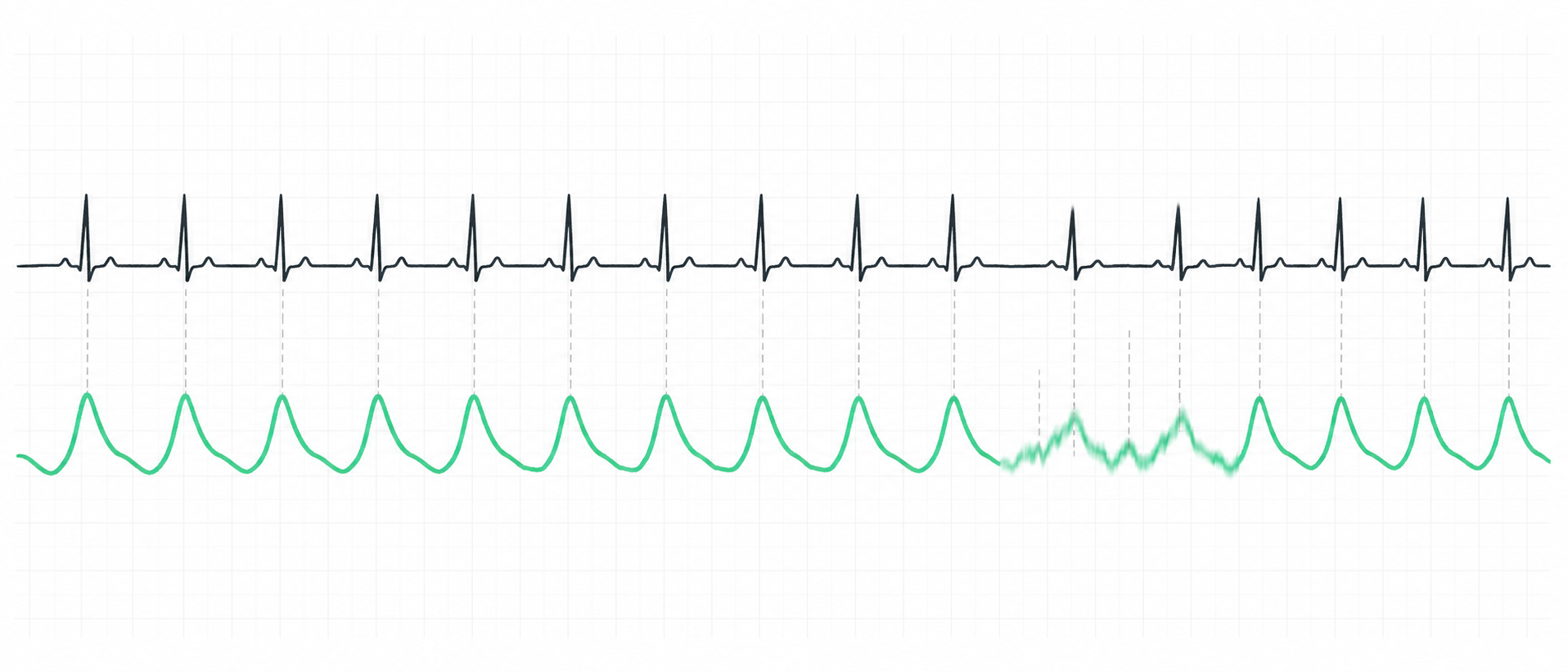
Wearable HRV can be useful, but it is not automatically the measurement an ECG would give. Most smartwatches and rings estimate beat-to-beat variability from an optical pulse signal. Evidence shows good agreement with ECG for some measures under controlled resting conditions, and clear limits under movement, across metrics and across devices. The soundest use is a consistent personal trend, not a universally interchangeable number.
Key points
- ECG and PPG measure different signals: ECG records the heart's electrical activity, while PPG estimates beat timing from pulse waves at the skin.
- PPG-derived pulse rate variability can agree well with ECG-derived HRV for selected metrics under controlled resting conditions — the agreement is conditional, not universal.
- Motion, sensor contact, peripheral perfusion, recording window, metric choice and proprietary processing all shape a wearable's HRV numbers.
- Two devices can legitimately report different HRV values without either being wrong; they may not be reporting the same metric from comparable windows.
- RMSSD and SDNN summarize different properties of a recording, and their numbers are not interchangeable.
- Your own trend, measured consistently with the same device and method, is usually more informative than comparing absolute values across devices.
- HRV is a physiological measurement, not a diagnosis; a single low or high reading establishes nothing by itself.
What is wearable HRV?
When a smartwatch or ring shows an HRV number, it is showing an estimate of heart rate variability — the natural variation in the time between consecutive heartbeats. The estimate is usually built from an optical pulse signal rather than from the heart's electrical activity, and that single fact is behind most of the confusion, most of the marketing and most of the honest questions about what the number means.
This page answers the method question that sits underneath the everyday ones. Why two devices disagree is a practical story told in why your HRV is different on every device; what Apple's two watch variants are is covered in Recovery HRV vs Overall HRV on Apple Watch; what to do about a low reading belongs to why is my Apple Watch HRV low; and keeping your own readings comparable is the job of how to measure HRV consistently. Here the question is: how closely can a sensor on the wrist or finger reproduce what a clinical ECG would measure — and what does the answer imply for how you read your numbers?
Three terms have to stay separate on this page, because collapsing them is where most overclaiming begins. An ECG-derived HRV value, a PPG-derived pulse rate variability value and a proprietary wearable score computed from HRV and other signals are related measurements — not one measurement [S3]. They may track each other closely, but the signal, the processing and the meaning differ at each step.
The short answer: wearable HRV can be useful, but its usefulness is conditional — on the metric, on the conditions and on what you compare it with.
How does wearable HRV work?
Two measurement chains start from two different signals.
The reference chain is electrical. An ECG records the heart's electrical activity, and the sharp R peak of each heartbeat gives a precise timing reference; the intervals between successive normal beats are what HRV is computed from [S1] [S4]. The wearable chain is optical. A photoplethysmography (PPG) sensor shines light into the skin and tracks the small changes in blood volume that each beat sends through the peripheral circulation; software finds the repeating pulse peaks and estimates the timing between them [S3]. The variability computed from those pulse intervals is usually called pulse rate variability (PRV).
In short: ECG → electrical peaks → beat-to-beat intervals → HRV. And: PPG → pulse peaks at the skin → pulse-to-pulse intervals → PRV.
Each heartbeat does ultimately produce a pulse wave, so the two chains are closely related. But the pulse has to travel to the measurement site, and what happens along the way — pulse transit time, vascular tone, peripheral circulation — together with motion artifacts, sensor contact, skin optical properties and the device's signal processing can all move a pulse-based value away from its electrical counterpart [S3]. A wrist or ring sensor is therefore not a smaller ECG electrode. It observes a related signal and estimates from it, and the quality of the estimate depends on the conditions.
This is also why the question "is this sensor accurate?" is incomplete. The evidence-based version asks: accurate for which metric, in which person, under which conditions, with which processing? The sections below take those pieces one at a time.
How is wearable HRV measured?
Every wearable HRV value is the end product of a chain of choices, and two numbers are comparable only to the extent that the choices match. Five questions decode any HRV number you see:
- What signal was measured? A clinical ECG, a chest strap that senses electrical activity, or an optical PPG sensor at the wrist or finger — the signal determines what the value is an estimate of [S1] [S4].
- Which metric was calculated? One device may report RMSSD — the root mean square of successive differences between heartbeats [S1]; another leans on SDNN — the standard deviation of the intervals between normal heartbeats [S1]. The two summarize different properties of the same recording — RMSSD isolates the changes between adjacent beats, SDNN the overall spread — and they lean differently on parasympathetic modulation, so their numbers are not interchangeable [S2]. Some apps go further and show a proprietary recovery or readiness score derived from HRV and other signals; a score is not a metric, and its computation is usually not published. The RMSSD and SDNN concept pages take each metric apart.
- When and how was it measured? A brief spot check, a controlled rest recording and an overnight window are different measurement regimes — and recording length even changes what a value means, because longer windows accumulate slower rhythms and larger SDNN-type values [S2].
- How good was the signal? Movement, loose fit and weak peripheral perfusion degrade an optical estimate first, and validation-grade studies filter such recordings out before computing anything [S4].
- Are you looking at a trend or reacting to one number? A single value is an observation; a sequence of values collected the same way is a signal [S5].
Apple's ecosystem is a live example of the metric question. Apple Health records HRV as SDNN [S6] — so the HRV values in Apple Health have always been SDNN-type, recorded automatically by Apple Watch. On recent models, Apple Watch Series 12 and Ultra 4 on watchOS 27 show two HRV variants — Recovery HRV and Overall HRV — and measure HRV as often as every five minutes [S7]; Apple has not stated how Recovery HRV is computed. Separately, iOS and watchOS 27 add an RMSSD data type to Apple Health [S8] — a platform change that lets apps write an RMSSD-type value to Apple Health, which matters whenever an Apple Watch number is compared with a ring that reports RMSSD.
A compact way to hold all of this:
| Situation | How to read it |
|---|---|
| One device, one metric, similar conditions each time | A sound setup for a personal trend |
| Two devices, two different metrics or windows | The numbers are not automatically comparable |
| A reading taken during movement | Expect the estimate to degrade; treat it with caution |
| One unusually low or high value | An observation, not a verdict |
| A persistent shift alongside concerning symptoms | A picture to discuss with a clinician |
The practical rule follows from the table: same device, same metric, similar conditions, repeated measurements — before comparing absolute numbers across devices. Where your numbers sit relative to population age bands is a separate question, answered by the HRV calculator and the normal HRV by age article rather than repeated here.
What affects wearable HRV?
- Movement and exercise. Motion distorts the optical signal, and exercise changes the physiology and the measurement environment at once; controlled-rest studies therefore look cleaner than free-living data [S4].
- Sensor fit and perfusion. A loose band or cold, poorly perfused skin weakens the pulse signal the algorithm depends on [S4].
- Recording window and time of day. A brief daytime sample and an overnight average describe different regimes; values across them are not interchangeable [S2] [S5].
- Metric and processing. RMSSD and SDNN answer different questions about the same recording [S2], and each manufacturer's filtering, interpolation and artifact handling shapes the final number [S3].
- Breathing and posture. Respiratory rate and depth during the window write themselves into the value [S5].
- Changing devices. Moving from one device to another can move the baseline too — a change of measurement regime rather than of physiology [S3].
What does the evidence show?
Established. The ECG is the reference method for beat-to-beat interval measurement [S1] [S4], and the signal chains are well understood: PPG estimates beat timing from peripheral pulse waves [S3], and PRV is related to — but not physiologically identical with — ECG-derived HRV [S3]. The properties of the metrics themselves are equally settled: RMSSD and SDNN summarize different aspects of a recording [S2], and recording length changes what a value means [S2].
Context-dependent. The newest evidence addresses the consumer question directly. A systematic review and meta-analysis (Xu et al., 2026) compared PPG-derived PRV with ECG-derived HRV in healthy or apparently healthy, non-clinical populations [S3]. Its qualitative synthesis covered 43 studies, but only 10 unique studies provided enough comparable data for quantitative pooling. Where the data could be pooled, the standardized errors for RMSSD and SDNN were relatively small, though sensitivity analyses supported the RMSSD findings more strongly than the SDNN estimates [S3]. The authors' own boundary matters more than the pooled numbers: the quantitative synthesis rested on few studies, drawn mostly from resting or controlled conditions, and the pooled estimates should not be generalized to sleep, exercise, stress or free-living settings, or read as evidence of interchangeability [S3].
A controlled validation study (Zuern et al., 2026) recorded 66 participants in sinus rhythm, with a clinical ECG and a wrist PPG sensor running simultaneously [S4]. Under controlled resting conditions, wrist-based PPG reproduced ECG-derived indices closely enough for the authors to support selected parameters for short-term assessment — while calling for further real-world validation [S4]. Agreement was metric-specific, with weaker agreement for short-term variability and entropy metrics than for interval-standard measures [S4], and recordings with poor signal quality — low perfusion, motion artifacts — were excluded before analysis [S4]. The same filtering is exactly what everyday use cannot rely on.
Apple's ecosystem facts belong here as device facts: Apple Health stores HRV as SDNN [S6], recent watch models expose two HRV variants [S7], and the platform now also accepts an RMSSD-type value [S8] — scoped statements about what is recorded, not about health.
Methodological guidance. Current guidelines state that the input signal, recording length, setting, breathing and analytical approach all affect rigor and reliability [S5], and that findings from wearable HRV — including in research — should be interpreted and contextualized within these limitations [S5]. The everyday extension is comparing like with like.
Unknown. How well these methods generalize across the variety of consumer devices and proprietary algorithms; how they perform during unrestricted daily movement and across overnight windows that devices define differently; how they behave in people with arrhythmias or specific conditions; and when a change a wearable detects becomes clinically meaningful. None of this is settled — which is a reason for measurement literacy, not for discarding the data.
What wearable HRV does not tell you
- It is not an ECG reading. A PPG-based value is an estimate from a related signal, and pooled agreement does not extend to every setting or count as interchangeability [S3].
- It is not one universal number. RMSSD, SDNN and proprietary scores describe different things; a value without its metric and window is incomplete information [S2] [S3].
- It is not a diagnosis or a stress verdict. a single low HRV reading does not by itself mean you are stressed or unwell [S1] [S5] — and the same caution bounds unusually high values.
- It is not vagal tone. The framing matters. Vagal tone cannot be measured directly; HRV measures such as RMSSD reflect vagally mediated changes in heart rate [S1] [S5].
- It is not a device ranking. Agreement depends on the metric, conditions, signal quality and processing [S3] [S4]; which device suits you is a question for product reviews, and this page deliberately names no "most accurate" tracker.
- A single value says little. Methodological guidance calls for contextualized interpretation [S5]; your own recent readings under comparable conditions are the more informative comparison.
In ONDA
ONDA sits on the consumer side of this evidence, and its documentation is plain about where each number comes from. The nightly baseline is built on the HRV values written into Apple Health — by Apple Watch or by any tracker whose app syncs heart data there — and those values are SDNN-type: Apple Health records HRV as SDNN [S6]. The live reading shown during a practice is a surrogate computed from the standard deviation of heart rate, not RMSSD or SDNN; the phone camera gives pulse, not HRV; and the coherence score available with Apple Watch is a proprietary feedback score, not a clinical HRV measurement. ONDA's use of the signal is biofeedback: the question is not only what the number is, but what happens to it while you practise. It compares each night with your own recent corridor and does not diagnose anything. See what ONDA measures.
Educational information, not a diagnosis or medical treatment.
Evidence at a glance
| Claim | Evidence | Limitation |
|---|---|---|
| The reference method for HRV interval measurement is the ECG, which times the heart's electrical R peaks. [S1][S4] | Established | A methodological convention for interval measurement; it does not mean everyday tracking requires a clinical ECG. |
| Wearables estimate beat-to-beat variability from the peripheral pulse signal: PPG infers the timing of pulses at the skin from changes in blood volume, rather than recording the heart's electrical activity. [S3] | Established | Describes the signal chain shared by wrist and ring sensors; it says nothing about the accuracy of any product. |
| ECG-derived HRV and PPG-derived PRV are related but not physiologically identical: pulse transit time, vascular tone, peripheral circulation, motion artifacts, sensor contact, skin optical properties and processing algorithms can all move a pulse-based value away from its electrical counterpart. [S3] | Established | A physiological and methodological distinction; the size of the gap depends on the person, the measurement site and the conditions. |
| A systematic review and meta-analysis compared PPG-derived PRV with ECG-derived HRV in healthy or apparently healthy non-clinical populations, focusing on RMSSD and SDNN (facts study.xu2026.studiesQualitative and study.xu2026.studiesPooled). [S3] | Established | Defines the scope of the pooled evidence: non-clinical populations; clinical populations sit outside it. |
| Where the data could be pooled, the meta-analysis found relatively small standardized errors for both RMSSD and SDNN. [S3] | Context-dependent | A statistical agreement measure, not an accuracy percentage for any product; the pooled data came mostly from resting or controlled conditions. |
| The robustness of the pooled findings differed by metric: sensitivity analyses supported the RMSSD findings, while the SDNN estimates were directionally stable but less statistically robust. [S3] | Context-dependent | About pooled estimates, not individual devices; few studies contributed to each metric's pool. |
| Pooled agreement estimates rest on a small quantitative base drawn mostly from resting or controlled conditions, and should not be generalized to sleep, exercise, stress or free-living settings, or read as evidence of interchangeability. [S3] | Context-dependent | A boundary drawn by the review's authors about pooled estimates; it does not rule out good performance by a specific device in a specific setting. |
| Under controlled resting conditions, wrist-based PPG reproduced ECG-derived HRV indices closely enough for the authors to support selected parameters for short-term assessment (fact study.zuern2026.participants). [S4] | Context-dependent | One wrist-worn device in resting adults in sinus rhythm; three of the twelve co-authors are affiliated with the device manufacturer (the paper declares no competing interests); the authors themselves call for further real-world validation. |
| Agreement with ECG is metric-specific: in the controlled validation, short-term variability and entropy metrics agreed less well than interval-standard measures. [S4] | Context-dependent | Single study, single device; which metrics agree best is device- and condition-specific. |
| Signal quality gates the measurement: in the controlled validation, recording pairs with poor ECG or PPG quality — low perfusion or motion artifacts — were excluded from analysis. [S4] | Context-dependent | Validation-grade filtering; consumer devices apply their own, mostly undocumented quality gates during everyday use. |
| The input signal, the length of the recording, the setting, breathing and the analytical approach all affect the rigor, reliability and interpretation of an HRV measurement. [S5] | Guideline / expert consensus | Expert consensus about methods; the size of each effect is condition- and person-specific. |
| Findings from wearable HRV — including in research — should be interpreted and contextualized within the method's limitations. [S5] | Guideline / expert consensus | Interpretation guidance, not outcome data; the everyday extension is comparing like with like — same device, same metric, similar conditions. |
| Numerous experimental, demographic and environmental factors influence HRV assessment, interpretation and reliability, which is one reason a cross-device difference is not automatically an error. [S5] | Guideline / expert consensus | Expert consensus about the many moving parts of a measurement; the specific mix of causes differs for every pair of devices and conditions. |
| RMSSD and SDNN summarize different properties of a recording — beat-to-beat changes versus overall spread — and RMSSD leans more on parasympathetic modulation than SDNN (facts hrv.rmssd.definition and hrv.sdnn.definition). [S2] | Established | A relative statement between the two metrics; recording length adds a further reason their values diverge. |
| Recording length changes what a value means: longer recordings accumulate slower rhythms and larger SDNN-type values, so values from different windows are not comparable. [S2] | Established | A property of the metric; it applies to comparisons between apps, studies and nightly routines alike. |
| Apple Health records HRV as SDNN, computed as the standard deviation of the inter-beat intervals between normal heartbeats and recorded automatically by Apple Watch (fact applewatch.hrv.healthkit). [S6] | Established | Official documentation; describes what the system records, not what the values mean for health; scoped to Apple's ecosystem. |
| Recent Apple Watch models on watchOS show two HRV variants — Recovery HRV and Overall HRV — and measure HRV as often as every five minutes (fact applewatch.hrv.variants2026). [S7] | Context-dependent | Manufacturer announcement scoped to specific hardware and OS versions; Apple has not stated how Recovery HRV is computed. |
| iOS and watchOS add an RMSSD data type to Apple Health (fact applewatch.hrv.rmssdType). [S8] | Context-dependent | Official documentation; availability is scoped to specific OS versions, and what apps record via this type depends on each app. |
| HRV is not a direct readout of vagal tone or of sympathetic–parasympathetic balance (fact claim.vagalTone). [S1][S5] | Established | Methodological caution from the standards and guideline literature; HRV reflects vagally mediated changes in heart rate, not the nerve's activity itself. |
| A single low or high value does not by itself establish stress, illness or health status (fact claim.hrvNotStress). [S1][S5] | Established | About interpretation, not about measurement accuracy; persistent changes with concerning symptoms belong with a clinician. |
Sources
- [S1] Task Force of the ESC and NASPE (1996). Heart rate variability: standards of measurement, physiological interpretation and clinical use. Circulation. DOI 10.1161/01.CIR.93.5.1043
- [S2] Shaffer & Ginsberg (2017). An overview of heart rate variability metrics and norms. Frontiers in Public Health. DOI 10.3389/fpubh.2017.00258
- [S3] Xu et al. (2026). Accuracy of photoplethysmography-derived pulse rate variability compared with electrocardiography-derived heart rate variability: a systematic review and meta-analysis. Sensors. DOI 10.3390/s26165192 · PMID 42655500
- [S4] Zuern et al. (2026). Validation of photoplethysmography-derived short-term heart rate variability using a wearable device. Scientific Reports. DOI 10.1038/s41598-026-52700-7 · PMID 42151374
- [S5] Carter et al. (2026). Guidelines for rigor and reproducibility of heart rate variability within human cardiovascular research. Am J Physiol Heart Circ Physiol. DOI 10.1152/ajpheart.00041.2026 · PMID 42495990
- [S6] Apple Inc. — HealthKit documentation. heartRateVariabilitySDNN. · official documentation
- [S7] Apple Newsroom (2026). Apple advances health and fitness capabilities using Apple Intelligence. · official documentation
- [S8] Apple Inc. — HealthKit documentation. heartRateVariabilityRMSSD (iOS/watchOS 27). · official documentation
Related
- ScienceRMSSD — What This HRV Metric Reflects, and What It Doesn't
- ScienceSDNN — What This HRV Metric Measures, and What It Doesn't
- ScienceHeart Rate Variability: What It Is, What It Reflects, What It Isn't
- ScienceHRV Baseline: Why Your Own Normal Matters More Than Any Norm
- GlossaryHeart Rate Variability
- ArticleWhy Your HRV Is Different on Every Device (and Which to Trust)
- ArticleApple Watch Now Shows Two HRV Numbers: Recovery HRV vs Overall HRV
- ArticleHow to Measure HRV So the Number Actually Means Something
- ToolHRV Calculator by Age
How ONDA Science pages are made: every number comes from one checked list of facts, every claim is mapped to its sources and graded by strength of evidence, and sources need a DOI or PMID (manufacturer documentation is used only for device facts).