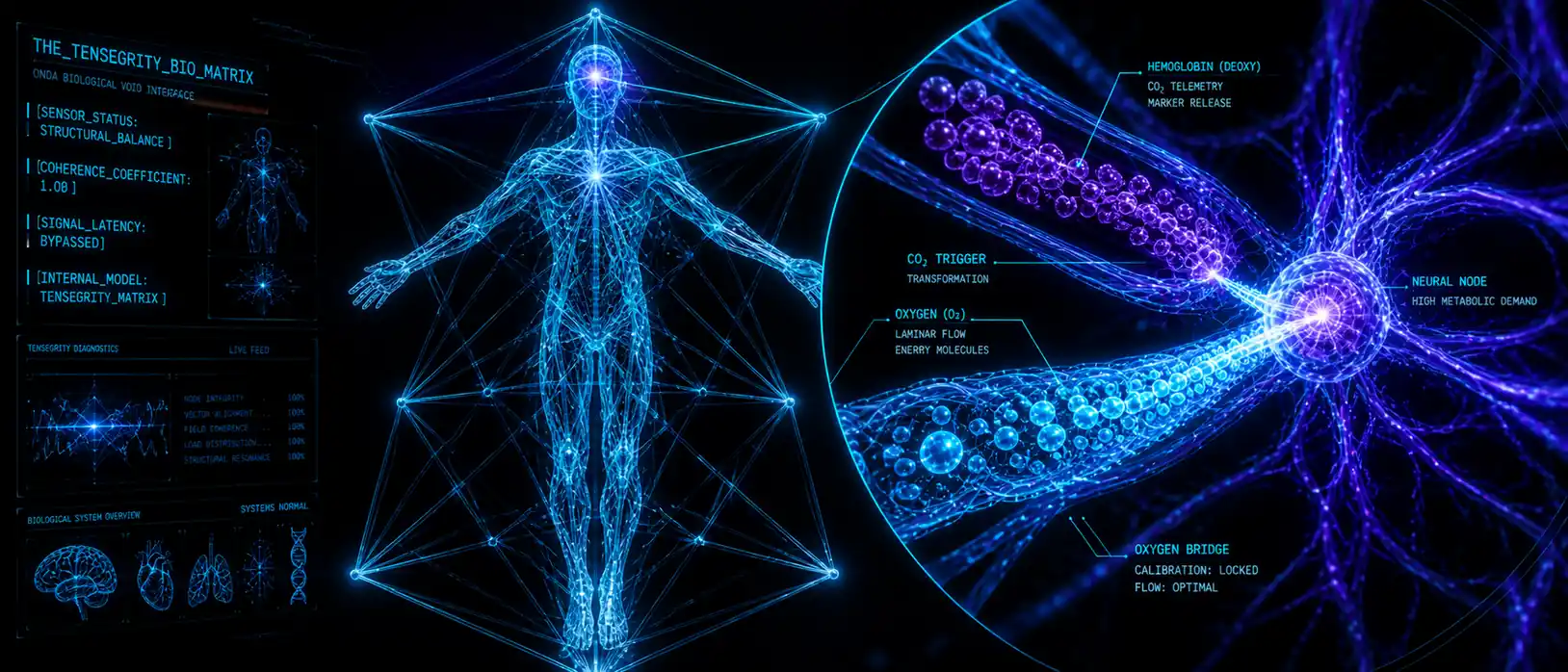
[ STATUS: PROTOTYPE_STAGED ]
"Vascular Tensegrity and Microvascular Mechanics"
In classical engineering, stability is achieved through rigid, heavy elements compressing against one another (e.g., masonry). Tensegrity (tensional integrity) operates on a completely different framework: the rigid elements do not touch but instead "float" within a continuous network of tension.
Section 1: The Logic — Structural Integrity
Within the human body, this principle operates at the core of the microcirculatory system.
Rigid Elements
Vascular walls, cellular membranes, and skeletal structures.
Tension Network
Myofascial sheaths, intracellular fluid pressure, and elastin fibers.
When this network is in optimal balance, internal and external forces distribute evenly across the matrix. This requires minimal energy expenditure to maintain structural form and facilitate the continuous flow of fluids.
Section 2: The Architecture — Hydraulics and Tension
Within the ONDA architecture, the vascular system is evaluated as a transport network rather than a standard pipeline.
Compression and Tension
Internal fluid pressure (blood pressure) pushes the vessel walls outward (compression), while the surrounding tissues (fascia and smooth muscle) supply the counterbalancing external tension.
Low-Impedance Delivery
This balance allows oxygen and nutrients to be delivered to the cortex with minimal resistance.
Mechanical Damping
The tensegrity matrix absorbs biochemical and physical shocks, protecting fragile microvessels from microtrauma.
Section 3: How does muscle tension from stress or sitting affect blood flow?
Prolonged sedentary work or psychological stress causes the neck, shoulder, and masticatory (jaw) muscles to lock up. This creates an imbalance in structural tension and compresses the vascular pathways.
Impedance Spikes: The microvasculature is constricted, reducing cerebral blood flow. Slowed flow also raises blood hydraulic viscosity, compounding the resistance.
Cerebral Hypoxia: The cortex becomes starved of oxygen and acetylcholine, causing the Acetylcholine Lens to lose its focal definition.
: Releasing myofascial tension returns the system to a state of low impedance, allowing the core (VTA and Acetylcholine Lens) to operate at maximum efficiency without wasting baseline energy.[ ONDA_PROTOCOL ]
[ HARDWARE_VALIDATION ]EXAMPLE_DEVICE: HRV monitor, capillary refill, subjective head clarityMETRIC: cerebral perfusion index, neck/jaw tension, focus persistenceSTATUS: STRUCTURAL_INTEGRITYIllustration — not a measurement
IMPACT_LOG: Stable Structural Integrity
Maintaining vascular tensegrity delivers the following.
Unrestricted Nutrient Flow: Essential metabolites are delivered to the active neural nodes without latency.
System Voltage Optimization: Physical tension, which draws attention and energy away from the prefrontal cortex, is eased — freeing up resources for focused work.
Resilience Under Load: The physical body acts as a coherent, resilient spring rather than a set of isolated, strained levers.
ONDA_STATEMENT: "Your vascular network is a living, structural matrix. Release the tension, restore the equilibrium, and your signal will reach the prefrontal cortex with zero impedance."