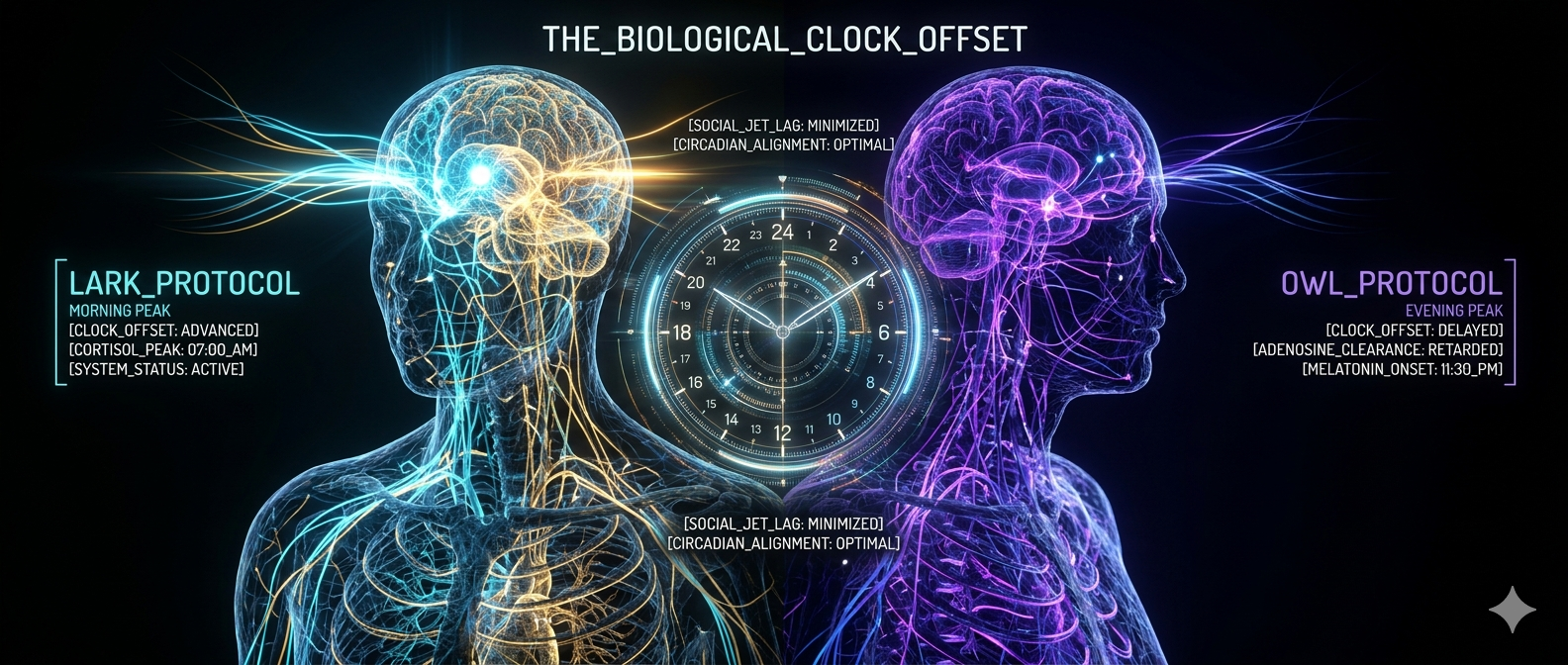
[ IDENTIFYING THE CLOCK TYPE ]
"Your chronotype is the natural timing of your body clock — whether you’re wired to peak early (a ‘lark’), late (an ‘owl’), or somewhere between. It’s not laziness or discipline; it’s biology. In the ONDA Biocomputer model, it’s your default clock-offset, and most of the friction people feel with mornings or late nights comes from running their life on a schedule that fights it."
Section 1: How do you find out if you're a lark or an owl?
Researchers measure chronotype with tools like the Morningness–Eveningness Questionnaire (Horne & Östberg 1976) and the Munich ChronoType Questionnaire, which uses your sleep timing on free days — when no alarm forces you — as the truest read (Roenneberg 2003). Most people are intermediate; true extreme larks and owls sit at the tails.
The quickest self-check: on a holiday with no obligations, when do you naturally fall asleep and wake? That’s your clock talking. The Chronotype Quiz turns six questions into your type plus a timing protocol.
Section 2: Is chronotype genetic, and does it change with age?
Chronotype is substantially heritable and changes predictably across life: children skew early, adolescents shift dramatically late (peaking around age 20 — biology, not attitude), then drift earlier again with age (Adan 2012; Roenneberg 2003). You can nudge it a little with light and routine, but you can’t simply will an owl into a lark. Working with your type beats fighting it.
Section 3: Social jet lag — the hidden cost
The Hack: Keep your weekday and free-day sleep times as close as you can.
The Science: When your social schedule (early work, school) clashes with a late clock, you build up "social jet lag" — sleeping short on workdays and long on free days. Late chronotypes accumulate real sleep debt this way (Roenneberg 2003), and it’s linked to worse mood, metabolism and health. Shrinking that gap is one of the highest-value things a night owl can do.
The Hack: If you must shift earlier, get bright light first thing and keep evenings dim.
The Logic: Morning light advances the clock; evening light delays it. Used consistently, light is the one lever that actually moves your chronotype (within limits).
[ HARDWARE_VALIDATION ]EXAMPLE_DEVICE: Sleep tracker (weekday vs free-day midpoint)METRIC: Smaller weekday/weekend sleep-timing gap; easier wakeupsSTATUS: ALIGNED_WITH_CLOCKIllustration — not a measurement
Educational only, not medical advice. Persistent inability to sleep or wake at socially required times (beyond normal owl tendencies) can indicate a circadian rhythm sleep disorder worth discussing with a clinician.