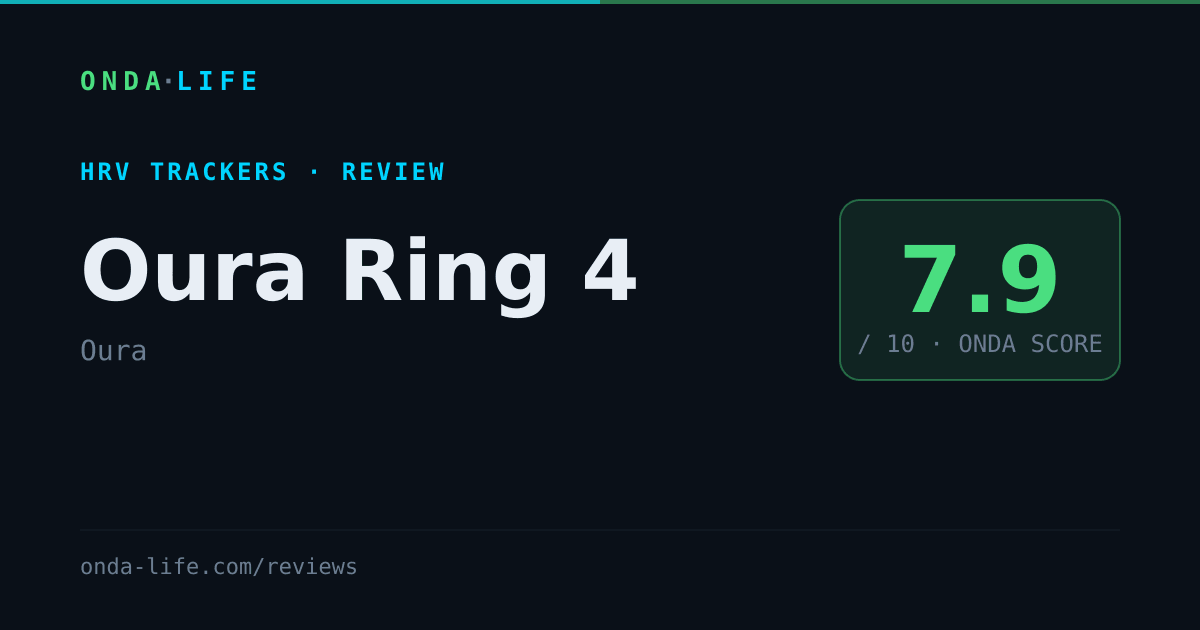
Our verdict in short
The Oura Ring 4 is still one of the best rings for overnight HRV and sleep tracking, and it gets the same new software as the newer Ring 5. It costs from $349 — $50 less than the Ring 5 — and is often discounted. The catch: full data needs a $5.99 per month membership, so the real cost is higher than the sticker price.
Ring 5 update: the Oura Ring 5 (June 2026) is now the flagship — slimmer, with redesigned sensors, from $399. Oura still sells the Ring 4 on its own store from $349. See Oura Ring 5 vs Ring 4 and our Oura Ring 5 review.
What does the Oura Ring 4 measure — and how well?
The ring uses optical sensors (PPG) on the finger to read heart rate, HRV (RMSSD), skin temperature, blood oxygen and movement. From these it builds sleep stages, a Readiness score and activity data.
HRV. The night is where Oura is strongest. In a study of 49 adults, nightly Oura HRV agreed closely with a medical ECG (r² = 0.98, mean difference about 1 ms; Kinnunen et al., 2020). That study used an earlier ring generation, but the finger-PPG method is the same. During the day, movement disturbs the signal, so treat daytime HRV as a rough estimate.
Sleep. A 2024 study compared the Oura sleep algorithm (on the Gen 3 ring) with home polysomnography in 96 people over 421,045 epochs. Accuracy per sleep stage ranged from about 76% (light sleep) to 91% (REM) (Svensson et al., 2024); the study was funded by Oura. That is among the stronger published results for a consumer device — but it is still not a clinical sleep test (why wearable sleep stages are estimates).
To make sense of your numbers, compare them with normal HRV by age — and, more importantly, with your own baseline over weeks.
How much does the Oura Ring 4 really cost?
The ring costs from $349 (Silver and Black; premium finishes $399–$499). The membership is $5.99 per month or $69.99 per year, with the first month free. Without it, the app shows only basic data. Over two years, a base Ring 4 with yearly membership costs about $490.
| Ring | Price | Subscription | Best for | |---|---|---|---| | Oura Ring 4 | from $349 | $5.99/month | overnight HRV + sleep, lower Oura price | | Oura Ring 5 | from $399 | $5.99/month | latest Oura hardware | | Ultrahuman Ring Pro | $479 | none | no subscription, long battery | | RingConn Gen 2 | $299 | none | lowest total cost |
Is the Oura Ring 4 still worth buying after the Ring 5?
Yes, for most people. Both rings use the same app and the same new features. The Ring 5 is slimmer and has new sensors, but there is no published evidence yet that it measures HRV or sleep better. If you want to save $50 or more, the Ring 4 is the smarter buy. If you want the newest, smallest ring, choose the Ring 5.
What are the downsides of the Oura Ring 4?
Two things keep it from a higher score. First, daytime HRV: away from rest, motion disturbs the optical signal. Second, the business model: the ring is only half the purchase, and raw beat-to-beat data is never fully exposed, even with the membership. There is also no display.
Who should buy the Oura Ring 4 — and who should not?
Buy it if you want overnight HRV (with an independent ECG check: overnight recordings from 13 people, Dial 2025) and sleep trends in a small ring, and the membership is an acceptable cost.
Skip it if you want to own your device outright — the Ultrahuman Ring Pro and RingConn Gen 2 have no subscription (see Oura Ring 4 vs RingConn Gen 2). If you train hard and care about daytime strain, look at Oura Ring 4 vs Whoop 5.0 or Oura Ring 4 vs Apple Watch Series 11.
For the full field, see the best HRV trackers of 2026.
Background reading
The science behind why HRV is the signal worth tracking — and how the body produces it.
- Normal HRV by age — typical HRV ranges by age, and why your own trend matters more
- HRV as fault-tolerant buffer — why a wide HRV envelope is what you are actually training for
- The baroreflex and the 0.1 Hz shift — the resonant-frequency breathing signature in your HRV trace
- Does HRV predict reaction time and focus? — what resting HRV does and does not say about attention and self-control