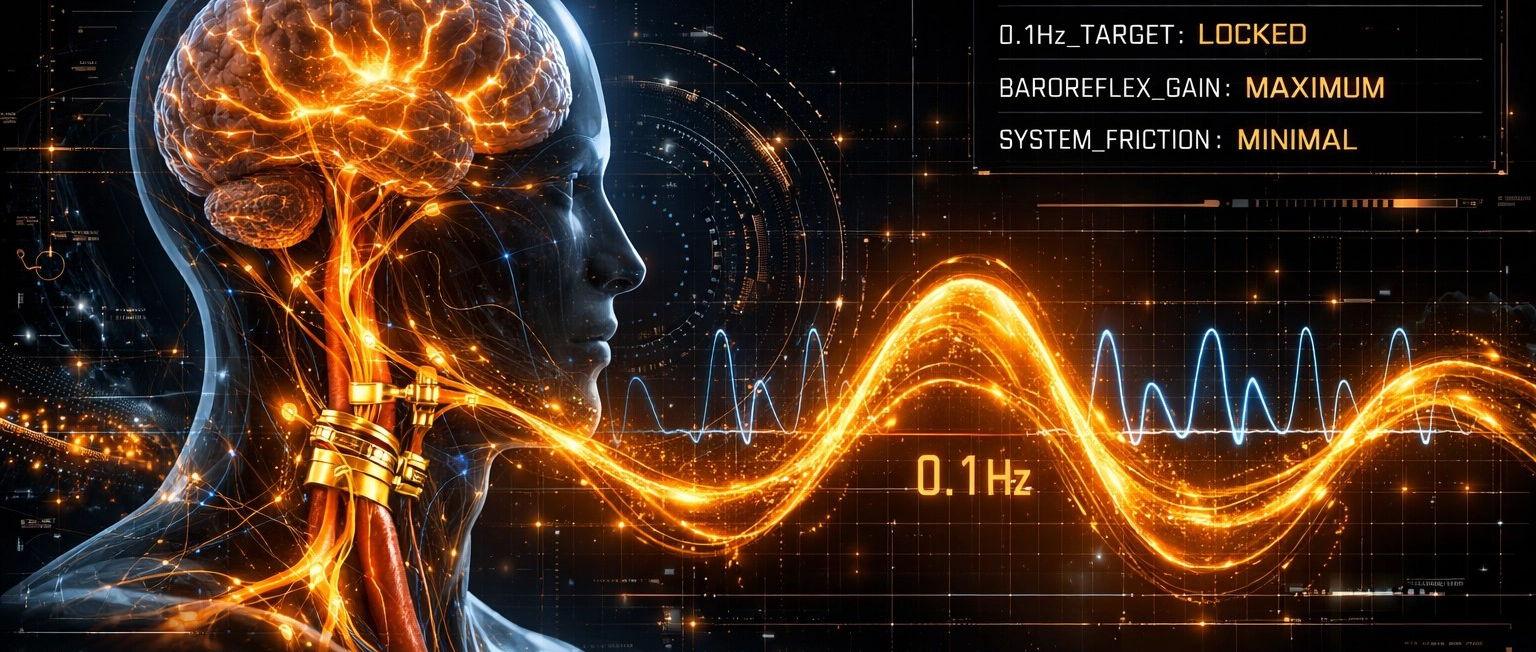
[ THE BIOLOGICAL THERMOSTAT ]
"Think of the baroreflex as the smart thermostat for your cardiovascular system. Its sole objective is to maintain blood pressure within a precise operational range.
Pressure rises → Baroreceptors send a signal to the brainstem. The brain commands the heart to slow down via the Vagus Nerve. Pressure drops → The cycle repeats. Normally, this process runs in the background — often out of sync with your breathing.
But when you breathe at exactly 0.1 Hz, you create Resonance."
Why does breathing at 6 breaths per minute affect blood pressure?
Breathing at around 0.1 Hz — about 5.5–6 breaths per minute — causes your respiratory rhythm to phase-lock with the natural oscillatory frequency of your blood pressure: the Mayer Waves.
The Alignment: Your inhale assists the pressure rise. Your exhale assists the pressure drop. Both happen in perfect tandem with baroreflex automation — for the first time, the two systems are working with each other instead of fighting in parallel.
The Result: This creates the maximum possible amplitude of HRV. The system stops "fighting" itself and enters Peak Operational Efficiency. HRV doesn't just increase — it surges, because the baroreflex oscillation is now fully expressed rather than partially cancelled by off-phase respiration.
What are the benefits of 0.1 Hz resonance breathing?
The three proposed benefits are blood-pressure leveling, a calmer parasympathetic state, and brain-heart coherence.
Benefit 1 — A stronger baroreflex response during the practice
Protocol: 10–20 minutes of 0.1 Hz breathing per session, daily for 4 weeks.
Mechanism: During a slow-breathing session, measured baroreflex sensitivity rises — the reflex responds more strongly while you breathe this way. This is a short-term effect. In one randomised study of healthy adults, a course of HRV biofeedback also raised resting baroreflex sensitivity across sessions; whether this lasts, and what it means for health, has not been established.
Blood pressure: some studies of consistent slow-breathing and HRV-biofeedback training report modest blood-pressure reductions, but results are inconsistent and it is not a substitute for medical treatment (evidence).
Benefit 2 — A calmer state during the practice
Protocol: 5 minutes of 0.1 Hz breathing immediately after acute stress — meeting, conflict, physical load.
Mechanism: When pressure rises, the baroreflex slows the heart through the vagus nerve. Slow 0.1 Hz breathing engages this loop strongly, and many people use it to nudge themselves toward Rest & Digest (a useful image, not a switch with a timer). Many people feel calmer within minutes; the effect varies from person to person.
Benefit 3 — A steady rhythm for focused work (a model, not a measurement)
Protocol: 15–20 minutes at 0.1 Hz for deep cognitive work, creative sessions, or pre-decision clarity.
The model: The same baroreceptors that steady blood pressure also give the brain a beat-by-beat picture of the heart. Some researchers propose that a smooth, regular heart rhythm feeds back on how the brain handles stress — an idea still being tested, not an established effect (heart–brain interaction). Treat the session as a calm, steady start to focused work, not as a brain upgrade.
ONDA Calibration Parameters
Target Frequency: around 0.1 Hz — about 5.5–6 breaths per minute.
Duty Cycle (Standard): 5.0s inhale / 5.0s exhale. Equal ratio. No breath holds — holds break the Mayer Wave synchronization.
Duty Cycle (Parasympathetic Bias): 4.0s inhale / 6.0s exhale. Extended exhale is commonly used when the goal is winding down or falling asleep; whether it adds anything beyond slowing the breath is still debated.
Suggested duration: about 10 minutes per session.
Biofeedback monitoring (optional but recommended): A real-time HRV display showing a low-frequency (LF) peak suggests you have reached resonance. Low-frequency HRV reflects baroreflex modulation, so the LF peak grows when your breathing is in step with the loop.
Note on individual variation: 0.1 Hz is the population average, not a universal constant. Some individuals resonate at 5.5 or 6.5 breaths per minute. If 6 breaths/min feels forced or doesn't produce the characteristic calm, perform a full Resonance Scan to find your exact frequency.
Impact Log: System in Coherence
Cardiovascular: Baroreflex sensitivity (BRS) rises during slow breathing. In patients with heart disease, reduced baroreflex sensitivity is linked to worse outcomes.
Autonomic: Sympathetic/Parasympathetic oscillation becomes coordinated instead of competitive. Sustained over weeks, this widened oscillation is what expands the fault-tolerant HRV buffer — the resilience headroom that absorbs stress without cascade failure.
Subjective: Many people feel calmer and steadier during and after the session; the effect varies from person to person.
"0.1 Hz is not just a rhythm; it is the frequency where your biology speaks the language of physics. It is the point where you stop wasting energy on internal friction."[ ONDA_STATEMENT ]
Recommended tools
Catching the 0.1 Hz shift cleanly requires an HRV device with enough sampling fidelity. An ECG chest strap is closest to lab ECG (at rest, in young healthy adults); the wearables are the lifestyle option.
- •Polar H10 — ECG chest strap that resolves resonant-frequency breathing cleanly
- •Oura Ring 4 — overnight HRV trending
- •Whoop 5.0 — continuous HRV with recovery framing