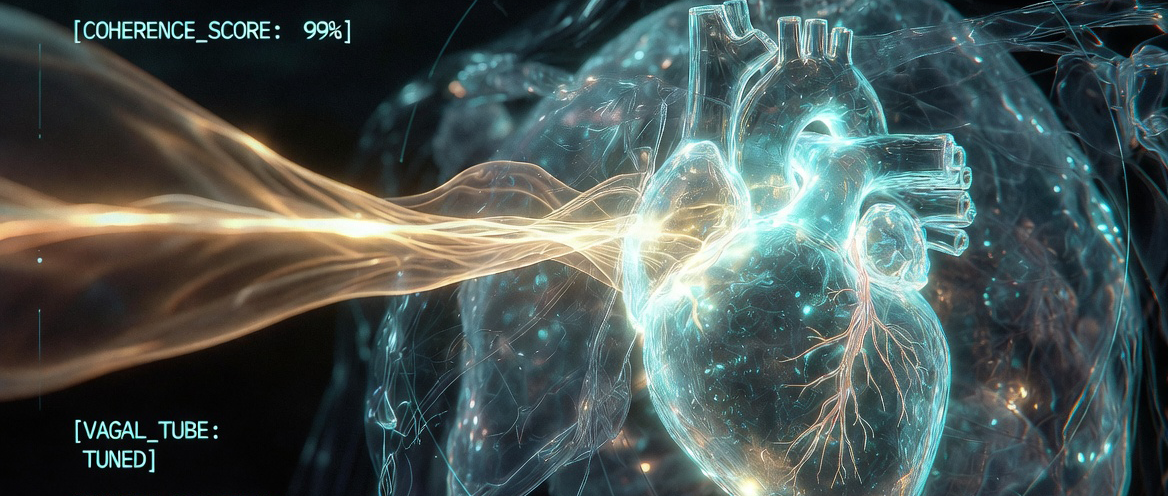
[ THE PHYSICS OF FLOW ]
"In physics, resonance occurs when an external frequency matches the natural frequency of a system, causing a dramatic increase in amplitude. Your body is not just a collection of organs — it is a complex biological oscillator.
Every individual has a unique Resonant Frequency — a specific breathing rhythm at which breathing, heart rate and blood pressure oscillations fall into step. In the ONDA framework, we call this System Coherence — our name for the state, not a clinical term. When you breathe at this frequency, the baroreflex amplifies the breath-linked swings in heart rate, and your HRV rises toward its personal peak."
The Diagnostics: Scanning for the Peak
Instead of a "one size fits all" 6-second inhale rule, HRV-biofeedback research uses a Resonance Scan — a systematic sweep you run yourself with a breathing timer and an HRV monitor to find the frequency where your biological oscillator reaches maximum amplitude.
Step 1 — Frequency Sweep: Test several breathing patterns in sequence: 5.0, 5.5, 6.0, and 6.5 breaths per minute. Each pattern is held for 3–4 minutes at rest, with HRV recorded throughout.
Step 2 — Amplitude Analysis: At each tested frequency, identify the spectral power of the LF (Low Frequency) band in your HRV. The target frequency is the one where the LF peak reaches its maximum. This is your baroreflex resonance point — the exact rhythm at which your heart and blood pressure regulatory system lock into phase.
Step 3 — Lock-In: Once identified, this frequency becomes your personal calibration protocol. It does not change significantly over time. Most people find their resonance at about 4.5–7 breaths per minute — typically about 5.5–6 (around 0.1 Hz), but individual variation is real and significant.
The Protocol: Tuning the Instrument
Three mechanisms activated by resonant frequency breathing:
Mechanism 1: The 0.1 Hz Shift
Action: Breathe at your identified resonant frequency for a minimum of 5 minutes. Use 5.5 seconds in, 5.5 seconds out (about 5.5 breaths per minute) as a starting point if your frequency has not been scanned yet.
Logic: Most people resonate near 0.1 Hz. Breathing at this frequency engages the baroreflex — your body's built-in blood-pressure regulator. At resonance, the breath-driven rise and fall of heart rate (respiratory sinus arrhythmia) and the baroreflex response fall into step, producing a high-amplitude oscillation that pushes HRV toward its personal peak. Baroreceptor signals reach the brainstem with every beat; whether resonance breathing also shifts prefrontal activity or amygdala reactivity is a hypothesis, supported so far only by small correlational studies.
Mechanism 2: Vagal Capture
Action: Maintain the resonant breathing rhythm for 10+ consecutive minutes without interruption. Avoid speaking, checking devices, or breaking the rhythm.
Logic: At resonance, the breathing rhythm engages vagally mediated control of the heart. In ONDA's language, the Vagus Nerve is the channel that carries a "safety" signal toward the heart, gut, lungs, and other systems: the environment is calm, recovery can be prioritised — an image, not a measurement. Studies of slow resonant breathing typically show vagally mediated HRV rising within a few minutes, though the exact timing varies from person to person. Vagal tone cannot be measured directly; HRV measures such as RMSSD reflect vagally mediated changes in heart rate.
Mechanism 3: Instant Reset
Action: Use 5-minute resonance sessions as a cognitive reset between high-load tasks — between meetings, before creative work, before sleep-onset.
Logic: In ONDA's language, five minutes of resonance breathing works like a system reboot between load cycles — a metaphor, not a measured effect. Many people feel calmer and clearer afterwards. The evidence is more modest than the image: claims that resonance breathing drives the brain into a specific Alpha/Theta state are not established, cortisol findings for breathing and meditation practices are mixed and depend on the context, and links between HRV and working memory or other thinking skills are small and correlational.
What are the benefits of resonant frequency breathing?
Breath–Heart Coordination: At resonance, breathing, heart rate and blood pressure oscillate together at one slow rhythm, with the parasympathetic (vagal) brake on the heart doing most of the visible work and the sympathetic branch still active in the background. The smooth, regular heart-rhythm wave this produces is what researchers call coherence: a measurable heart-rhythm pattern, not a definition of a healthy nervous system.
Calm Focus (an ONDA image): Many people describe a state of "relaxed alertness" during and after a session and use it before creative work or hard decisions. In ONDA's language, this is a quieter line with less noise — a subjective experience, not a proven brain state, and not shown to equal what long-term meditators train for.
Energy Efficiency (an ONDA model): In ONDA's model, resonance is the system running with less internal friction — breath and heartbeat working together instead of against each other. This is an image of the experience, not a measured drop in the energy your organs use.
"You aren't broken; you are just out of tune. Resonance is the key to returning your biology to its original, effortless frequency."[ ONDA_STATEMENT ]
Recommended tools
Resonant-frequency work needs a device that captures the breathing-driven HRV envelope without smoothing it away.
- •Polar H10 — ECG chest strap for app-agnostic resonance training
- •Oura Ring 4 — overnight HRV (RMSSD) trends
- •Whoop 5.0 — daily recovery on continuous HRV