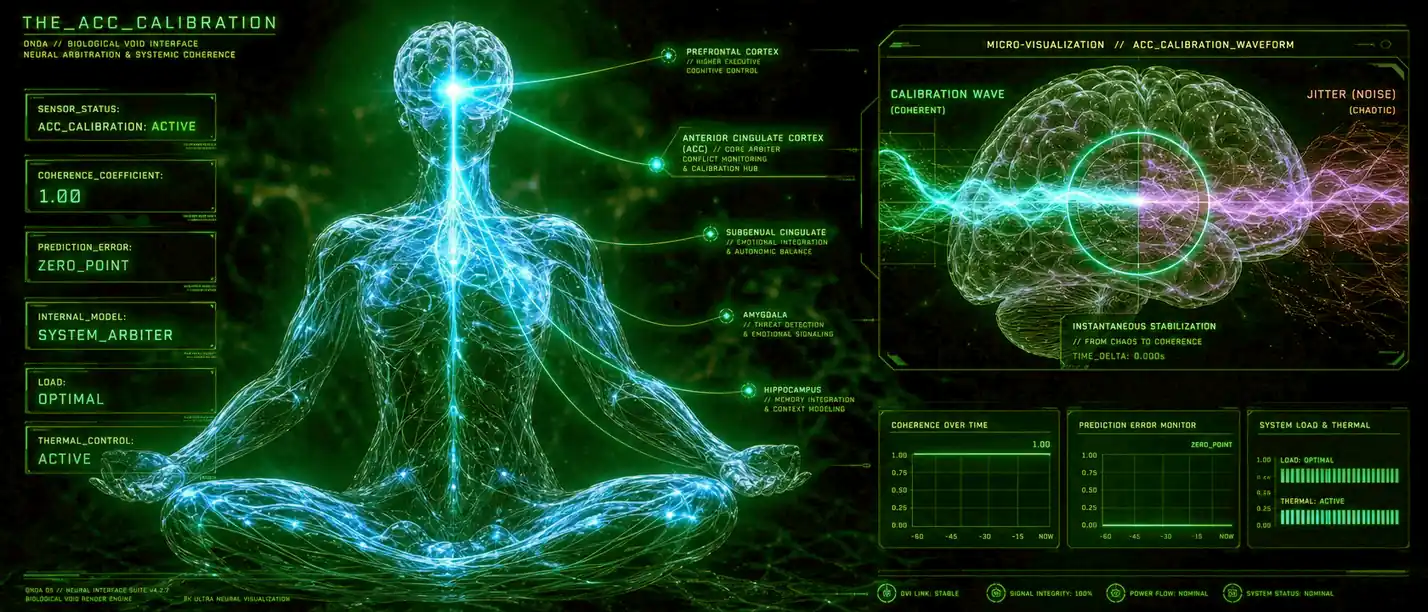
[ STATUS: ACTIVE ]
"ACC Calibration Protocol: Cognitive Control Training"
In the ONDA architecture, the dorsal component of the ACC handles action selection and cognitive control. When running complex operations for extended periods in a multitasking environment, this node overheats, resulting in performance degradation.
Section 1: Why does constant task-switching wear out your focus?
Frequent task-switching places a heavy computational load on the ACC, and three structural levers define the calibration.
Thermal Control
Frequent task-switching places a heavy computational load on the ACC.
Noise Suppression
Limiting the input data stream reduces the number of false triggers in the conflict monitoring system.
Objective
Reduce the load on the node and return cognitive flexibility to a FOCUS_LOCKED state.
Section 2: How do you train cognitive control day to day?
This protocol pairs single-task execution with a mindfulness gate to switch the system into a [ FOCUS_LOCKED ] state.
[CALIBRATE] ---> Monotasking Check (Halt Conflict) ---> Mindfulness Alignment (Quiet vACC)
Stage A: Monotasking Check
This step cuts down excess task-switching and the kind of conflicts that strain the dACC.
The Hack: Select a single task (Core Vector). Set a timer for 50 minutes of deep work. Isolate all external distractors — disable notifications and close unnecessary tabs.
System Effect: The ACC node transitions into a steady task-execution state, halting conflict processing.
Stage B: Mindfulness Alignment
Reduces the sensitivity of the ACC to background system noise and minor distractors.
The Hack: Whenever the urge to switch tasks or check notifications appears during work, do not react immediately. Pause for 15 to 30 seconds. Acknowledge the impulse, but do not act on it. Return focus to the core task.
System Effect: Lowers the emotional reaction of the vACC to trigger events, conserving system resources.
[ HARDWARE_VALIDATION ]EXAMPLE_DEVICE: focus-block timer / impulse log / HRV monitorMETRIC: uninterrupted focus duration, impulse-act ratio, post-block claritySTATUS: FOCUS_LOCKEDIllustration — not a measurement
Section 3: What changes when you train cognitive control?
Regular execution of the ACC calibration protocol brings longer uninterrupted focus, less mental fatigue and more resilience to distraction.
Focus Retention: Increased duration of uninterrupted focus on the primary task.
Mental Fatigue Reduction: Elimination of system strain when working with complex operations.
Distraction Resilience: Maintenance of structural stability when exposed to background noise.
ONDA_STATEMENT: "Cool down your system arbiter. Monotasking and mindfulness alignment are the most effective ways to clear the error buffer and restore focus to its maximum potential."
Recommended tools
Neurofeedback aims at this kind of attention control, though trials in healthy adults are few and small. Hardware that gives you live feedback:
- •Muse S Athena — EEG + fNIRS with the app’s own session scores
- •Neurosity Crown — developer-grade EEG with raw access
- •Myndlift — clinical-supervised neurofeedback at home