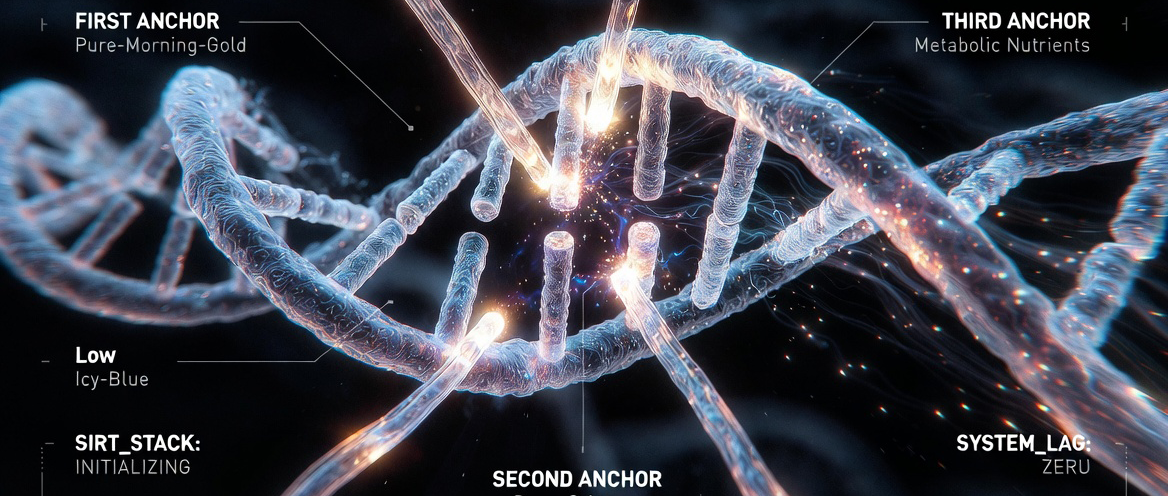
[ THE HERITAGE STACK ]
"Your DNA is an operating system written millions of years ago. It doesn't understand the concept of a 'deadline' or 'infinite scrolling.' It only understands Zeitgebers — external synchronization signals.
When these signals contradict each other (e.g., a freezing cold phone screen in the middle of a warm night), the system enters a state of Conflict Resolution. Instead of repairing cells, your body wastes resources trying to determine if it's day or night. To stop this cellular chaos, we must set three primary Anchors."
Anchor 1: Why does morning sunlight set your body clock?
Morning sunlight sets your body clock because the first light hitting your retina is the master signal every other circadian protocol runs on.
Signal: Low-Angle Sunlight
The first photons of morning light hitting your retina trigger a cascade of critical reactions. This isn't just about "waking up." It's a command for the mitochondria to begin ATP production and a master signal to suppress melatonin — the two biochemical bookends of your circadian rhythm.
The photoreceptors responsible — intrinsically photosensitive retinal ganglion cells (ipRGCs) — are maximally sensitive to the short-wave spectrum of low-angle morning light. This is the exact wavelength that artificial light sources fail to replicate at sufficient intensity. A screen cannot boot the system; a window barely can.
The Hack: Get 10 minutes of direct (non-filtered by glass) sunlight within the first hour of waking. If the sun isn't visible, use a 10,000-lux therapy lamp.
This is your primary Boot Loader for the entire system. Every other circadian protocol runs on the foundation set by this one signal.
Anchor 2: How does temperature affect your circadian rhythm?
Temperature affects your circadian rhythm because the body's thermoregulatory system is a timing device, and a constant indoor temperature mutes it.
Signal: Thermal Variance
In nature, temperature drops at night and rises during the day. A constant 22°C (72°F) in your apartment "mutes" your regulatory mechanisms. The body's thermoregulatory system is not just a comfort mechanism — it is a timing device. Core temperature oscillates with a circadian period: lowest around 4 AM, peak in mid-afternoon. When the environment is thermally flat, this oscillation dampens.
Brown adipose tissue (BAT), activated by cold exposure, is particularly sensitive to this signal. BAT thermogenesis is regulated by the sympathetic nervous system — the same system that governs morning cortisol release. Cold in the morning sharpens the sympathetic spike. Heat in the evening mimics sunset and accelerates the parasympathetic transition.
The Hack: Use a cold shower in the morning (stimulating the sympathetic nervous system) and a hot bath or sauna in the evening. The idea is that the body cooling after a hot bath works like a natural sunset, signaling the hypothalamus that it is time to sleep. This may help some people; the evidence that sauna improves sleep is limited. Finish at least an hour before bed, skip it after alcohol, and drink water.
Anchor 3: Does meal timing affect your body clock?
Yes — your liver, kidneys and gut have their own clocks, wound by food rather than light.
Signal: The First Bite
Your internal organs — liver, kidneys, gut — have their own independent clocks. They aren't wound by light, but by food. The timing of the first meal acts as a Start Command for the peripheral metabolic network. These clocks operate via transcription factors (CLOCK, BMAL1, PER, CRY) that are directly responsive to nutrient availability, not photons.
The consequence of temporal misalignment here is severe: eating at 11 PM tells your liver "Stay active, the sun is still high," while your brain is already broadcasting "Shutdown sequence initiated." The result is Data Corruption — misexpression of metabolic genes, impaired lipid clearance, and blunted insulin sensitivity the following morning.
The Hack: Eat breakfast at a consistent time to lock in the start of your metabolic day. Even a small caloric input (protein + fat) is sufficient to trigger the peripheral clock cascade.
Impact Log: Synchronization Results
When all three anchors are correctly set, the system converges:
DNA Repair: Genes responsible for fixing molecular damage — Sirtuins (SIRT1, SIRT3) — are activated on schedule. DNA repair enzymes peak during sleep phases that are only accessible when the circadian architecture is intact.
Cognitive Flux: Many people find mornings feel clearer once their wake time is regular and they get light early. The idea that this works by "aligning your cortisol peak" is popular but not strongly evidenced.
System Stability: Your HRV becomes predictable, adaptive, and resilient — not because you "relaxed more," but because the autonomic nervous system is receiving coherent timing signals from all three anchor systems simultaneously.
"We don't change biology. We simply return the input data for which it was originally designed."[ ONDA_STATEMENT ]
Recommended tools
Ancestral anchors are easy to claim, harder to verify. The trackers that catch real circadian shifts:
- •Sleep Cycle — tracks the actual timing shift
- •Oura Ring 4 — overnight HRV and stage data
- •Rise — sleep-debt model