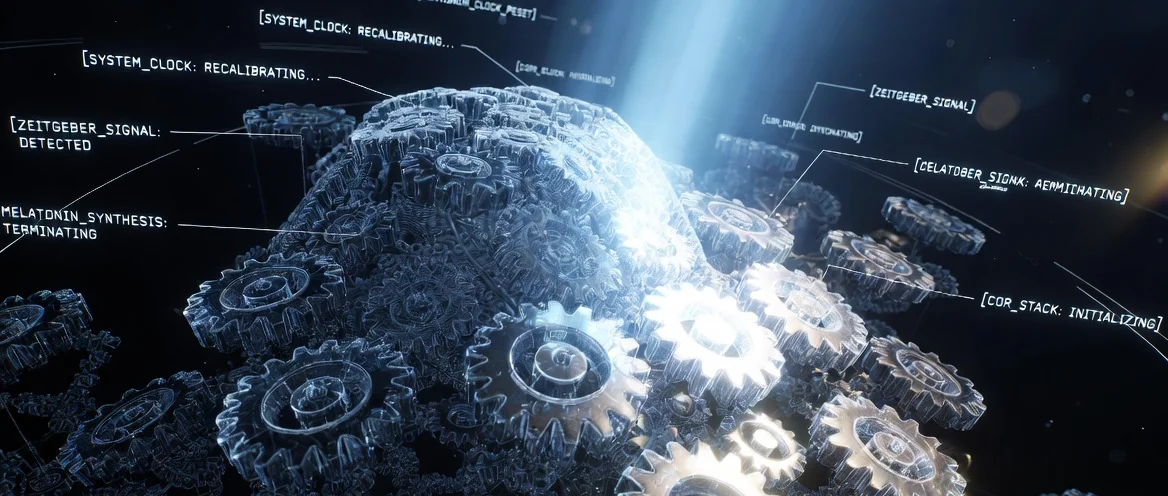
[ BIOLOGY AS CODE ]
"In systems programming, the System Clock synchronizes every process — from command execution to data logging. If the clock 'drifts,' the entire database descends into chaos. Your body operates on the exact same principle.
Circadian rhythms are more than just 'sleep and wake' cycles. They are the master schedule for every cell: when to synthesize proteins, when to clear toxins from the brain (the glymphatic system), and when to repair DNA. Desynchronization — caused by blue light, irregular eating, or late-night scrolling — is essentially System Lag, which accelerates biological wear and tear."
Step 1: How do you know your body clock is off?
Consistently low HRV on waking and midnight glucose spikes are the two primary signals — measure the scale of the desync before performing a Hard Reset. In the ONDA framework, we prioritize two primary signals:
HRV as a Stress Indicator: If your HRV is consistently low upon waking, your system failed to "reboot" overnight. Your clock is stuck in High Performance mode, never entering Recovery.
Glucose Patterns (CGM): Midnight glucose spikes are a signal to the brain that it is "noon." This corrupts the settings of metabolic clocks in your liver and pancreas.
The delta between your subjective fatigue and your biometric output reveals the true depth of the drift. A low morning HRV combined with stable daytime glucose is a green light for Step 2. If both are dysregulated, extend the diagnostic window by 24 hours before executing the protocol.
Step 2: How do you reset your circadian rhythm?
Reset it with 72-hour strict adherence to three primary Zeitgebers (time-givers):
Protocol 1: Light Injection (The Optical Patch)
Action: 100,000 lux within the first 30 minutes of waking.
Logic: Photons activate the SCN (Suprachiasmatic Nucleus) — your master processor. This sends a global command to terminate melatonin production and initialize the cortisol stack. Without this morning signal, peripheral clocks in every organ run on estimated time, drifting further from one another each cycle.
Protocol 2: Metabolic Window (Input Gating)
Action: Restrict all caloric intake to a 10-hour window (e.g., 08:00 AM – 06:00 PM).
Logic: Peripheral clocks in your organs synchronize via nutrient signaling. A consistent breakfast time acts as the Start Command for your entire metabolic engine. Eating outside the window — especially at night — sends a "noon" signal to liver and pancreatic clocks while the SCN is already broadcasting "midnight." The result is multi-organ desynchronization.
Protocol 3: VNS Termination (Graceful Shutdown)
Action: Vagus Nerve Stimulation (VNS) 2 hours before target sleep time.
Logic: We help the body settle from alert toward rest — a useful image, since the two branches work together rather than as an on/off mode switch. Think of this as "Safely Remove Hardware" before cutting the power. Practical methods: slow diaphragmatic breathing (4-7-8 pattern), cold water face immersion, or low-frequency humming — all can help you shift toward the calmer, more parasympathetic-leaning state that helps lower stress-hormone load.
Step 3: Monitoring Uptime (Verification)
Post-reset, check your sleep regularity and duration in ONDA's Life Rhythm.
Target: 15–20% increase in Deep Sleep phase within the first 3 nights.
Target: Resting Heart Rate (RHR) stabilization within the first hour of sleep — a sign the parasympathetic system has taken command.
Target: Morning HRV trending upward by Night 3. This is the clearest confirmation that the SCN has re-established dominance over peripheral clocks.
If HRV does not improve by Day 4, the issue is likely upstream: chronic psychological stress, or unresolved inflammatory load blocking recovery. The clock cannot synchronize a system that is perpetually in threat-response mode.
STATUS: RECALIBRATION_SEQUENCE_COMPLETE NEXT_MAINTENANCE: Repeat protocol at first sign of HRV drift or sustained sleep phase fragmentation.[ SYSTEM_LOG ]
Recommended tools
A hard reset deserves measurement. Tools that report whether it stuck:
- •Oura Ring 4 — sleep model that resolves a reset
- •Sleep Cycle — simple timing and disturbance tracking
- •Sleepio — clinical CBT-I for when timing is not the only problem