[ STATUS: REDUNDANCY_ACTIVE ]
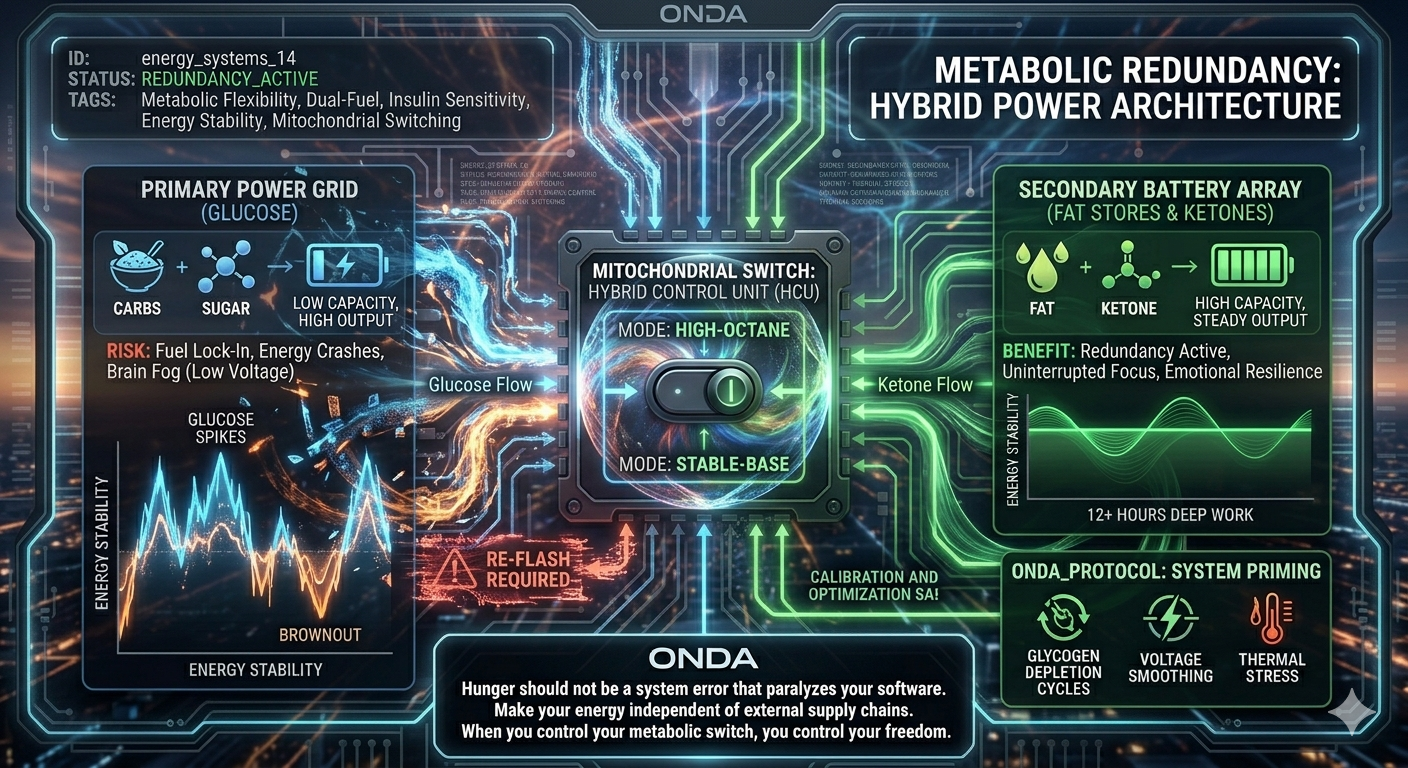
"Metabolic Redundancy: Hybrid Power Architecture"
In mission-critical IT infrastructure, there is always a primary and a backup power source. Most people rely exclusively on the external grid — glucose. As soon as blood sugar dips, the system enters a brownout: brain fog, irritability, and a total loss of focus.
Metabolic Redundancy is your body's ability to instantaneously switch to internal batteries — fat stores and ketones. This transforms you from a fragile device dependent on a wall socket into an autonomous hybrid engine.
Section 1: The Mitochondrial Switch
At the heart of this system is the mitochondrial switch. Its job is to determine the most efficient fuel for the current load.
High-Octane Mode (Glucose)
Fast energy for peak cognitive bursts or explosive movement. Powerful, but leaves behind oxidative byproducts.
Stable-Base Mode (Fatty Acids / Ketones)
Low-temperature, clean-burning fuel for deep work and sustained focus for 12+ hours.
The Redundancy Layer
When glucose runs low, a flexible system transitions to fats with less of a performance hit. This is what tends to soften the post-lunch food coma. The switch becomes the system's most valuable hardware feature.
Section 2: Fuel Lock-In
The modern human suffers from fuel lock-in. Due to a constant surplus of carbohydrates, the switch becomes rusted, and the body forgets how to access its fat stores.
Energy Crashes
Sharp drops in cognitive ability two hours after eating. The primary grid collapses with no backup available.
Brain Fog (Low Voltage)
The brain cannot access energy even when fat stores are full. This is starvation in the midst of plenty.
Insulin Noise
High insulin levels create background static that interferes with the vagus nerve and disrupts the neural signal-to-noise ratio.
: Fuel lock-in is not a diet problem. It is a mitochondrial firmware issue. The switch needs to be re-flashed.[ SYSTEM_ALERT ]
Section 3: System Priming
We restore metabolic flexibility by re-flashing the biochemical pathways.
Glycogen Depletion Cycles
Short periods of low-carb intake combined with ONDA protocols force mitochondria to remember the fat-burning script.
Voltage Smoothing
Specific nutrient sequencing — fiber, then protein, then carbohydrates — flattens glucose spikes and avoids contact bounce in the endocrine system.
Thermal Stress
ONDA cold protocols activate brown adipose tissue, which acts as a high-efficiency energy converter, increasing total system output and metabolic range.
[ HARDWARE_VALIDATION ]VALIDATION_DEVICE: Apple Watch / CGMMETRIC: glucose variability, energy stability, focus durationSTATUS: SWITCH_CALIBRATED
Section 4: The Uninterruptible Operating System
Developing metabolic redundancy delivers measurable system upgrades.
Uninterrupted Focus: 8–10 hours of stable cognitive output without needing a recharge break.
Emotional Resilience: No blood sugar swings means no mood swings. Emotional voltage remains steady.
Fast Recovery: The system recovers from stress faster because it always has a reserve power source for tissue repair.
ONDA_STATEMENT: "Hunger should not be a system error that paralyzes your software. Make your energy independent of external supply chains. When you control your metabolic switch, you control your freedom."
Recommended tools
Watching the metabolic system live requires CGM. Three programmes covering the price tiers:
- •Levels — continuous Dexcom G7 with deep analytics
- •Nutrisense — registered-dietitian coach on the same hardware
- •Stelo by Dexcom — OTC version at a third of the cost