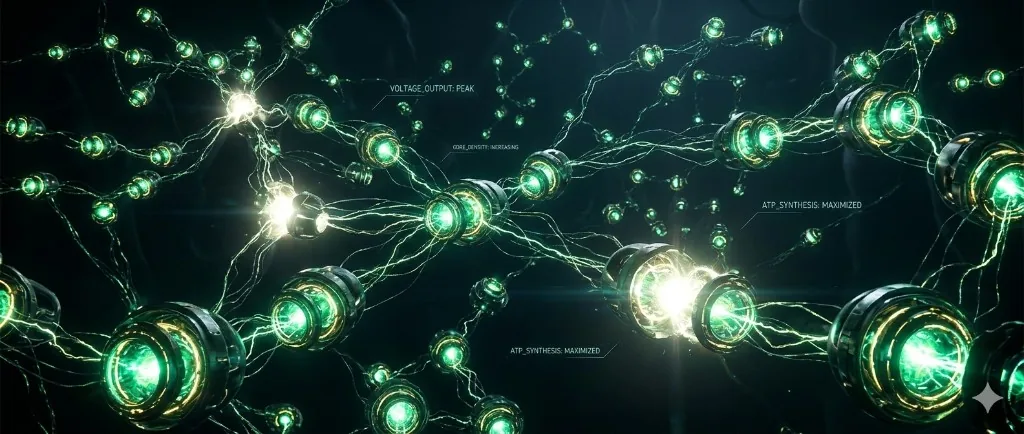
[ ANALYZING POWER INFRASTRUCTURE ]
"Your mitochondria are the cellular power plants responsible for generating ATP—the universal energy currency of your biological hardware. Most chronic system lag is not a software issue, but a 'Power Grid' failure caused by damaged, inefficient mitochondria.
To optimize your output, you must trigger Mitochondrial Biogenesis: the process of creating new, high-density power units while recycling the old ones. This is how you increase the total wattage of your organism."
What happens when your mitochondria run low on power?
When mitochondria become 'leaky' or sparse, your system experiences brownouts—brain fog, fatigue, and slow recovery. Energy in the human machine is a matter of electrical potential: mitochondria produce ATP by pumping protons across a membrane, creating a 'Voltage' that drives cellular work. Increasing mitochondrial density effectively raises your system's 'RAM' for physical and cognitive tasks.
What triggers the growth of new mitochondria?
The primary command for building new mitochondria is the activation of the PGC-1α protein. This is the 'Master Switch' for mitochondrial biogenesis. In the ONDA model, PGC-1α is triggered by specific stressors that signal the hardware to expand its energy capacity. Without these signals, the system stays in a low-power, 'Legacy' state.
[ SECTION 3: POWER GRID PROTOCOLS ]
PROTOCOL_01 > Thermal Shock (Mito-Stimulation)
The Hack: High-heat sauna (80°C+) for 20 minutes, 3 times a week.
Safety: Never use a sauna after drinking alcohol — alcohol is the main factor in sauna deaths. Drink water before and after, start with shorter sessions, and get out at once if you feel dizzy, sick or have palpitations. If you have heart disease or low or poorly controlled blood pressure, or are pregnant, talk to a doctor first. See the evidence on sauna and heat.
The Logic: The idea is that heat stress raises 'Heat Shock Proteins' and pushes mitochondria to handle thermal energy more efficiently — an idea, not something shown in people. In research, this kind of acute stressor is associated with increased PGC-1α signalling — the pathway linked to building more power units in muscle and brain tissue. Individual response varies.
PROTOCOL_02 > Photonic Charging (Red Light Therapy)
The Hack: Exposure to 660nm (Red) and 850nm (Near-Infrared) light for about 10 minutes, following the maker's distance and time. Wear the goggles supplied and never look into the LEDs: near-infrared light is invisible and does not trigger the blink reflex. Doses used in studies do not transfer directly to home panels. See the evidence and safety review.
The Logic: Near-infrared light penetrates the skin and is absorbed by Cytochrome c Oxidase in the mitochondria. The working hypothesis is that this supports the ATP production cycle and may help lower markers of oxidative stress — the lab equivalent of cleaning 'soot' off your cellular engines. The evidence is promising but still early.
PROTOCOL_03 > The 'NAD+' Fuel Cell (Molecular Repair)
The Hack: Supplementation with NAD+ precursors or intense HIIT (High-Intensity Interval Training).
The Logic: NAD+ is a critical co-enzyme for energy transfer. Low NAD+ levels mean your mitochondria can't process fuel efficiently. HIIT creates a massive 'Energy Debt' that forces the body to recycle old mitochondria (Autophagy) and build a newer, more resilient power grid.
[ HARDWARE_VALIDATION ]EXAMPLE_DEVICE: VO2 Max MaskMETRIC: Peak Oxygen ConsumptionSTATUS: WATTAGE_INCREASEDIllustration — not a measurement
Recommended tools
Mitochondrial effects of photobiomodulation are studied mainly in cells and animals, not established in people. If you still want to try a panel:
- •Joovv Solo 3.0 — modular panel
- •Mito Red MitoPRO 1500 — six-wavelength biohacker favourite (now the 1500X)
- •Hooga HG500 — budget entry with honest specs