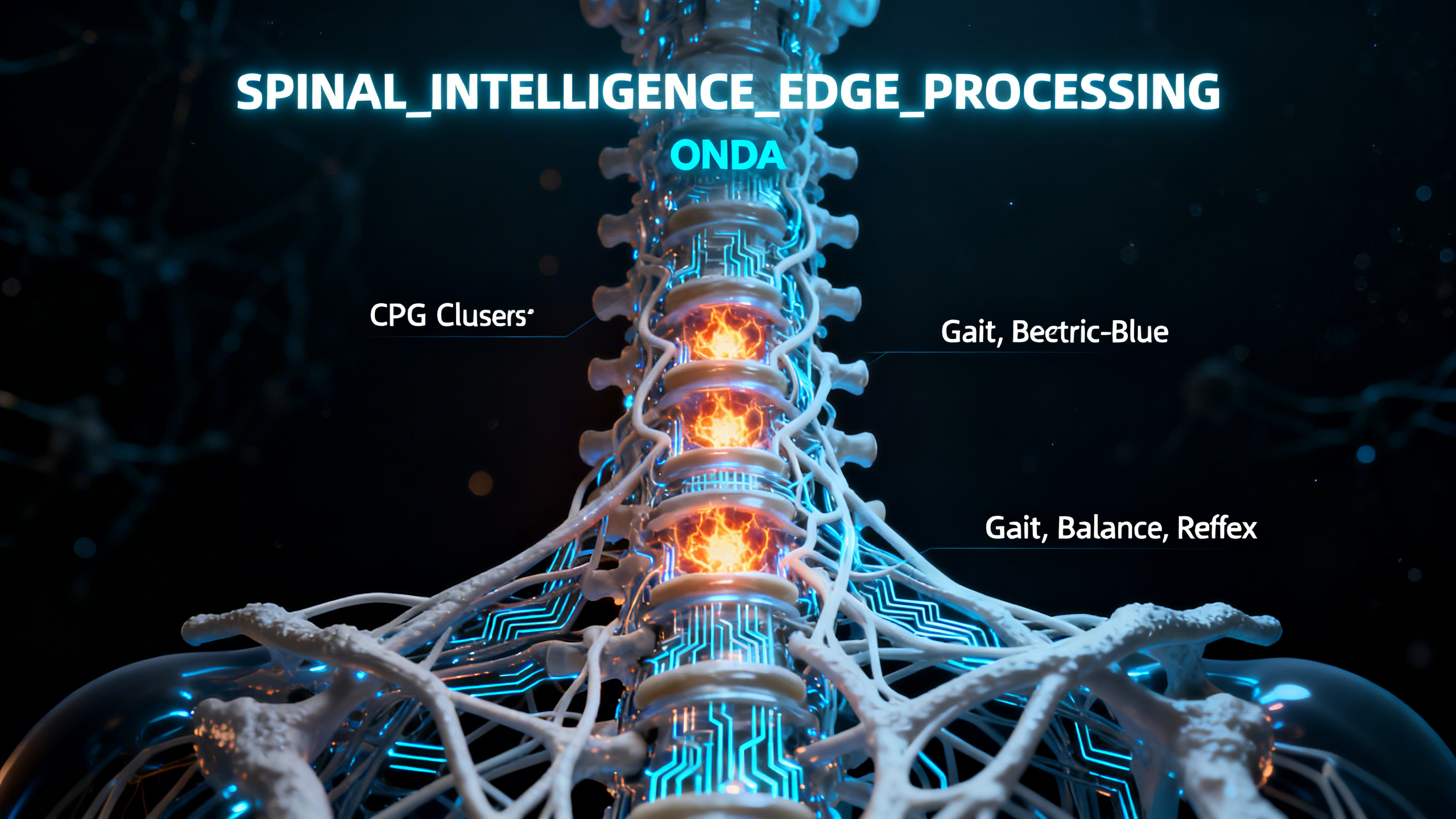
[ THE EDGE COMPUTING MODEL ]
"In modern IT architecture, there is a concept called Edge Computing. To avoid overloading the central server, data is processed locally — 'at the edge' of the network.
Spinal Intelligence is the Edge Computing of your body. The spinal cord doesn't just pass signals; it possesses its own 'memory' and logic. When your foot slips on ice, the reaction occurs at the level of the spinal CPGs in milliseconds — far faster than the signal of the fall can reach your conscious mind. Developing this intelligence is the key to true grace and superhuman reaction speeds."
The edge computing model is not a loose analogy. The spinal cord contains approximately 100 million neurons — only slightly fewer than the entire rat brain. It processes, integrates, and responds to sensory data locally. Reflex arcs bypass the brain entirely: sensory input enters at the spinal level, is processed by spinal interneurons, and motor output exits — all within the cord. The brain learns about the event after the response has already been executed. Developing this distributed intelligence is not supplementary to physical performance. For high-speed, high-complexity movement, it is the primary performance variable.
The Architecture: Decentralized Mastery
How intelligence is distributed across three processing layers in the ONDA system:
The Strategic Layer (Cortex): Plans long-term goals and intent: "I want to run this trail." Sets the movement context, selects the general locomotor mode, and monitors whether outcomes align with intention. Operates at the scale of seconds to minutes. The cortex is an exceptional strategist and a terrible micromanager — when it attempts to operate at the millisecond timescale of active movement execution, it introduces latency, interference, and the Choke Effect.
The Tactical Layer (Subcortical — Basal Ganglia, Cerebellum): Manages movement tone, emotional regulation of motor output, and the coordination of learned movement sequences. "Am I in a state of flow or fear?" The cerebellum in particular is the predictive error-correction system: it maintains a model of intended movement and adjusts motor commands in real-time based on discrepancies between predicted and actual sensory feedback. When operating correctly, it functions invisibly — producing smooth, coordinated motion without conscious monitoring.
The Execution Layer (Spinal CPGs): Possesses its own "motor intelligence" — the half-center oscillator networks that generate rhythmic movement patterns and the interneuron circuits that execute reflexive adaptations. It knows how to adapt a stride to an uneven stone, absorb a gust of wind, or recover from an unexpected slip — without a single conscious thought, because the full sensory-motor loop completes at the spinal level before the signal reaches the brain. This layer is not a passive cable. It is an active, adaptive, memory-capable processing system that becomes more intelligent with every hour of complex sensory input it receives.
Why does conscious control get in the way of movement?
The biggest barrier to spinal intelligence is Cognitive Interference — the cortex inserting itself into execution-level processes it was never designed to manage:
The Choke Effect: When you think too hard about how to perform a complex movement during execution — "am I landing correctly?", "is my form right?" — you recruit the prefrontal cortex into the motor loop. Prefrontal cortical involvement in movement execution introduces 150–300ms of additional latency compared to the same movement executed via subcortical and spinal circuits. At slow speeds, this is tolerable. At high speeds, it produces the Choke Effect: the system "freezes" mid-execution — milliseconds of hesitation that, in sport, art, and real-world reactive situations, are the precise window in which injury, error, or failure occurs. Elite performers under pressure are characterized by lower prefrontal activation during execution, not higher.
Sensory Deprivation: Living in perfectly flat environments (concrete, tiled floors) and wearing thick-soled shoes creates a sensory poverty condition for the spinal cord. The proprioceptive feedback channels — muscle spindles, Golgi tendon organs, plantar mechanoreceptors — are designed for continuous, complex, varied input. In the absence of this input, the spinal interneuron networks receive insufficient data to maintain their calibration and adaptability. CPG drivers degrade: the spinal cord's real-time terrain-adaptation capacity diminishes, and the brain compensates by increasing cortical involvement in movement — which is slower, less efficient, and paradoxically more prone to error.
Reaction Lag: Attempting to control high-speed movements through visual processing creates a latency window that is structurally too wide for reactive situations. The visual reaction time (stimulus → conscious awareness → motor command) is 200–400ms. Spinal reflex latency is 30–80ms. Situations that require the faster pathway — a slip, a trip, a sudden obstacle — will always exceed the visual pathway's response capacity. Training the spinal reflex network directly is how you close this gap.
ONDA Protocol: Upgrading Spinal Intelligence
Three techniques to train the system to trust its periphery:
Technique 1: Unpredictable Loading (Micro-Learning Forced Induction)
Action: Train on unstable surfaces (balance board, BOSU, uneven terrain, sand, grass) or use shifting weights (kettlebells, odd-object lifting, water-filled containers) for 15–20 minutes per session. Vary the surface, the load direction, and the movement pattern unpredictably within each session.
Logic: Stable, predictable training environments allow the cortex to predict every sensory event in advance — and pre-plan motor responses rather than reacting in real-time. This is efficient for skill acquisition but actively prevents spinal intelligence development. Unpredictable loading forces the spinal CPGs and reflex interneurons into a state of continuous micro-learning — every step, every rep introduces a novel perturbation that the spinal system must resolve autonomously. Over weeks of unpredictable loading, the spinal interneuron networks develop denser, faster, more adaptive response patterns. The system learns by doing, at the speed the spinal cord operates: milliseconds, not seconds.
Technique 2: Proprioceptive Focus (Internal Sensing Protocol)
Action: During movement sessions (walking, strength training, balance exercises), deliberately shift attention from visual feedback (watching your limbs) to proprioceptive feedback — the felt sense of joint position, pressure, and movement direction without visual confirmation. Eyes can be open but gaze is soft and unfocused. Practice locating your limbs, weight distribution, and movement trajectory entirely through internal sensing.
Logic: Visual dominance in movement monitoring is the cortical override of the proprioceptive channel. When you watch your limbs, you route motor control through the visual cortex and prefrontal areas — bypassing the spinal proprioceptive feedback loop that is faster and more granular. Proprioceptive focus trains the spinal cord to "see" the body from the inside out: to process limb position, ground contact quality, and movement efficiency through the sensory channels that connect directly to the spinal CPGs. This is the ONDA technique for building the internal model that the spinal cord uses for autonomous operation. The more calibrated the internal model, the more reliably the spinal system can execute without cortical oversight.
Technique 3: Flow State Triggers (Cognitive Interference Elimination)
Action: Before high-complexity movement sessions, execute the Alpha-state entry protocol — 3–5 minutes of 0.1 Hz resonance breathing, followed by peripheral awareness expansion and the ONDA Alpha-Drop. Enter the movement task from Alpha state rather than from High-Beta task-focus.
Logic: Alpha state (8–12 Hz) automatically reduces prefrontal cortical activation via thalamocortical gating — the same mechanism that makes Alpha the prerequisite for flow state. This cortical quieting directly reduces Cognitive Interference: the prefrontal cortex, operating in default-mode rather than task-positive mode, exerts less active override on subcortical and spinal motor circuits. The "steering wheel" transfers to spinal intelligence not because it was forced, but because the primary source of cortical interference has been temporarily suspended. Alpha entry before movement is not a relaxation ritual. It is the hardware configuration required for the spinal execution layer to run without interruption.
What are the benefits of training spinal reflexes?
Reactive Resilience: The ability to regain balance and avoid injury in extreme situations on autopilot — the direct result of a calibrated spinal reflex network. Reactive resilience is not a function of strength or conditioning. It is a function of the speed and precision of the spinal interneuron response. A well-developed spinal intelligence system responds to the slip before the brain knows it happened.
Movement Elegance: The disappearance of "robotic" patterns — the halting, effortful, visually-monitored movement that characterizes cortical micromanagement. Fluid, predatory motion is the perceptual signature of a movement system operating primarily through subcortical and spinal circuits: faster, more adaptive, more economical, and entirely without the self-conscious monitoring that produces mechanical, effortful-looking motion.
Mental Reserve: Your brain no longer spends its primary computational budget on not falling, not stumbling, and not compensating for inadequate proprioceptive calibration. The cognitive overhead of managing a poorly-calibrated movement system is substantial and largely invisible — until it is removed. When spinal intelligence handles execution autonomously, the prefrontal cortex becomes available for the tasks only it can perform: strategy, creativity, and high-level decision-making.
"The highest form of intelligence is when you don't need to think to act flawlessly. Your spinal cord is not a cable; it is your second processor. Give it the freedom to run its code."[ ONDA_STATEMENT ]