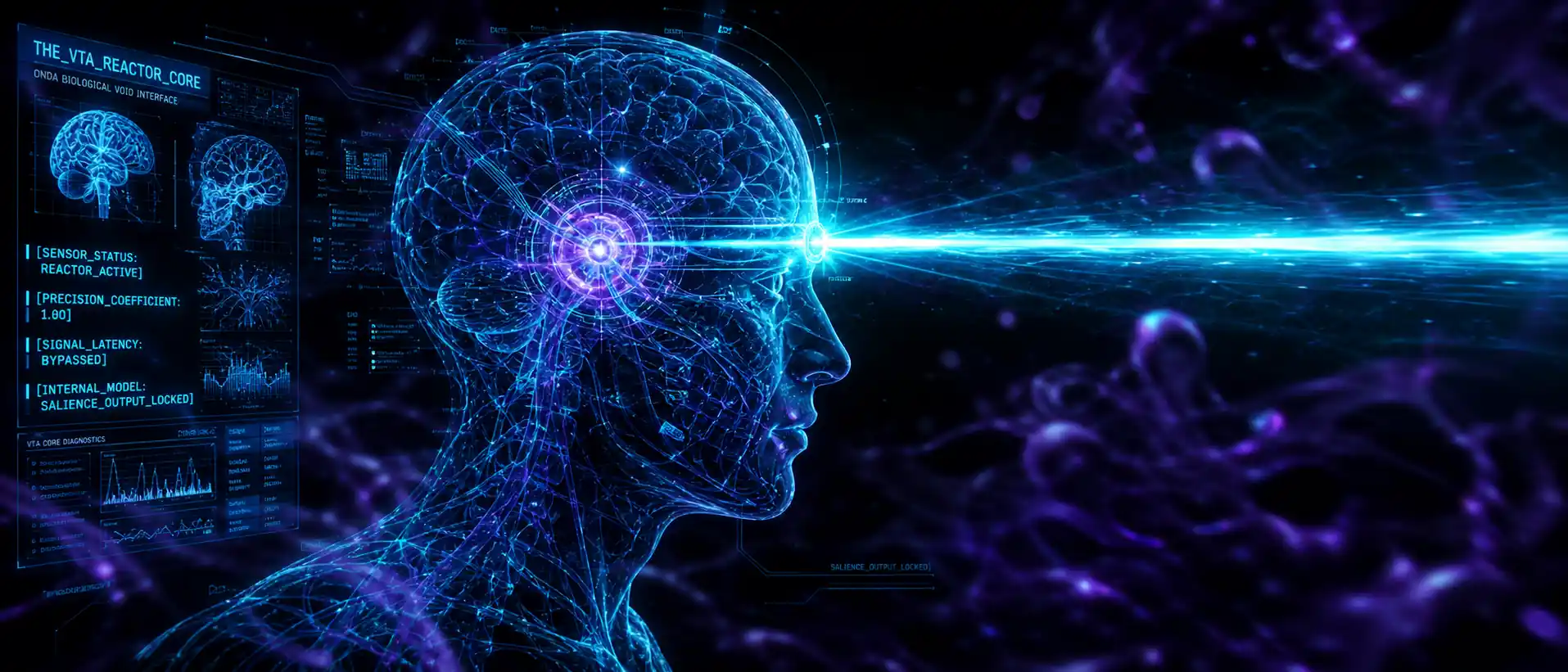
[ STATUS: REACTOR_ACTIVE ]
"Ventral Tegmental Core: The Reactor of Motivational Salience"
In the ONDA architecture, we view the Ventral Tegmental Area (VTA) not merely as a metaphorical pleasure center, but as the Ventral Tegmental Core — the central processor governing Motivational Salience. It acts as the master reactor that decides where to allocate your computational and physical resources.
Section 1: What neurons make up the ventral tegmental area?
The core is comprised of three primary neuron types.
Dopaminergic Neurons (~60%)
Form the "dopamine telemetry" channels that map the pathway toward high-priority targets.
GABAergic Neurons (~35%)
Act as system dampeners and brakes, preventing overflow and erratic context switching.
Glutamatergic Neurons (~5%)
Provide high-speed bursts of excitation when a genuine, mission-critical signal is detected.
Section 2: What does dopamine in the VTA actually signal?
Dopamine within the VTA signals prediction error — it is not merely a "reward chemical" released after a task is completed. In ONDA, we define it as a Prediction Error signal.
Anticipation (Zero-Latency Signal)
When the system predicts a result, the VTA releases exactly enough baseline dopamine to keep the system locked in on the task.
Reward
If reality exceeds your system model, additional spikes occur, strengthening the neural pathways.
Noise (Jitter)
When overloaded by low-grade stimuli (such as social media notifications or instant carbohydrate spikes), the reactor generates chaotic impulses that drop your SNR and scatter your focus.
Section 3: What happens when the VTA is overstimulated?
When the VTA reactor is overdriven, it triggers Motivational Leakage.
Reward Desensitization: Receptors downregulate. You require exponentially more input to get even simple tasks done.
Context Switching (Background Static): The VTA continuously scans for quick fuel, causing the Acetylcholine Lens to lose its focal lock.
Voltage Drop: Physical feelings of fatigue and apathy set in, even when your actual glycogen stores are full.
Section 4: ONDA_PROTOCOL — Calibrating the Reactor
To stabilize the VTA according to ONDA protocols.
PROTOCOL 1: System Reset (High-Fidelity Inputs only)
The Hack: Eliminate high-frequency pulse stimuli for at least 24 hours. This allows the VTA to restore receptor sensitivity.
The Logic: Removing notifications, social feeds, and refined sugar for a full day lets the dopamine baseline recover. The reactor exits constant-firing mode and receptors begin to upregulate.
PROTOCOL 2: Overclocking via Stress
The Hack: Use controlled exposure to stressors such as an ONDA cold plunge or intense training to generate a clean, intense baseline signal.
The Logic (hypothesis): The idea is that hormetic stress resets dopamine sensitivity — a hypothesis, not a shown effect. Picture cold and heavy load as a wide, slow pulse rather than empty jitter; that is an image, not something measured in the VTA.
PROTOCOL 3: Bypassing External Grids
The Hack: Shift focus to prolonged work cycles where the reward is delayed.
The Logic: The VTA learns to derive value from the processing stage itself — the deep-work loop. The reactor stops chasing micro-rewards and locks onto the long-form mission signal.
[ HARDWARE_VALIDATION ]EXAMPLE_DEVICE: Subjective drive log / focus block timerMETRIC: Time-to-task, post-task energy, baseline moodSTATUS: REACTOR_STABLEIllustration — not a measurement
IMPACT_LOG: Stable Reactor Operation
Proper calibration of the VTA Core delivers measurable upgrades.
Steady System Voltage: Your energy levels no longer depend on the external grid (eating every 3 hours or continuous coffee).
Salience Control: You decide what constitutes mission-critical data and what is simply background noise.
Resilience: A stable source of motivation dedicated to tissue repair and cognitive recovery.
ONDA_STATEMENT: "Your motivation shouldn't depend on external triggers. The VTA is a reactor, not a dumping ground for fast fuel. When you control the dopamine telemetry, you become the operator rather than the victim of the algorithm."