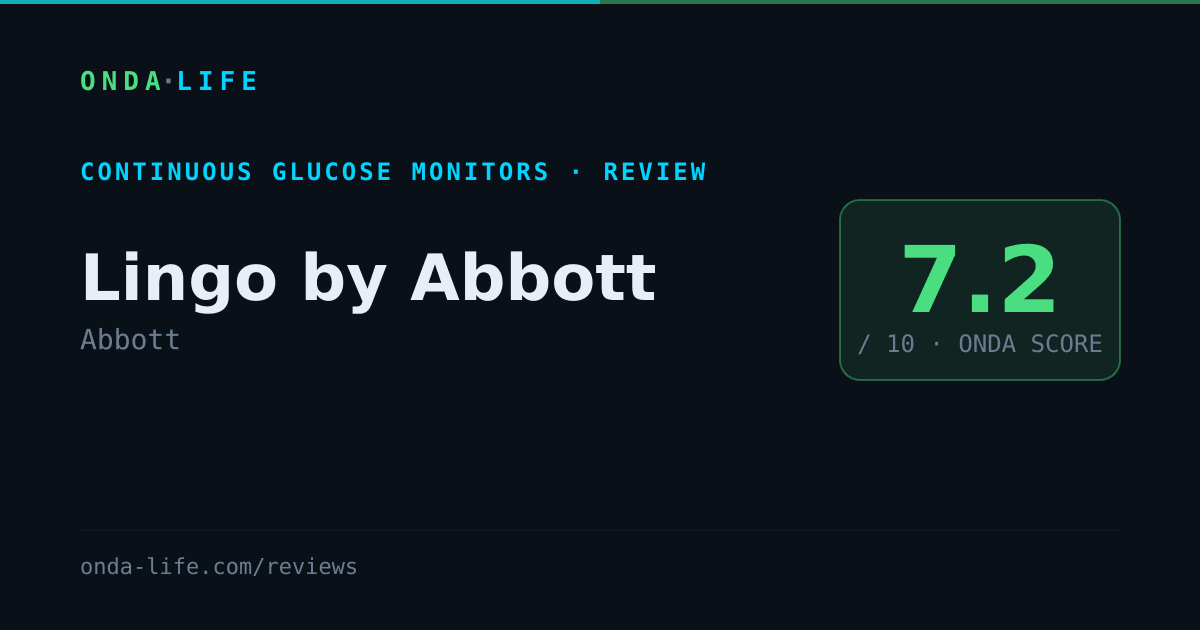
Abbott’s Libre hardware sold without a prescription — the simplest entry into CGM at the lowest single-sensor price.Best for first-time CGM users who want the cheapest legitimate entry without subscription.
Lingo is Abbott’s direct-to-consumer CGM, sold over the counter (no prescription) with Libre 3 hardware and an app aimed at metabolic-health beginners. Two-week sensors at $54 each, no subscription required. The app focuses on a single “Lingo Count” metric per meal rather than the deep analytics of Levels. The right entry point if cost and simplicity matter more than insight depth.
How we tested: Evidence-based assessment — scored from Abbott Lingo product documentation, Libre 3 validation literature and independent 2026 reviews. Not hands-on tested by ONDA.
Abbott Libre 3-based sensor — 14-day wear, calibration-free, 60-minute warm-up. In an independent head-to-head study (Eichenlaub et al. 2025) Libre 3 and Dexcom G7 were similarly accurate. Lingo presents itself honestly: the site says it is “NOT intended for diagnosis of diseases, including diabetes” and makes no clinical overclaims.
Insights and analysis quality
7.0
Built around a single per-meal “Lingo Count” spike score. Simpler than Levels — easier for beginners, frustrating for advanced users.
Coaching and guidance
5.0
Minimal — in-app guidance only, no coach. Abbott bet on simplicity over coaching.
App and integration UX
7.5
Clean iOS/Android app with Apple Health and Google Fit support. Limited third-party connectors compared with Levels.
Programme flexibility and data access
8.5
No subscription required — buy single 2-week sensors as needed at $54 each, or multi-sensor plans. The most flexible commercial CGM in this list.
Value
9.0
$54 per 2-week sensor with no commitment; multi-sensor and subscription plans lower the per-sensor cost. Among the cheapest legitimate CGM access in the US.
Pros
+No prescription, no subscription — buy single sensors as you need them
+Cheapest legitimate consumer CGM access in the US
Price: $54 $54 for a 2-week plan (1 sensor, no auto-renew); multi-sensor/subscription plans cost less per sensor (as of 2026-09-30)
Where it leads
Lingo is the cheapest legitimate path into CGM for a US non-diabetic. Abbott’s Libre 3 sensor — the same reliable 14-day platform used by Ultrahuman M1, Veri and Hello Inside — sold OTC without a prescription, with no subscription requirement. A single two-week sensor is $54 with no commitment; multi-sensor and subscription plans bring the per-sensor cost down. The app is deliberately simple: a per-meal “Lingo Count” spike score rather than a deep analytics suite. For a first-time CGM user who wants to experiment without committing to a $200-a-month programme, that simplicity is the value.
What are the downsides of the Lingo?
It is a beginner tool. The single-score insight layer becomes frustrating once you have learned to read your own curves — there is no AUC decomposition, no food-by-food ranking history, no coaching. The third-party integration list is short, and the 60-minute sensor warm-up is twice Stelo’s 30 minutes. As an instrument for ongoing biohacker self-experimentation, Lingo is the entry point, not the destination.
Who should buy the Lingo?
Choose Lingo if you have never worn a CGM and want the lowest-cost legitimate way to find out whether it changes anything for you. If you have outgrown the beginner framing and want depth, Levels or Stelo are the natural next steps.
Background reading
The metabolic biology these programmes surface — and the protocols the data unlocks.
No. Lingo is Abbott's over-the-counter CGM, sold without a prescription or subscription. It uses Libre 3 hardware with reliable, calibration-free 14-day wear, and you simply buy sensors as you need them. It is the cheapest legitimate consumer CGM access in the US.
How much does Lingo cost?
Lingo costs $54 for a two-week plan (one sensor, no auto-renew), with multi-sensor and subscription plans that cost less per sensor. No subscription is required: you can buy single sensors as you need them. That makes it the lowest-cost entry into continuous glucose monitoring for a US non-diabetic.
Lingo vs Levels: which is better?
Lingo is cheaper and simpler: no subscription, and one Lingo Count score per meal. Levels offers far deeper analytics on Dexcom Stelo (G7 platform), as a membership from about $80 a year (app-only) to $1,329 a year. Neither includes a human coach. Choose Lingo if cost and simplicity matter more than insight depth.