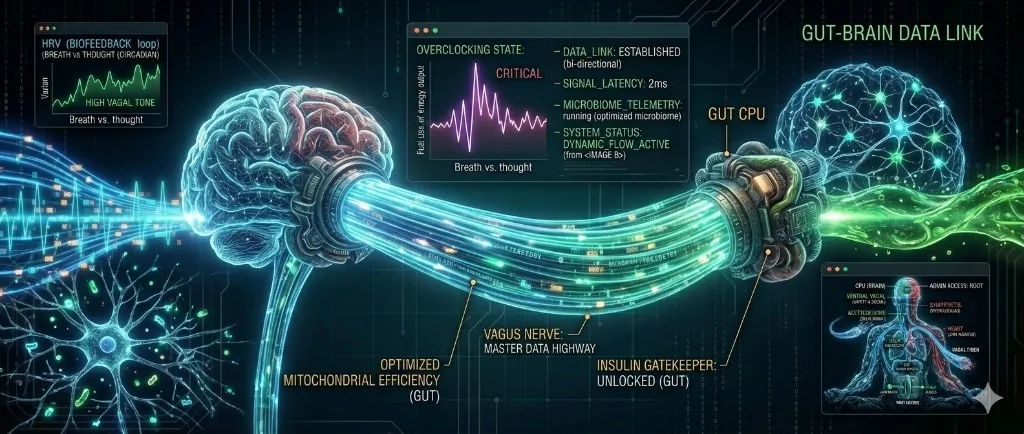
[ PERIPHERAL DATA LINK ]
"Your gut is not just a digestive tube; it is your second brain. With over 500 million neurons and a direct fiber-optic connection via the Vagus Nerve, your microbiome acts as a biological modem, modulating your mood, immunity, and even your thoughts.
In the ONDA model, the Gut-Brain Axis is your 'Data Link.' If your microbiome is corrupted by 'Noise' (inflammation and dysbiosis), your mental software will experience lag, crashes, and emotional instability. To optimize the CPU, you must first clean the peripheral hardware."
[ SYSTEM STATUS: DATA LINK ACTIVE ]
Your gut-brain axis is online. The bidirectional communication between your microbiome and your brain — partly via the Vagus Nerve, partly via immune and chemical signals — is one of many influences on mood and immune function; much of the evidence still comes from animal studies. See the vagus nerve.
Section 1: How much of your serotonin is made in the gut?
About 95% of your body’s serotonin is made in your gut, where it controls gut movement. But gut serotonin cannot cross the blood-brain barrier: the brain makes its own. The gut influences mood indirectly — through the vagus nerve, immune signals and substances made by gut bacteria — and most of that evidence still comes from animal studies. See what serotonin actually does.
Section 2: How does the vagus nerve connect the gut and the brain?
The Vagus Nerve serves as the high-speed data cable between your gut and your brainstem. Interestingly, 80-90% of the nerve fibers are 'Afferent'—meaning they carry information from the gut to the brain, not the other way around. Your gut is constantly 'uploading' reports on your internal state, which your brain then translates into feelings and intuitions.
Section 4: Gut-Brain Firmware Upgrades
PROTOCOL 1: The Microbiome Patch (Prebiotic Loading)
The Hack: Aim for 30g+ of diverse fiber from leeks, onions, garlic, and asparagus daily.
The Logic: You are feeding the "Good Code." Fiber is fermented by beneficial bacteria into Short-Chain Fatty Acids (SCFAs). These molecules cross the Blood-Brain Barrier to reduce neuroinflammation, effectively 'defragmenting' your brain's processing speed.
PROTOCOL 2: System De-noising (Polyphenol Boost)
The Hack: Consume high-density polyphenols (dark chocolate 85%+, blueberries, green tea) daily.
The Logic: Polyphenols act as antioxidants that protect your 'Peripheral Hardware' from oxidative stress. This reduces the 'Background Noise' in the Gut-Brain data link, leading to clearer signaling and improved cognitive focus.
PROTOCOL 3: The 'Cold Restart' (Fasting for the Microbiome)
The Hack: Practice a 24-hour fast once a month or regular 16:8 intermittent fasting.
The Logic: Fasting triggers Autophagy in the gut lining and allows the microbiome to reset its composition. This clears out "Dead Code" (harmful bacteria) and strengthens the intestinal barrier, preventing 'Leaky Gut' syndrome.
[ HARDWARE_VALIDATION ]EXAMPLE_DEVICE: Microbiome Kit (Viome)METRIC: Microbial Diversity IndexSTATUS: TRACK_OVER_WEEKSIllustration — not a measurement
Recommended tools
The gut-brain axis is measured at the gut: food, glucose, microbiome. Three programmes that surface that data:
- •Zoe — multi-biomarker including gut microbiome test
- •Levels — food-by-food impact analytics
- •Nutrisense — registered dietitian on continuous data