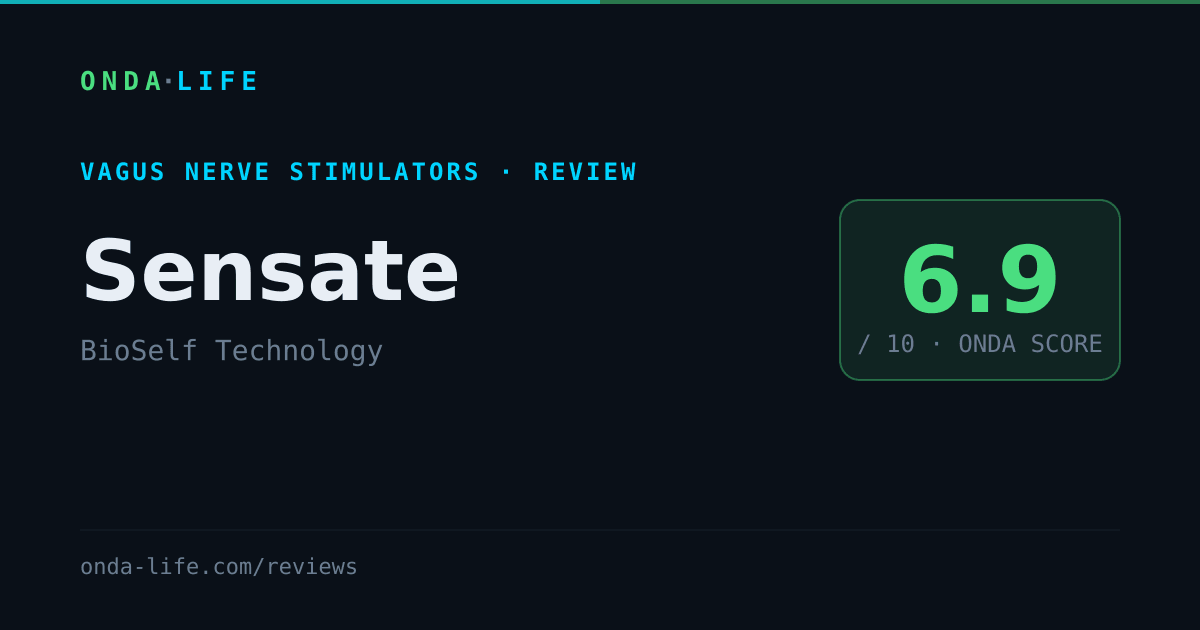
BioSelf TechnologyInfrasonic chest-worn pebble, marketed as a vagal modulatorEvidence-based assessment
Sensate review
Updated 2026-10-10
6.2
/ 10
A passive, calming infrasonic device — gentle, well-loved, with mechanism evidence that lags its user enthusiasm.Best for sound-paired evening wind-down rituals — comfort and calm over acute stimulation.
Sensate is a chest-placed smooth-stone-shaped device that emits low-frequency infrasonic vibration into the thoracic cavity, paired with synced soundscapes through the phone. The premise — that infrasonic resonance against the chest acts on vagal pathways via thoracic mechanoreceptors — is plausible and supported by a small published trial, but mechanism evidence is thinner than electrical tVNS. As a passive 10-minute wind-down ritual it is highly effective for most users.
How we tested: Evidence-based assessment — scored from BioSelf Technology product documentation, the published Sensate trial and independent 2026 reviews. Not hands-on tested by ONDA.
One published RCT showing stress/HRV improvement; its company-funded studies do not count as evidence in ONDA scores. Its “Research has proven” line is about vagus-nerve activation in general; its sleep figures come from a company study report.
Stimulation mechanism
5.5
Infrasonic chest resonance — proposes vagal stimulation via thoracic mechanoreception. Mechanism plausible but less direct than tVNS.
Protocol flexibility
7.5
Library of paired soundscape sessions (10–30 minutes) for sleep, focus, anxiety reduction. Content depth is unusual for the category.
Comfort and wearability
8.5
Smooth pebble lies on the sternum; no electrodes, no skin contact issues. Most-pleasant device in this list.
Biofeedback and data
5.5
App logs sessions and pairs with Apple Health for HRV import; no on-device measurement.
Value
6.5
$299 hardware plus Sensate+ subscription ($79/yr) to unlock the full session library.
Pros
+The most-pleasant device in this category to actually use
+Sound-paired sessions make it a complete wind-down ritual, not just hardware
+No electrodes, no pads, no skin contact concerns
+Strong sleep-onset use case
Cons
−Mechanism evidence is thinner than electrical tVNS
−Effect is subtle compared to direct vagal stimulation
−Phone tethered — requires the app running during sessions
Price: $299 one-time; Sensate+ subscription ~$79/yr (as of 2026-05-21)
Where it leads
Sensate is the most pleasant device in this category. It is a smooth river-stone-shaped pebble that lies on the sternum during a 10–30 minute session, emitting low-frequency infrasonic vibration through the chest while a paired soundscape plays through headphones. The premise — that infrasonic resonance modulates vagus nerve tone via thoracic mechanoreceptors, pulling the system toward parasympathetic calm — is supported by one published RCT and several company-funded studies. As a passive evening wind-down ritual it is well-loved by daily users.
What are the downsides of Sensate?
Mechanism evidence is the weak point. The infrasonic-to-vagus pathway is plausible, but the trial base is small compared to either electrical tVNS or even Apollo Neuro’s vibrotactile-mechanoreceptor model. The effect is subtle by design — sessions are about cumulative calming, not the acute parasympathetic shift a direct electrical device can produce. Full content access requires the Sensate+ subscription, which adds to the long-term cost.
Who should buy Sensate?
Choose Sensate if you want a calming evening ritual you will actually use — sound-paired, passive, comfortable — rather than a clinical-grade stimulation device. If you want acute electrical vagus stimulation, Nurosym, Truvaga 350 or Pulsetto are the right shape. Apollo Neuro is the closest non-electrical alternative if you want all-day passive wear instead of session-based use.
Background reading
The biology behind what these devices target — and the protocols that compound with the hardware.
Vagus nerve exercises — why the vagus nerve sits upstream of HRV, sleep, mood and inflammation
Sensate is worth it for evening wind-down rituals where comfort matters more than strong stimulation. It is the most pleasant device in its category to use, pairs vibration with sound, and needs no electrodes or pads. Expect a subtle effect, though: its mechanism evidence is thinner than electrical tVNS.
How much does the Sensate cost?
Sensate costs $299 one-time for the device. The full session library requires the Sensate+ subscription, at roughly $79 per year. Factor that ongoing cost in, because the sound-paired sessions are a large part of what makes the device a complete wind-down ritual.
What are the downsides of the Sensate?
Sensate's downsides are thinner mechanism evidence than electrical tVNS and an effect that feels subtle next to direct vagal stimulation. The full library sits behind the Sensate+ annual subscription, and the device is phone-tethered, so the app must run during every session.
Who is the Sensate best for?
Sensate is best for people who want a sound-paired evening wind-down ritual and value comfort and calm over acute stimulation. It suits sleep-onset use and anyone wary of skin contact, since it uses no electrodes or pads. Those wanting direct vagal stimulation should look at electrical tVNS instead.