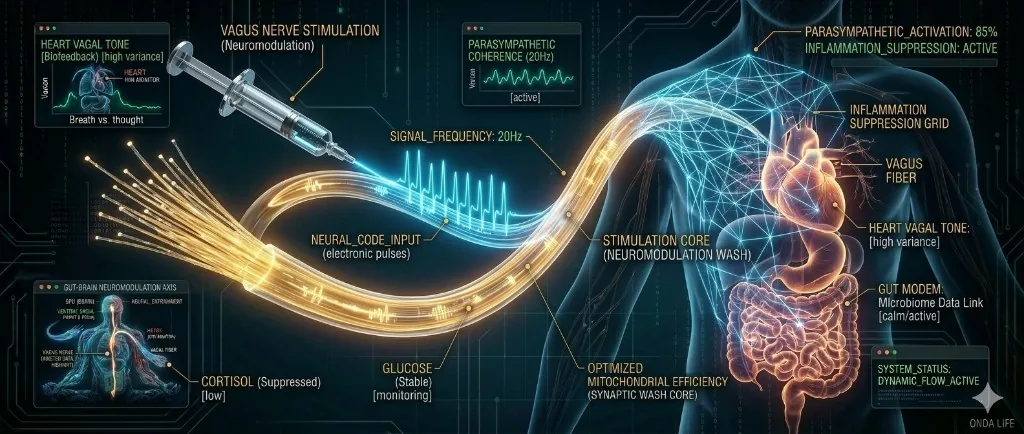
[ ELECTRIC_MEDICINE: NEUROMODULATION ]
"The biological nervous system is a complex electrochemical network. Most traditional optimization methods—supplements, nutrition, lifestyle—operate through the slow chemical pathway. Neuromodulation is a direct access point to your brain's 'Command Line.'
In the ONDA model, we view the Vagus Nerve and the Cerebral Cortex as data buses. By utilizing targeted, low-frequency electrical impulses, researchers are testing whether they can reduce 'System Noise' (stress), support sleep, or sharpen focus — effects that so far are modest, inconsistent and not instant. This is not medicine in the classical sense—it is the direct management of your consciousness's Hardware."
What role does the vagus nerve play in neuromodulation?
The Vagus Nerve is the primary communication channel between your CPU (the brain) and the rest of the system (the organs). Modulating this nerve allows for an immediate system-wide shift from 'Emergency Mode' (Sympathetic) to 'System Recovery' (Parasympathetic). In 2026, this no longer requires implants; non-invasive wearable modules targeting the auricular branch or the neck are sufficient to bypass the standard hormonal lag.
What is tDCS (transcranial direct current stimulation)?
Transcranial Direct Current Stimulation (tDCS) allows for the manipulation of neuronal excitability thresholds. This is effectively 'overclocking' specific brain regions: we apply a current to the Prefrontal Cortex to accelerate data processing or to the Motor Cortex to expedite the encoding of new physical skills.
[ EXECUTION_PROTOCOLS ]
PROTOCOL_01 > VAGUS NERVE RESET
The Hack: Utilize a transcutaneous stimulation device (e.g., Pulsetto or Nurosym) on the left branch of the Vagus Nerve for 10 minutes.
The Logic: Low-frequency impulses mimic deep-relaxation signals. This is a 'Hardware Hack' to deceive the brain into believing the body is in total safety, overriding the stress response.
PROTOCOL_02 > COGNITIVE FOCUS (NEURAL ENTROPY)
The Hack: Apply a tDCS protocol (1.5 – 2 mA) to the F3 zone (Left Prefrontal Cortex) prior to a deep work session.
The Logic: Lowering the activation threshold of neurons in the decision-making hub. This expands 'RAM' bandwidth and filters out distracting external signals.
PROTOCOL_03 > ELECTRICAL SLEEP CALIBRATION (CES)
The Hack: Cranial Electrotherapy Stimulation (CES) for 30 minutes before system shutdown (sleep).
The Logic: Harmonizing Alpha and Delta wave frequencies. This helps the system exit 'Looping Thought' cycles, transitioning Hardware into a state ready for MELATONIN_UPLOAD.
[ HARDWARE_VALIDATION ]EXAMPLE_DEVICE: HRV monitor (chest strap or wearable)METRIC: HRV before vs. after a session, compared with your own baselineSTATUS: TRACK_OVER_WEEKSIllustration — not a measurement
[ FINALIZE_ANALYSIS ]
System Integrity: High. Signal Quality: Stable.
Recommended tools
Neuromodulation devices for consumers exist in three regulatory tiers — FDA-cleared prescription, OTC clinical platform and CE-marked consumer.
- •gammaCore Sapphire CV — the only FDA-cleared non-invasive VNS device (prescription; migraine, cluster headache, paroxysmal hemicrania, hemicrania continua)
- •Nurosym — consumer auricular tVNS with the largest independent trial record (about twenty device studies; 50+ according to the manufacturer, as of October 2026)
- •Truvaga 350 — gammaCore platform without the prescription gate