HRV and Age: Why Your Number Drifts Down Over the Years
Editorial: ONDA Life (Yakiv Bilenko) · Updated November 11, 2026
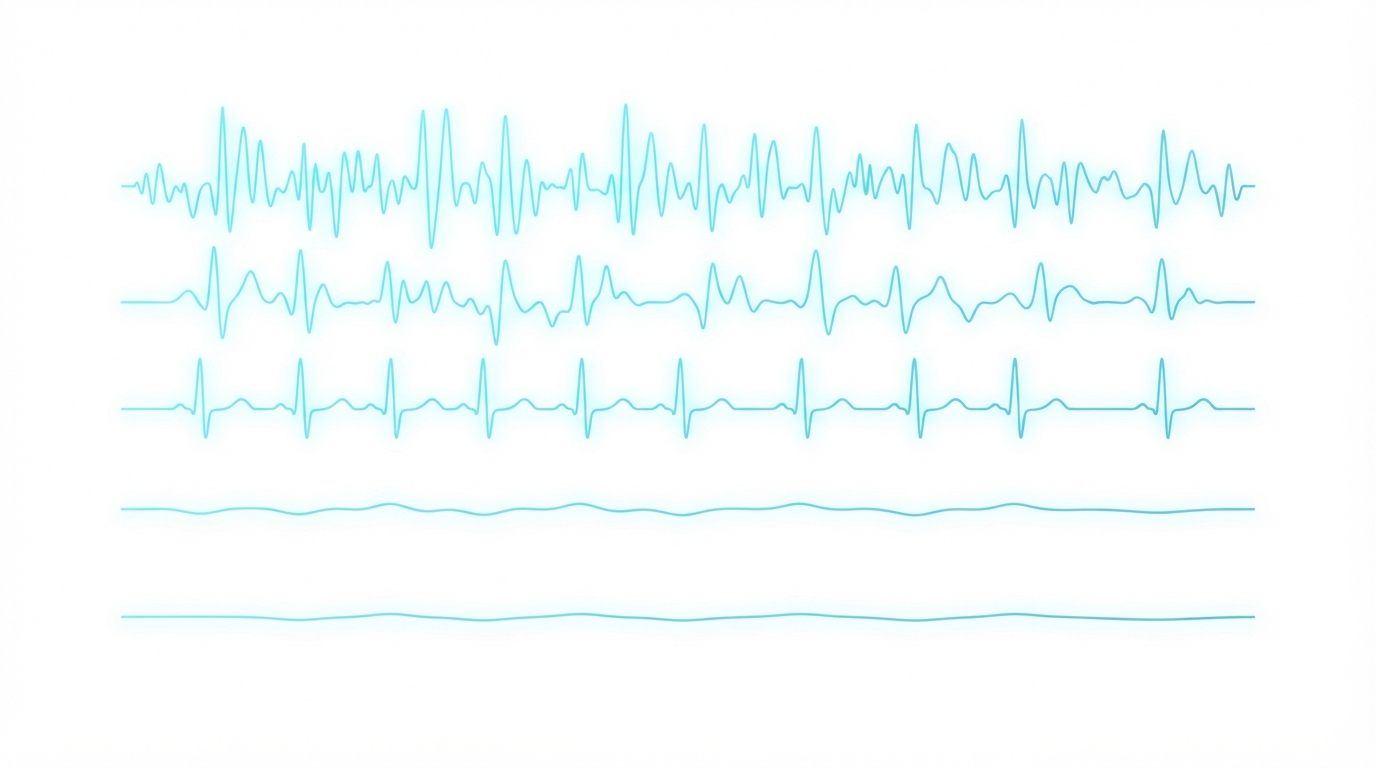
Heart rate variability falls with age in every large group of healthy people studied, from hospital recordings to millions of wrist trackers. How fast it falls depends on the metric. Published reference values differ widely between studies, so there is no single normal number for an age. A value below the average for your age is not a diagnosis; changes against your own baseline say more.
Key points
- HRV declines with age in healthy people across all large datasets, with a pattern that depends on the metric.
- Measures of fast beat-to-beat change, such as RMSSD, fall faster in early adulthood and then level off, while overall variability falls more gradually.
- Differences between men and women are small and fade in older age groups.
- Reference values differ between studies, devices and recording lengths, so there is no universal norm.
- Large wrist-tracker data show the same decline with age, but these benchmarks come from one manufacturer's devices.
- A value below the average for your age is not a disease; compare it with your own baseline over time.
How does HRV change with age?
Heart rate variability (HRV) is the natural variation in time between heartbeats. One of the most consistent findings in HRV research is that it falls with age. It does so in healthy people, in day-long hospital recordings, in short clinical ECGs and in data from millions of wrist trackers [S1] [S5] [S6]. If your HRV is lower than it was ten years ago, that alone is expected.
This page explains how age changes HRV and how to read that change. It does not give age norms; average values by age are collected in the article on normal HRV by age.
How does it work?
HRV reflects how the autonomic nervous system adjusts the heart from beat to beat. Measures of fast beat-to-beat change, such as RMSSD, are read as reflecting vagally mediated changes. With age, the heart and its nervous control change, and the variability shrinks.
The decline does not follow one curve. In a study covering nine decades, RMSSD and similar measures fell fastest and then levelled off by middle age, while SDNN fell more gradually [S1]. The relationship between HRV and resting heart rate also changes: in one study it was weaker in older adults than in younger ones, and it differed between men and women [S7]. So the same number can mean different things at different ages.
How is it measured?
Studies of age use very different recordings: a full day with a Holter monitor [S1] [S4], five minutes at rest [S3], ten seconds of a standard ECG [S5] or wrist-tracker data at a fixed hour of the morning [S6]. Each gives different values for the same person. Recording length, setting, breathing and analysis all affect HRV, which is why values from different methods are not interchangeable [S8].
That is also why a "normal" value depends on where it comes from. A review of short-term studies found values lower than the old Task Force norms and large differences between people [S2]. A study of day-long recordings reached reference values that differed considerably from the same Task Force figures [S4].
What affects it?
Age is one factor among many. Fitness and daily activity, sleep, illness, alcohol, medication, breathing and the time of day all change HRV [S6] [S8]. In the wrist-tracker data, more daily steps went with higher HRV at every age, but this was a cross-sectional comparison, not proof that activity reverses ageing [S6]. Other everyday factors are explained in Why is my HRV low?
What does the evidence show?
Decline with age: established. HRV falls with age in healthy people on every time-domain measure, with a pattern that depends on the measure [S1]. Large clinical datasets from birth to old age show the median and the lower limit of normal falling steadily [S5], and data from millions of wrist trackers show the same decline [S6].
Pattern by metric: context-dependent. RMSSD and similar measures fall fastest and then level off, while SDNN falls more slowly [S1]. Which metric your device shows changes how steep the drop looks.
Men and women: context-dependent. Differences between the sexes appear in younger adults but shrink with age and disappear in older age groups [S1] [S3].
Reference values: context-dependent. Published values differ between studies, devices and recording lengths, and several differ considerably from the older Task Force norms [S2] [S4]. Without matching reference values, HRV can best be compared within the same person over time [S4].
Wearable benchmarks: emerging. The largest wrist-tracker study published benchmark tables by age and sex and suggests using them for individual interpretation [S6]. They come from one manufacturer's devices and algorithm, and they do not transfer to other devices.
Hormone therapy: emerging. In a small subgroup of post-menopausal women, hormone replacement therapy did not change how HRV related to resting heart rate [S7].
Unknown. How much of the decline in one person comes from ageing itself and how much from changes in fitness, sleep and health, and whether wearable values from different brands age in the same way.
What it does not tell you
- Not a diagnosis. A value below the average for your age is not a disease; healthy people span a wide range [S2]. A single low HRV reading does not by itself mean you are stressed or unwell [S8].
- Not comparable across devices. An age average from one device or method does not apply to readings from another [S6] [S8].
- Not a "biological age" score. Studies describe group averages by age; they do not turn your HRV into an age.
- Not a reason to chase a younger number. Associations with activity and fitness are not proof that a younger HRV can be restored.
In ONDA
ONDA builds a personal baseline from the values stored in Apple Health [S9]. The window is 14 days, and ONDA compares your latest day of data with your own corridor — the average of your earlier days with enough data plus or minus one standard deviation — and flags it only when it is at least 1.5 standard deviations outside and has changed by a minimum amount. A value outside your corridor describes a change in your own data, not its cause. A slow drift over the years is expected with age.
Educational information, not a diagnosis or medical treatment.
Evidence at a glance
| Claim | Evidence | Limitation |
|---|---|---|
| In healthy people, HRV declines with age on every time-domain measure, with a pattern that depends on the measure. [S1] | Established | Small sample per decade in an older Holter study; the decline itself is repeated in every large dataset. |
| RMSSD and pNN50 fall fastest and then level off by middle age, while SDNN and SDANN fall only very gradually. [S1] | Context-dependent | Cross-sectional comparison of age groups, not the same people followed over time. |
| Sex differences in HRV are seen in younger adults but shrink with age and disappear in older age groups. [S1][S3] | Context-dependent | Differences vary by metric and cohort; group averages, not individual expectations. |
| Short-term HRV values reported in the literature are lower than the Task Force norms, and values vary widely between people. [S2] | Established | Systematic review of studies with differing methods; methodological differences explain part of the spread. |
| Reference values for day-long recordings by sex and age group differed considerably from the values published by the Task Force. [S4] | Context-dependent | Volunteer sample covering ages twenty to sixty only; Holter recordings, not wearables. |
| Before such reference values existed, HRV findings could only be compared within a group or within the same person over time. [S4] | Context-dependent | Authors' framing of the field; still applies to devices without validated norms. |
| In heart-rate-corrected ten-second ECG data from birth to old age, the median and lower limit of normal decreased steadily with age. [S5] | Established | Very short clinical ECGs from Dutch cohorts; corrected values are not comparable with wearable readings. |
| In data from millions of wrist trackers, HRV metrics decrease with age. [S6] | Established | One manufacturer's devices and algorithm, funded by that manufacturer; cross-sectional; its LF and HF interpretation is the authors' own. |
| The authors of the wrist-tracker study suggest population distributions of HRV can serve as a framework for individual interpretation. [S6] | Emerging | Benchmarks apply to that device and time of day; other devices and algorithms give different values. |
| The link between vagally mediated HRV and resting heart rate depends on sex and age, and hormone replacement therapy showed no effect on it in a small subgroup. [S7] | Emerging | One study with a very small hormone therapy subgroup; does not apply to other health outcomes. |
| Recording length, setting, breathing and analysis method all affect HRV values, so values from different methods are not interchangeable. [S8] | Guideline / expert consensus | Methodological guideline (expert consensus) for research recordings. |
| A single low HRV reading does not by itself mean a person is stressed or unwell; HRV is not a specific marker of a state. [S8] | Guideline / expert consensus | Methodological guideline (expert consensus), not a study of ageing. |
| ONDA builds a personal baseline from values in Apple Health and compares new values with the user's own corridor. [S9] | Established | Describes how the app works only; not evidence for any health claim. |
Sources
- [S1] Umetani et al. (1998). Twenty-four hour time domain heart rate variability and heart rate: relations to age and gender over nine decades. Journal of the American College of Cardiology. DOI 10.1016/s0735-1097(97)00554-8 · PMID 9502641 · one co-author is affiliated with the HeartMath Institute
- [S2] Nunan, Sandercock & Brodie (2010). A quantitative systematic review of normal values for short-term heart rate variability in healthy adults. Pacing and Clinical Electrophysiology. DOI 10.1111/j.1540-8159.2010.02841.x · PMID 20663071
- [S3] Voss et al. (2015). Short-term heart rate variability—influence of gender and age in healthy subjects. PLOS ONE. DOI 10.1371/journal.pone.0118308 · PMID 25822720
- [S4] Sammito & Böckelmann (2016). Reference values for time- and frequency-domain heart rate variability measures. Heart Rhythm. DOI 10.1016/j.hrthm.2016.02.006 · PMID 26883166
- [S5] van den Berg et al. (2018). Normal Values of Corrected Heart-Rate Variability in 10-Second Electrocardiograms for All Ages. Frontiers in Physiology. DOI 10.3389/fphys.2018.00424 · PMID 29755366
- [S6] Natarajan et al. (2020). Heart rate variability with photoplethysmography in 8 million individuals: a cross-sectional study. The Lancet Digital Health. DOI 10.1016/S2589-7500(20)30246-6 · PMID 33328029 · funded by the wearable's manufacturer (Fitbit)
- [S7] Carnevali et al. (2025). Sex and age differences in the association between heart rate variability and cardiac chronotropy: A replication-extension study. Physiological Reports. DOI 10.14814/phy2.70399 · PMID 40495293
- [S8] Carter et al. (2026). Guidelines for rigor and reproducibility of heart rate variability within human cardiovascular research. Am J Physiol Heart Circ Physiol. DOI 10.1152/ajpheart.00041.2026 · PMID 42495990
- [S9] ONDA — product documentation: How ONDA works. How ONDA works.
Related
- ScienceWhat a Single HRV Value Can and Can't Tell You
- ScienceRMSSD — What This HRV Metric Reflects, and What It Doesn't
- ScienceSDNN — What This HRV Metric Measures, and What It Doesn't
- ScienceHRV Baseline: Why Your Own Normal Matters More Than Any Norm
- ScienceCan You Trust HRV From a Smartwatch or Ring?
- ScienceExercise and HRV: What Training Does and What HRV Guidance Shows
- ScienceWhy Is My HRV Low? Common Causes and What the Evidence Shows
- GlossaryHeart Rate Variability
- ArticleNormal HRV by Age: Chart for Men and Women, and What’s a Good HRV
- ArticleYour Baseline Knows First: The Signal Your Body Sends Before You Notice
- ToolApple Watch Baseline
How ONDA Science pages are made: every number comes from one checked list of facts, every claim is mapped to its sources and graded by strength of evidence, and sources need a DOI or PMID (manufacturer documentation is used only for device facts).