Sleep Apnea and Wearables: What a Watch Can Tell You
Editorial: ONDA Life (Yakiv Bilenko) · Updated November 18, 2026
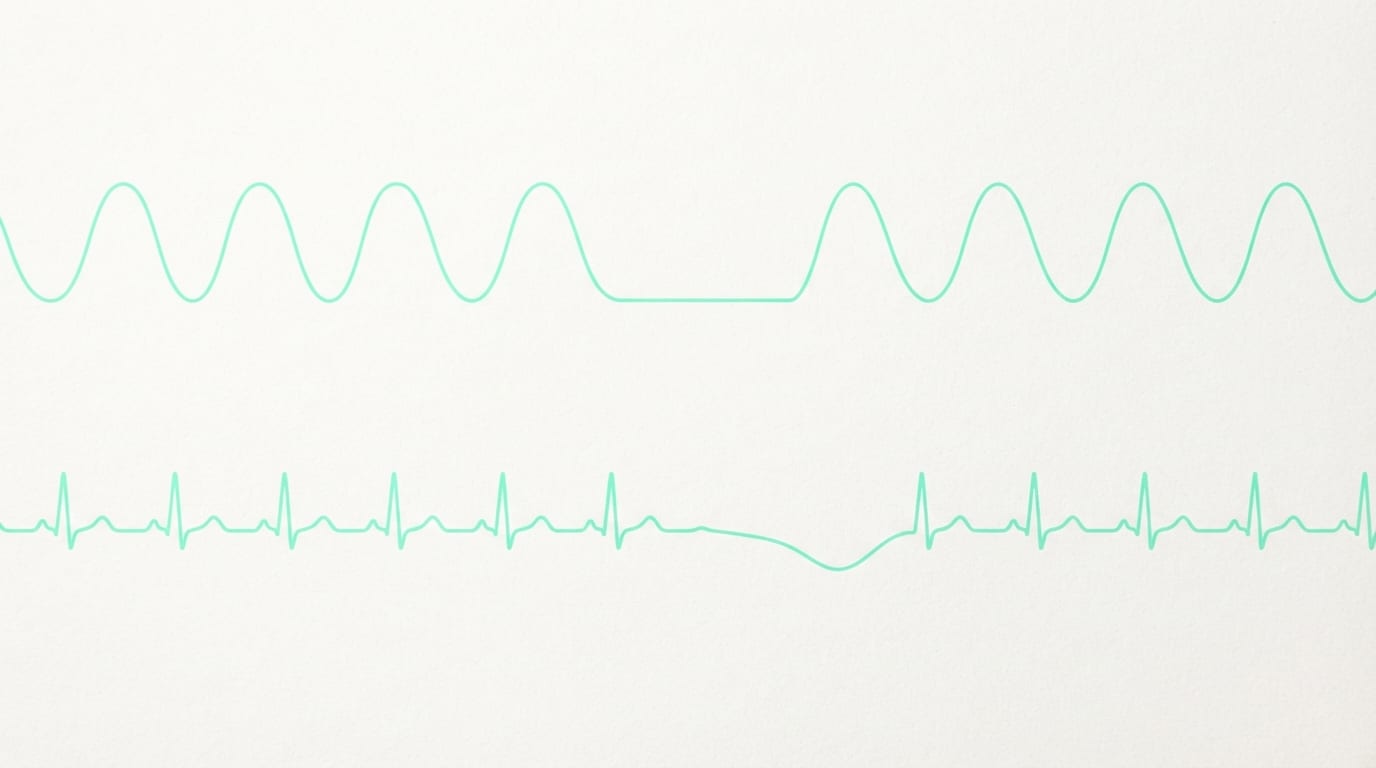
A wearable can notice patterns that may be worth discussing, but it cannot diagnose or rule out obstructive sleep apnea [S1, S3, S4]. The AASM names an overnight sleep study as the standard diagnostic test; a home sleep apnea test is an option for selected adults after a clinical evaluation [S1]. The Apple Watch Sleep Apnea Notification Feature is a risk notification, not a diagnosis, and no notification does not rule out sleep apnea [S3]. Reviews of oxygen devices support screening in selected settings, but a positive result needs confirmation with a diagnostic test [S4]. HRV studies show group-level differences in sleep apnea, but they do not establish a wearable HRV test or a personal diagnostic threshold [S5].
Key points
- Polysomnography is the standard diagnostic test; a technically adequate home test is an option for selected adults after clinical evaluation [S1].
- A negative, unclear or technically inadequate home sleep apnea test should be followed by polysomnography when sleep apnea remains the concern [S1].
- The Apple Watch Sleep Apnea Notification Feature is intended to flag patterns suggestive of moderate-to-severe sleep apnea, not to diagnose it [S3].
- The Apple feature uses accelerometer data over consecutive 30-day windows, not blood-oxygen data [S3].
- A systematic review found that oxygen-based screening devices have limited specificity; positive results need confirmation [S4].
- HRV meta-analysis findings describe group differences and do not provide a validated consumer-wearable test for an individual [S5].
- ONDA builds a personal baseline from Apple Health HRV, resting heart rate and respiratory rate; it does not detect, predict or treat sleep apnea [S6].
What can a wearable tell you about sleep apnea?
A wearable may record pulse, movement, oxygen-related signals or patterns that suggest disturbed breathing, depending on the product [S3] [S4]. These signals are not all the same, and they do not all measure breathing directly [S3] [S4]. A notification or unusual overnight pattern can be a reason to discuss sleep testing, but it is not a diagnosis [S1] [S3].
Which tests can diagnose obstructive sleep apnea?
The American Academy of Sleep Medicine (AASM) names polysomnography, usually called a sleep study, as the standard test for adults with suspected obstructive sleep apnea after a full sleep evaluation [S1]. A home sleep apnea test can be used for some adults who are otherwise uncomplicated and have signs that suggest a higher risk of moderate-to-severe disease [S1]. It must use a technically adequate medical test device and sit within a clinical pathway [S1]. A negative, unclear or technically inadequate home test should be followed by polysomnography when the question remains [S1]. The AASM recommends polysomnography rather than a home test for people with certain major heart or lung conditions, possible breathing-muscle weakness, suspected hypoventilation, chronic opioid use, a history of stroke or severe insomnia [S1].
What does an Apple Watch sleep apnea notification mean?
The FDA record describes the Apple Watch Sleep Apnea Notification Feature as an over-the-counter risk notification for adults who have not already been diagnosed with sleep apnea [S3]. It looks for patterns that may suggest moderate-to-severe sleep apnea; it is not intended to diagnose, treat or manage the condition [S3]. The feature analyses accelerometer data over consecutive 30-day windows, rather than measuring each breathing pause as it happens [S3]. The FDA submission states that no notification does not mean that sleep apnea is absent [S3]. In practical terms, a notification is a reason to seek a clinical assessment and possible sleep test, not a diagnosis [S1] [S3].
The Apple feature should not be confused with oxygen-based screening [S3]. In the FDA comparison, Apple's feature uses accelerometer data, while the Samsung predicate device uses blood-oxygen sensor data [S3]. These are different signals and different device designs [S3].
What can oxygen-based wearable screening show?
A systematic review compared oximetry-based devices with polysomnography in adults and separated consumer wearables from medical devices [S4]. The authors said these tools may support screening in selected high-risk adults, but positive results should be confirmed with a diagnostic method [S4]. The review's abstract reports limited specificity, which means that some people without sleep apnea may still receive a positive screening result [S4]. Study-level differences, risk of bias and subgroup heterogeneity could not be checked from the published abstract, so pooled accuracy figures are not used here [S4]. Oximetry-based screening evidence should not be applied to every wrist sensor or to Apple's accelerometer-based notification feature [S3] [S4].
What does HRV research show in sleep apnea?
A systematic review and meta-analysis found group-level differences in autonomic and HRV measures between people with obstructive sleep apnea and control groups [S5]. The reported patterns differed by disease severity and by whether measurements were collected during the day or at night [S5]. This suggests that sleep apnea can be linked with changes in heart regulation, but it does not show that HRV can identify the condition in one person [S5]. The review does not establish a validated HRV threshold for a smartwatch, ring or app to diagnose sleep apnea [S1] [S5]. Pooled HRV values are not presented here, because heterogeneity and risk of bias for each measure were not checked [S5].
What can these signals not tell you?
A consumer wearable reading cannot replace polysomnography or a clinician-directed home sleep apnea test [S1] [S2]. HRV is not a diagnostic test for sleep apnea, and an ordinary HRV trend cannot confirm or rule out the condition [S1] [S5]. A watch notification does not tell you the final diagnosis or the severity of sleep apnea [S3]. No notification does not rule it out [S3]. If you have loud snoring, witnessed pauses in breathing, gasping during sleep or persistent daytime sleepiness, discuss the symptoms with a healthcare professional even if your wearable shows no alert [S1] [S3].
What does the evidence support?
Guideline-level evidence: polysomnography is the standard diagnostic test, while home testing is suitable for selected adults within a clinical pathway [S1]. Device-specific regulatory evidence: the Apple feature is a risk-notification tool with clear limits, not a diagnostic test [S3]. Screening evidence: oximetry-based devices may help identify people who need further assessment, but positive results need confirmation [S4]. HRV evidence: meta-analysis supports group-level autonomic differences, not individual diagnosis or a consumer-wearable threshold [S5].
What does ONDA do?
ONDA builds a personal baseline from HRV, resting heart rate and breathing rate values in Apple Health [S6]. This is a comparison with a person's own recorded history, not a sleep-apnea assessment. ONDA is not a medical device and does not detect, predict or treat sleep apnea. It does not replace a sleep study or medical evaluation.
Educational information, not a diagnosis or medical treatment.
Evidence at a glance
| Claim | Evidence | Limitation |
|---|---|---|
| Polysomnography is the standard diagnostic test for adults with suspected obstructive sleep apnea after a comprehensive sleep evaluation. [S1] | Guideline / expert consensus | AASM adult diagnostic-testing guideline; diagnosis still depends on clinical evaluation and appropriate test interpretation. |
| A technically adequate home sleep apnea test can be used for selected uncomplicated adults at increased risk of moderate-to-severe OSA. [S1] | Guideline / expert consensus | Not a general consumer-wearable test; selection follows a comprehensive clinical evaluation. |
| A negative, inconclusive or technically inadequate home sleep apnea test should be followed by polysomnography. [S1] | Guideline / expert consensus | Applies to the AASM diagnostic pathway when OSA remains a concern. |
| The AASM position statement distinguishes consumer sleep technology from clinical diagnosis. [S2][S1] | Context-dependent | The 2018 statement predates later FDA-authorized risk-notification features; the current AASM diagnostic pathway remains the anchor. |
| The Apple Watch Sleep Apnea Notification Feature is intended to notify users about patterns suggestive of moderate-to-severe sleep apnea, not to diagnose or treat it. [S3] | Context-dependent | Specific to FDA 510(k) K240929 and its stated intended-use population; not a general claim about every watch or sleep feature. |
| The FDA submission says that no notification does not indicate that sleep apnea is absent. [S3] | Context-dependent | A negative notification result cannot rule out OSA. |
| The Apple feature analyses accelerometer data over consecutive 30-day windows. [S3] | Context-dependent | Describes the Apple feature in the FDA submission; it is not an instantaneous breathing measurement. |
| The Apple feature's sensor input differs from the blood-oxygen input used by the Samsung predicate device in the FDA comparison. [S3] | Context-dependent | Do not describe Apple's cleared feature as an SpO2 or PPG apnea detector. |
| A systematic review found that oximetry-based devices may be used for screening in selected high-risk adults, with positive results confirmed by a diagnostic method. [S4] | Context-dependent | The review includes both consumer wearables and medical devices; full-text heterogeneity and risk-of-bias details were not accessible, so pooled accuracy figures are not used. |
| A systematic review and meta-analysis found group-level differences in HRV-related autonomic measures between OSA patients and controls. [S5] | Context-dependent | Group-level association only; metric-specific heterogeneity and risk of bias were not fully checked; this does not establish an individual diagnostic threshold. |
| HRV findings vary by OSA severity and by the time of recording. [S5] | Context-dependent | The review reports different patterns across severity and collection-time subgroups; no consumer wearable diagnostic performance follows from this. |
| ONDA builds a personal baseline from Apple Health HRV, resting heart rate and respiratory rate. [S6] | Established | Product documentation only; it does not establish any sleep-apnea screening, diagnosis, prediction or treatment capability. |
Sources
- [S1] Kapur et al. (2017). Clinical Practice Guideline for Diagnostic Testing for Adult Obstructive Sleep Apnea: An American Academy of Sleep Medicine Clinical Practice Guideline. Journal of Clinical Sleep Medicine. DOI 10.5664/jcsm.6506 · PMID 28162150 · AASM clinical practice guideline for adult diagnostic testing; task-force guideline, not a consumer-device validation study; funding and author disclosures not re-audited; Crossref: no corrections or updates (checked 2026-11-18).
- [S2] Khosla et al. (2018). Consumer Sleep Technology: An American Academy of Sleep Medicine Position Statement. Journal of Clinical Sleep Medicine. DOI 10.5664/jcsm.7128 · PMID 29734997 · AASM Board of Directors position statement; predates the 2024 Apple FDA clearance and is used only for the general boundary between consumer sleep data and clinical diagnosis; funding and individual COI details not stated in the accessible article text; Crossref: no corrections or updates (checked 2026-11-18).
- [S3] U.S. Food and Drug Administration (2024). 510(k) Summary: Sleep Apnea Notification Feature (K240929). FDA 510(k) Premarket Notification database. · official documentation · Official FDA 510(k) record and manufacturer-submitted summary; decision was Substantially Equivalent, not a diagnostic authorization; Apple submitted the clinical performance data; Crossref does not apply; FDA record checked 2026-11-18.
- [S4] Dantas et al. (2025). Oximetry-based devices in diagnosis of obstructive sleep apnea: A systematic review and meta-analysis. Sleep Medicine Reviews. DOI 10.1016/j.smrv.2025.102139 · PMID 40749523 · Systematic review and meta-analysis of adult oximetry-based devices, with consumer-wearable and medical-device subgroups; full text was not accessible, so subgroup heterogeneity, risk of bias and threshold variation remain unverified; funding/COI not established from the accessible PubMed record; Crossref: no corrections or updates (checked 2026-11-18).
- [S5] Wang et al. (2023). Heart rate variability changes in patients with obstructive sleep apnea: A systematic review and meta-analysis. Journal of Sleep Research. DOI 10.1111/jsr.13708 · PMID 36070876 · Systematic review and meta-analysis comparing OSA groups with controls; PubMed records non-U.S. government research support; author-level COI details not verified here; metric-specific heterogeneity and risk of bias were not extracted, so no pooled values are used; Crossref: no corrections or updates (checked 2026-11-18).
- [S6] ONDA — product documentation: How ONDA works. How ONDA works. · Product documentation, cited only to describe the app's personal-baseline inputs and not as evidence about sleep apnea.
Related
How ONDA Science pages are made: every number comes from one checked list of facts, every claim is mapped to its sources and graded by strength of evidence, and sources need a DOI or PMID (manufacturer documentation is used only for device facts).