How ONDA Measures and Interprets Your Body's Signals
Yakiv Bilenko — editor · Updated October 6, 2026
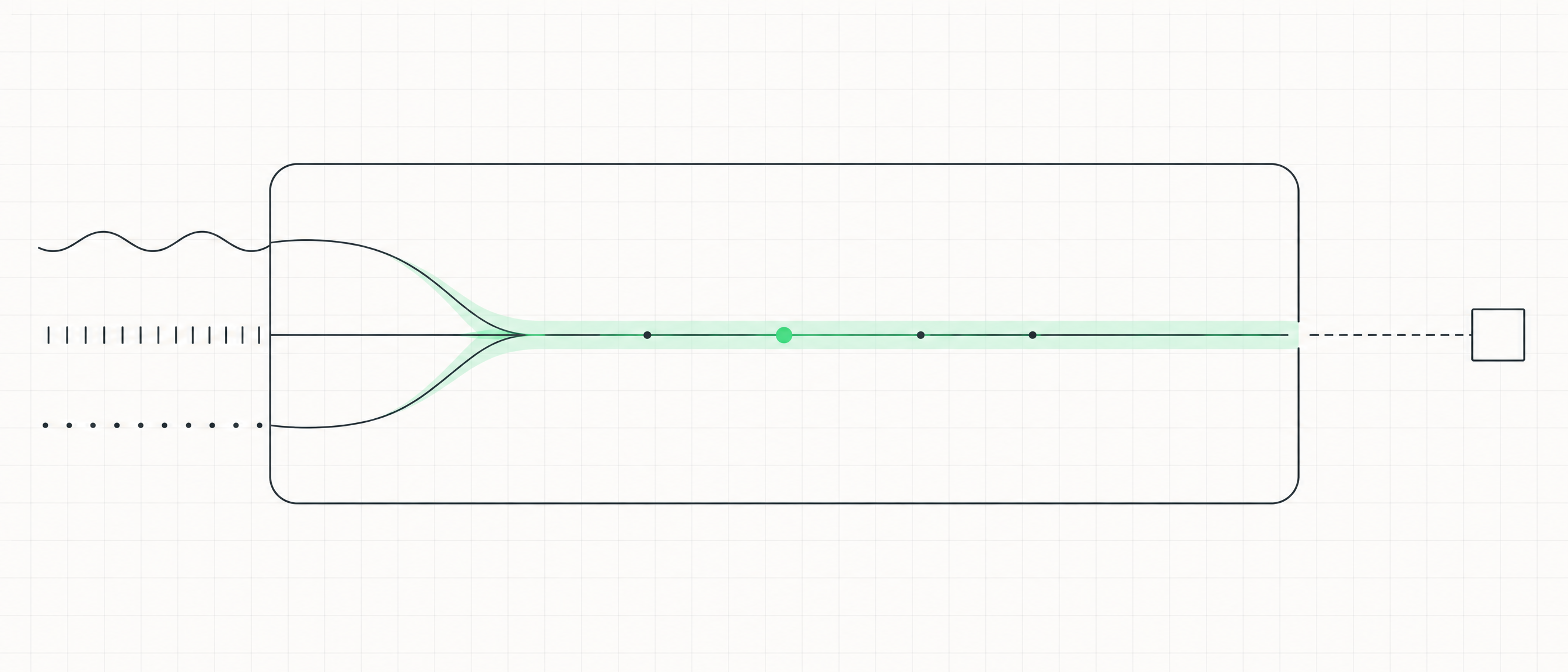
ONDA reads heart rate variability, resting heart rate and breathing rate from Apple Health, and can take a fingertip pulse with the iPhone camera. It builds a personal corridor from your own nights and points out nights that fall well outside it. These are descriptive comparisons, not a diagnosis. ONDA has run no accuracy or efficacy study of its own, and its numbers are only as good as the device that recorded them.
Key points
- ONDA reads heart rate variability as SDNN, resting heart rate and breathing rate from Apple Health, written by Apple Watch or another device that syncs there; it only reads, never writes.
- The iPhone camera gives a pulse reading and a breathing estimate, not heart rate variability, and the live coherence score does not work on the camera.
- Your baseline and signals compare you with your own recent nights, never with a population norm, and they stay silent until enough nights exist.
- A signal needs a large change measured in your own spread and a minimum absolute or relative change, so small wobbles are ignored.
- The baseline, signals and reports are calculated on your phone. Starting with version 1.9.3, practice progress stays on the device without an account and syncs only after you sign in, and the diary is device-only.
- ONDA is not a medical device, has no published study of its own on accuracy or benefit, and does not diagnose anything.
What is ONDA's method?
ONDA is a breathing and biofeedback app. It reads signals that other devices have already recorded, compares them with your own history and shows you where a night stands. This page describes that method as it is written in the app, including where it stops. It is a description of a product, not a scientific finding, and every rule below is a design choice rather than a validated clinical threshold.
Where does the data come from?
Apple Health. With your permission, ONDA reads heart rate variability, resting heart rate and breathing rate from Apple Health. Heart rate variability arrives as SDNN, the form Apple Health stores it in, and ONDA does not recompute it from beat intervals. The values are written by Apple Watch or by another device whose app syncs heart data to Apple Health [S1]. ONDA only reads; it never writes anything to Apple Health. It also reads sleep timing for its sleep-regularity view and a few single values around the baseline, such as walking heart rate and an estimated aerobic fitness value, when Health holds them.
The iPhone camera. With a fingertip over the rear camera, ONDA estimates your pulse from the colour changes in the skin, and a breathing estimate from the rhythm of that pulse. The camera gives a pulse, not heart rate variability: until a watch or another tracker writes heart rate variability to Apple Health, that part of the baseline stays empty [S1]. The live coherence score is also unavailable on the camera; it appears only with an Apple Watch.
What ONDA does not measure. It does not record an ECG, blood pressure, blood oxygen, temperature, brain activity, hormones or blood markers, and it does not score sleep stages or give a single readiness number. See what ONDA measures for the full register.
How is your baseline built?
The baseline is the range your own body usually sits in. ONDA builds it over 14 days from nightly values in Apple Health [S1] [S4]. Starting with version 1.9.3, the heart rate variability chart shows that whole window as soon as Apple Health access is granted, instead of filling in night by night. Nights with too few samples are dropped before any calculation, and heart rate variability is taken only from overnight samples.
For signals, ONDA compares each night with your own corridor — the average of your recent nights plus or minus one standard deviation — and flags a night only when it is at least 1.5 standard deviations outside and has changed by a minimum amount [S1]. ONDA stays silent until it has at least 7 nights, so early weeks show a baseline that is still building rather than a judgement. The minimum changes it requires are: resting heart rate up at least 5 bpm, HRV down at least 15%, breathing rate up at least 2 breaths per minute.
In Simple mode the same rule drives a traffic light. Its corridor uses 90 days of nights, so that a few unusual nights barely move it. Green means every signal is inside your corridor; yellow means one night outside; red means two or more nights in a row outside. These colours describe distance from your own history. They do not grade your health. For how to read such comparisons, see your HRV baseline and interpreting HRV.
When does ONDA show a signal?
A signal appears when last night's resting heart rate rose, heart rate variability fell, or breathing rate rose past both the spread gate and the minimum change described above. If several signals moved, ONDA shows only the largest one. Signals are limited to at most one signal every two days, and the notification carries no numbers; the numbers are in the app.
When your nights stay inside the corridor, ONDA sends a calm check-in instead, a calm check-in every four steady nights, with at most one calm message a day, and never on a day with a signal. Without watch data, check-ins come about every three days. Calm check-ins can be turned off in Settings.
Nightly values move for ordinary reasons such as alcohol, a late meal, training, travel or a short night, which is why one night is never read as a verdict. See why HRV changes from day to day.
What do you see during a practice?
ONDA shows your pulse live during a practice, from the iPhone camera or an Apple Watch. With a watch, ONDA also shows a coherence score: how strongly your heart rate rises and falls with your breathing over a rolling window. It is a feedback metric for the practice, not a clinical biomarker, and it is not comparable between people. The live breathing value is an estimate from the pulse rhythm. The live waveform is not heart rate variability in the RMSSD or SDNN sense.
What is stored, and where?
The baseline, the signals, the traffic light and the check-ins are calculated on your phone. The camera frames used for pulse are processed in memory and are not saved or sent. Starting with version 1.9.3, your practice progress is kept on the device even without an account; if you sign in, it is also synced to your account so it survives a reinstall. Starting with version 1.9.3, the diary, including voice notes and camera pulse checks saved to it, is device-only and is not synced. A PDF or HTML report is generated on the phone and leaves it only if you share it yourself.
What it does not tell you
ONDA has not published a study of its own on the accuracy of its readings or on whether its practices change health outcomes. What ONDA knows about accuracy comes from studies of the underlying technologies, not of ONDA.
Accuracy depends on the device that recorded the data and on the conditions. Pulse-based variability agrees with ECG mainly at rest and in controlled conditions, and the evidence does not support treating the two as interchangeable [S2]. Breathing rate can be estimated from the pulse signal, but by many different algorithms with different performance [S3]. A fingertip camera reading is more sensitive to movement, pressure and light than a chest ECG, so treat it as an estimate. For device differences, see heart rate variability as a measurement, resting heart rate and respiratory rate.
The baseline and signals are statistical comparisons with your own past. They are not a diagnosis, and ONDA is not a medical device: it does not diagnose, treat or monitor any condition [S1]. A green light does not mean you are well, and a red one does not mean you are ill. If you feel unwell, have chest pain, fainting or severe breathlessness, seek medical care whatever the app shows.
How does ONDA treat evidence?
The ONDA Science section explains the physiology behind these signals. Its pages cite sources that have been checked against PubMed or Crossref, use approved wording for numbers and for claims about ONDA, and separate established findings from emerging or debated ones. Pages are edited by Yakiv Bilenko.
Educational information, not a diagnosis or medical treatment.
Evidence at a glance
| Claim | Evidence | Limitation |
|---|---|---|
| ONDA reads heart rate variability (SDNN) from Apple Health, written by Apple Watch or another device that syncs heart data there. [S1] | Established | Describes app behaviour only; ONDA does not compute SDNN itself and cannot check how the recording device did. |
| The iPhone camera gives a resting pulse and a breathing estimate; heart rate variability appears only with a watch or another tracker writing it to Apple Health. [S1] | Established | Describes app behaviour only; not a validation of the camera reading. |
| ONDA builds a personal baseline, compares nights with a personal corridor, waits for enough nights, and requires minimum changes; the traffic light uses a longer corridor. [S1] | Established | Product documentation; the thresholds are ONDA design choices, not clinically validated cut-offs. |
| ONDA is not a medical device and does not diagnose or monitor any condition. [S1] | Established | Positioning statement; not a regulatory classification by any authority. |
| Pulse-signal (PPG) variability agrees with ECG mainly at rest and in controlled conditions, and should not be treated as interchangeable with ECG. [S2] | Context-dependent | Ten studies in the quantitative synthesis, healthy adults, mostly at rest; not specific to the iPhone camera. |
| Breathing rate can be estimated from the ECG or the pulse signal by many different algorithms. [S3] | Established | A methods review; it does not validate any consumer device or ONDA's estimate. |
| ONDA limits deviation signals and sends calm check-ins on a fixed cadence. [S1] | Established | Product documentation; the cadence values are ONDA design choices, not clinical recommendations. |
Sources
- [S1] ONDA — What ONDA measures. What ONDA measures.
- [S2] Xu et al. (2026). Accuracy of Photoplethysmography-Derived Pulse Rate Variability Compared with Electrocardiography-Derived Heart Rate Variability: A Systematic Review and Meta-Analysis. Sensors. DOI 10.3390/s26165192 · PMID 42655500
- [S3] Charlton et al. (2018). Breathing Rate Estimation From the Electrocardiogram and Photoplethysmogram: A Review. IEEE Reviews in Biomedical Engineering. DOI 10.1109/RBME.2017.2763681 · PMID 29990026
- [S4] ONDA — How ONDA works. How ONDA works. · Product documentation, aligned with the app code on 2026-10-06.
Related
- ScienceCan You Trust HRV From a Smartwatch or Ring?
- ScienceResting Heart Rate: What It Reflects and How It's Measured
- ScienceResting Respiratory Rate: What It Reflects and How It's Measured
- ScienceHRV Baseline: Why Your Own Normal Matters More Than Any Norm
- ScienceWhat a Single HRV Value Can and Can't Tell You
- ScienceWhy HRV Changes From Day to Day
- ToolHRV Calculator by Age
How ONDA Science pages are made: every number comes from one checked list of facts, every claim is mapped to its sources and graded by strength of evidence, and sources need a DOI or PMID (manufacturer documentation is used only for device facts).