HRV and Heart Rate During Sleep: Why the Night Is the Best Window
Yakiv Bilenko — editor · Updated October 8, 2026
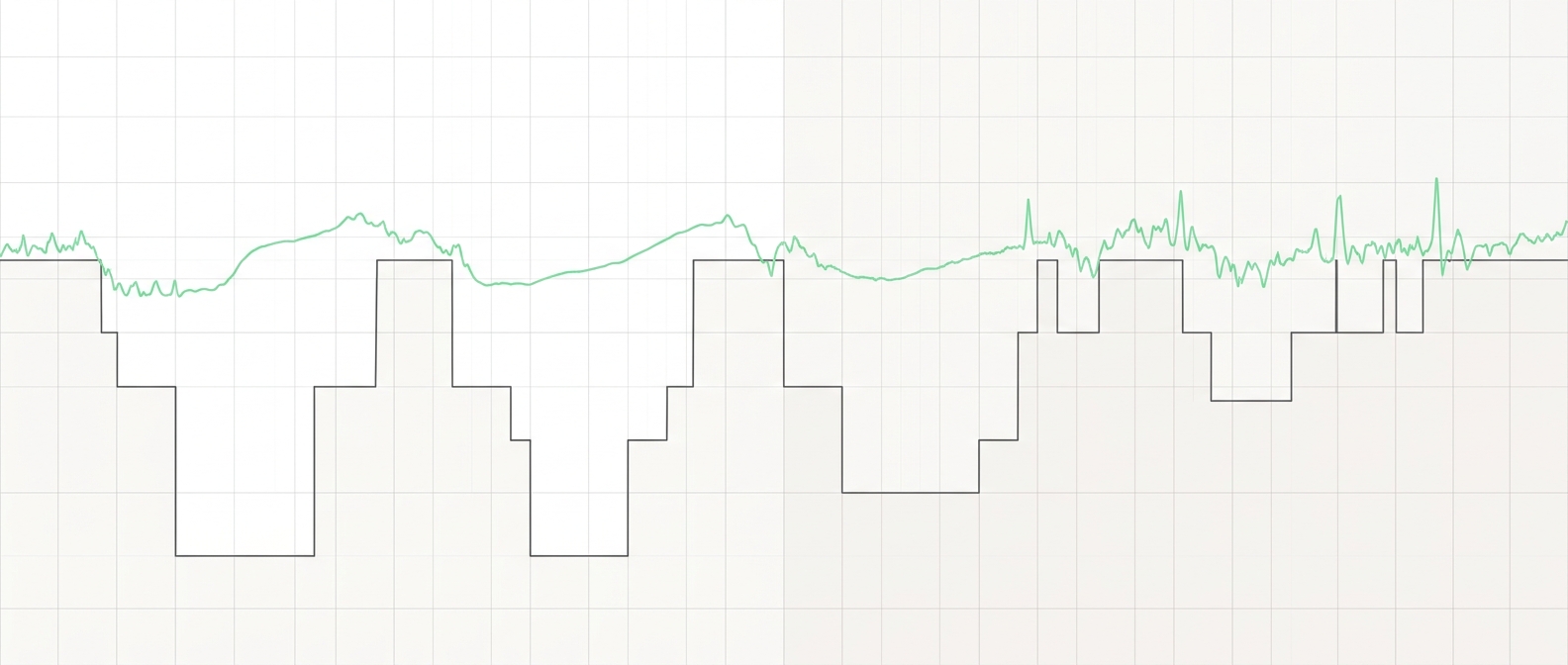
During sleep, heart rate falls and the beat-to-beat variation linked to the vagus nerve usually rises, most clearly in deep non-REM sleep. Night readings are used for tracking because movement, food, talking and posture are mostly absent. The values depend on sleep stages, the body clock, breathing and the device's method. A nightly HRV value does not by itself establish how well you slept or which sleep stages you had.
Key points
- In non-REM sleep, heart rate falls and vagally mediated heart rate variability rises; REM sleep looks more like quiet wakefulness.
- Heart rate jumps briefly at each shift from deeper to lighter sleep and at awakenings.
- Both sleep stages and the body clock shape the night-time pattern, and studies disagree on how much each contributes.
- The night removes most everyday disturbances, so it is a steadier window for personal trends than a daytime spot check.
- Wearables compute a nightly value in different ways, over different parts of the night and with different metrics, so their numbers are not interchangeable.
- Consumer devices detect sleep versus wake fairly well, but their sleep-stage estimates agree inconsistently with polysomnography.
- Sleep apnea causes a repeating slow-then-fast heart rate pattern; snoring with breathing pauses or heavy daytime sleepiness belongs with a doctor, not a wearable score.
What happens to heart rate and HRV at night?
When you fall asleep, the heart slows down and the small beat-to-beat changes in its rhythm — heart rate variability (HRV) — change character. In non-REM sleep the balance of the autonomic nervous system shifts toward parasympathetic influence, mainly through more parasympathetic activity rather than less sympathetic activity [S1]. In a laboratory study of fourteen young healthy people over three nights, this shift happened abruptly at sleep onset [S1].
Two processes overlap. One is sleep itself and the sequence of sleep stages. The other is the body clock: heart rate and high-frequency HRV follow a circadian rhythm in wakefulness and in every non-REM stage [S3]. In the same body of work, heart rate also showed an effect of time across the night beyond the stage mix [S1]. What this page adds to the general picture of why HRV changes from day to day is the night itself: what changes within it, and why it is the usual window for tracking.
How does it work across sleep stages?
Non-REM sleep (light and deep stages; the deepest is called slow-wave sleep). Sleep onset and the move into deeper stages are associated with a shift toward greater parasympathetic modulation of the heart [S3]. Heart rate is lowest and breathing is most regular here, which is why deep sleep is the calmest stretch of the night on most recordings. Within each stage, the high- and low-frequency HRV components stayed roughly constant across the night, so much of the change over the night follows the changing mix of stages [S1].
REM sleep. Autonomic balance in REM sleep was, in general, similar to wakefulness [S1], with a shift back toward sympathetic modulation compared with deep sleep [S3]. Breathing and heart rate become more irregular.
Awakenings and stage transitions. Heart rate rises abruptly at each transition from deeper to lighter sleep and at awakenings [S2]. Short awakenings are normal and are often not remembered.
What depends on the metric. "Higher" and "lower" HRV in sleep depend on which number is computed. In a small laboratory study, SDNN — which captures slower swings as well as beat-to-beat ones — was lowest in slow-wave sleep and high in REM sleep and during awakenings [S2]. Measures that track faster, breathing-linked changes behave differently. So a stage can look "high" on one metric and "low" on another; this is a property of the metrics, not a contradiction.
What is debated. One study found that sleep stages, not the body clock, mainly shape the overnight profile [S2]; another found a clear circadian rhythm within sleep stages [S3]. Both were small laboratory studies with different designs. The practical point holds either way: a shorter, later or broken night changes the reading partly through the sleep itself.
How is nightly HRV measured?
In research, overnight HRV usually comes from the ECG channel of a polysomnogram (PSG) — the full laboratory sleep recording [S4]. Wearables instead estimate it from the pulse signal of a ring, watch or strap, and each maker chooses how to turn a night into one number:
- Oura measures HRV only during sleep; the value shown is the mean of five-minute samples taken while you sleep [S13].
- Garmin HRV Status shows an average HRV calculated from data across the entire sleep period [S14].
- Apple Watch. Apple Health records HRV as SDNN [S15]. Apple's documentation for that data type does not describe a nightly averaging window, so this page does not state one.
Other devices weight parts of the night differently, for example deep sleep or the last part of the night. Different windows, different metrics (SDNN or RMSSD) and different pulse-processing steps mean that two devices worn on the same night can disagree, and neither number transfers to a laboratory value. How a single value should be read is on interpreting HRV.
Why is the night the best window?
During sleep most of the everyday disturbances to the heart's rhythm are absent: you are not moving, eating, drinking coffee, talking or changing posture. Many experimental, demographic and environmental factors influence how HRV is measured and how reliable it is [S5], and the night holds more of them steady from one recording to the next. That is why a nightly value is a useful input for a personal trend — the reference described on HRV baseline.
This also explains why a morning reading on waking or a daytime spot check gives a different number. It is recorded in a different state, often over a few minutes, with breathing, posture and recent activity shaping it. Neither is wrong; they are different measurements, and they should be compared only with readings taken the same way. The same applies to resting heart rate and breathing rate recorded at night.
The night is steadier, not clean. Sleep stages, awakenings and the timing of sleep still move the value (see above), which is why a single night says little on its own.
What affects nightly values?
Short or broken sleep, alcohol, a hard training day, infection, stress, a late meal and the menstrual cycle can all shift a night's heart rate and HRV. Their mechanisms and evidence are set out on why HRV changes from day to day and are not repeated here.
What do sleep disorders do to night-time heart rhythm?
Sleep apnea. In obstructive sleep apnea, the airway repeatedly narrows or closes during sleep. In a large clinical series, heart rate slowed progressively at the onset of each breathing pause and then sped up abruptly when breathing resumed; this repeating pattern is mediated by the autonomic nervous system [S9]. In a small study of patients with obstructive sleep apnea, sympathetic nerve activity and blood pressure did not fall during any stage of sleep, unlike in healthy sleep [S10]. These swings add variability to the overnight heart rhythm rather than signalling rest. HRV patterns have been used to screen people for referral to a sleep laboratory [S4], but a wearable value cannot diagnose apnea. Diagnosis uses polysomnography or a technically adequate home sleep apnea test [S12]. Nasal versus mouth breathing in sleep is covered on nasal breathing.
Insomnia. It is widely assumed that people with insomnia have lower HRV, but a critical review could not confirm that HRV is reliably impaired in insomnia, because the studies differed widely and most were at high risk of bias [S11].
When to see a doctor. Loud snoring with pauses in breathing that someone else notices, waking up gasping or choking, heavy daytime sleepiness, or long-standing trouble falling or staying asleep are reasons to see a doctor or a sleep specialist. Chest pain, fainting, severe breathlessness or palpitations with dizziness need urgent care. How to bring wearable data to that appointment is covered in the ONDA report for your sleep specialist and the wider doctors and your data series.
What does the evidence show?
Established. Non-REM sleep shifts the heart toward parasympathetic influence and REM sleep looks more like wakefulness [S1] [S3] [S4]. Sleep apnea produces a cyclical slow-then-fast heart rate pattern [S9]. Recording conditions shape HRV, which is why comparable conditions are recommended (expert consensus) [S5]. Consumer devices have known limits in classifying wake during the sleep period [S7].
Context-dependent. Heart rate and high-frequency HRV follow a circadian rhythm within sleep stages [S3]. In healthy young adults in a laboratory, sleep trackers detected sleep well but their stage assessments were inconsistent with PSG [S6]; the sample was thirty-four healthy young adults over three consecutive nights [S6].
Emerging. A manufacturer-run analysis reported better sleep-stage agreement when autonomic and circadian signals were added to movement [S8]. Sustained sympathetic activity during sleep in obstructive sleep apnea comes from a small study [S10].
Debated. How much of the night-time profile belongs to sleep stages and how much to the body clock [S2] [S3]. Whether HRV is lower in insomnia [S11].
Unknown. How well any specific current wearable model reproduces laboratory overnight HRV in a given person, and how nightly HRV relates to sleep quality as a person experiences it.
What it does not tell you
"A watch accurately determines my sleep stages from HRV." Not as a general rule. In a laboratory comparison with polysomnography, the devices' sleep-stage assessments were inconsistent, and performance was worse on disrupted nights [S6]. An expert review lists misclassification of wake during the sleep period and unclear performance in some groups of people [S7]. The more favourable stage results come from studies run by device makers [S8]. Stage graphs are estimates, not a sleep study.
"High nightly HRV means good sleep." Not by itself. SDNN was high in REM sleep and during awakenings and lowest in deep sleep in a small laboratory study [S2], and the repeating heart rate swings of sleep apnea add variability rather than signal rest [S9]. A higher number can come from a more broken night on some metrics.
- No single night is a verdict. Stages, awakenings and timing move the value from one night to the next.
- Devices are not interchangeable. Windows, metrics and processing differ [S13] [S14] [S15], and the methods used in research vary as well [S4] [S5].
- A wearable is not a sleep study. It cannot diagnose sleep apnea or insomnia [S12].
In ONDA
ONDA builds its personal baseline from nightly values stored in Apple Health — from Apple Watch or another device that syncs heart data there [S16]. The window is 14 days, and ONDA compares each night with your own corridor — the average of your recent nights plus or minus one standard deviation — and flags a night only when it is at least 1.5 standard deviations outside and has changed by a minimum amount. Apple Health records HRV as SDNN, so ONDA's HRV baseline is an SDNN baseline. ONDA does not stage sleep from HRV and does not diagnose sleep apnea, insomnia or any other condition.
Educational information, not a diagnosis or medical treatment.
Evidence at a glance
| Claim | Evidence | Limitation |
|---|---|---|
| In non-REM sleep the autonomic balance of the heart shifts toward parasympathetic influence, while REM sleep resembles wakefulness. [S1][S3] | Established | Small laboratory studies in young healthy adults, using spectral HRV indices whose autonomic meaning is debated; consistent with the wider literature reviewed in S4. |
| REM sleep is associated with a shift back toward sympathetic modulation compared with deep non-REM sleep. [S3] | Context-dependent | Thirteen young participants in a nap protocol; spectral indices. |
| Heart rate rises abruptly at each transition from deeper to lighter sleep or to an awakening; SDNN is lowest in slow-wave sleep and higher in REM sleep and awakenings. [S2] | Emerging | Seven subjects under constant conditions; HRV here is SDNN and a spectral ratio, not RMSSD. |
| Heart rate and high-frequency HRV follow a circadian rhythm during sleep stages as well as wakefulness. [S3] | Context-dependent | Laboratory protocol that separates the body clock from sleep; small sample. |
| Within each sleep stage, HF and LF components stayed constant across the night, so changes over the night follow the changing mix of stages; heart rate also showed a time effect. [S1] | Emerging | Small study; the relative weight of clock and sleep stages is debated (compare S2 and S3). |
| How much the night-time profile reflects sleep processes versus the circadian clock is debated. [S2][S3] | Debated | Two small laboratory studies with different protocols and conclusions. |
| HRV has been studied across sleep stages and in sleep-disordered breathing, insomnia and limb movements; its interpretation needs caveats. [S4] | Established | Narrative review; mostly ECG recordings from polysomnography, not wrist devices. |
| Many experimental, demographic and environmental factors influence HRV assessment, so comparable recording conditions matter. [S5] | Guideline / expert consensus | Research-rigour guideline; expert consensus, not direct evidence that night readings outperform day readings for any outcome. |
| Oura measures HRV only during sleep and shows the mean of five-minute samples taken while you sleep. [S13] | Established | Manufacturer documentation of the device's method only; says nothing about accuracy. |
| Garmin HRV Status shows an average HRV calculated from data across the entire sleep period. [S14] | Established | Manufacturer documentation of the feature only. |
| Apple Health records HRV as SDNN. [S15] | Established | Documents the data type only, not when the watch samples it during the night. |
| Consumer sleep trackers detect sleep well, are weaker at detecting wake, and their sleep-stage assessments were inconsistent against polysomnography. [S6] | Context-dependent | Healthy young adults in a laboratory; seven devices of that generation; performance worse on disrupted nights. |
| Wearables misclassify wakefulness during the sleep period and their performance may not translate to people with certain characteristics or conditions. [S7] | Established | Expert review; device performance changes with models and firmware. |
| A manufacturer-run study reported better four-stage agreement when autonomic and circadian features were added to movement. [S8] | Emerging | Authors employed by or advising the manufacturer; cross-validated model, not an independent test of the shipped product. |
| In sleep apnea, heart rate slows during each breathing pause and speeds up abruptly when breathing resumes, a pattern mediated by the autonomic nervous system. [S9] | Established | Classic large clinical series with ECG and polygraphy; not wearable data. |
| In obstructive sleep apnea, sympathetic activity and blood pressure rise during sleep instead of falling. [S10] | Emerging | Ten patients; direct nerve recordings in a laboratory. |
| It is not established that HRV is reliably impaired in insomnia. [S11] | Debated | Studies heterogeneous and mostly at high risk of bias; no meta-analysis possible. |
| Sleep apnea is diagnosed with polysomnography or technically adequate home sleep apnea testing, not with questionnaires or prediction tools alone. [S12] | Guideline / expert consensus | Clinical practice guideline for adults; does not evaluate consumer wearables. |
| ONDA builds its baseline from nightly Apple Health values and compares each night with the user's own corridor. [S16] | Established | Describes app behaviour only; not evidence for any health claim. |
Sources
- [S1] Trinder et al. (2001). Autonomic activity during human sleep as a function of time and sleep stage. Journal of Sleep Research. DOI 10.1046/j.1365-2869.2001.00263.x · PMID 11903855 · Small laboratory study in young healthy adults
- [S2] Viola et al. (2002). Sleep processes exert a predominant influence on the 24-h profile of heart rate variability. Journal of Biological Rhythms. DOI 10.1177/0748730402238236 · PMID 12465887 · Experimental study in seven healthy subjects under constant conditions
- [S3] Boudreau et al. (2013). Circadian variation of heart rate variability across sleep stages. Sleep. DOI 10.5665/sleep.3230 · PMID 24293767 · Ultradian sleep-wake protocol in thirteen healthy young participants
- [S4] Stein & Pu (2012). Heart rate variability, sleep and sleep disorders. Sleep Medicine Reviews. DOI 10.1016/j.smrv.2011.02.005 · PMID 21658979
- [S5] Carter et al. (2026). Guidelines for rigor and reproducibility of heart rate variability within human cardiovascular research. American Journal of Physiology. Heart and Circulatory Physiology. DOI 10.1152/ajpheart.00041.2026 · PMID 42495990
- [S6] Chinoy et al. (2021). Performance of seven consumer sleep-tracking devices compared with polysomnography. Sleep. DOI 10.1093/sleep/zsaa291 · PMID 33378539 · Laboratory validation in healthy young adults; several authors employed by government contractors; no device-maker authors
- [S7] de Zambotti et al. (2024). State of the science and recommendations for using wearable technology in sleep and circadian research. Sleep. DOI 10.1093/sleep/zsad325 · PMID 38149978 · Sleep Research Society review; the first author lists an affiliation with a health-technology company, and one co-author has advised a ring maker
- [S8] Altini & Kinnunen (2021). The Promise of Sleep: A Multi-Sensor Approach for Accurate Sleep Stage Detection Using the Oura Ring. Sensors. DOI 10.3390/s21134302 · PMID 34201861 · Conflict of interest: one author employed by Oura Health, the other an Oura adviser
- [S9] Guilleminault et al. (1984). Cyclical variation of the heart rate in sleep apnoea syndrome. Mechanisms, and usefulness of 24 h electrocardiography as a screening technique. Lancet. DOI 10.1016/s0140-6736(84)90062-x · PMID 6140442
- [S10] Somers et al. (1995). Sympathetic neural mechanisms in obstructive sleep apnea. Journal of Clinical Investigation. DOI 10.1172/JCI118235 · PMID 7560081 · Small study: ten patients
- [S11] Dodds et al. (2017). Heart rate variability in insomnia patients: A critical review of the literature. Sleep Medicine Reviews. DOI 10.1016/j.smrv.2016.06.004 · PMID 28187954
- [S12] Kapur et al. (2017). Clinical Practice Guideline for Diagnostic Testing for Adult Obstructive Sleep Apnea: An American Academy of Sleep Medicine Clinical Practice Guideline. Journal of Clinical Sleep Medicine. DOI 10.5664/jcsm.6506 · PMID 28162150
- [S13] Oura support: Heart Rate Variability. Heart Rate Variability. · official documentation
- [S14] Garmin Technology: HRV Status. HRV Status. · official documentation
- [S15] Apple HealthKit documentation. heartRateVariabilitySDNN. · official documentation
- [S16] ONDA — product documentation: How ONDA works. How ONDA works.
Related
- ScienceWhy HRV Changes From Day to Day
- ScienceHRV Baseline: Why Your Own Normal Matters More Than Any Norm
- ScienceCan You Trust HRV From a Smartwatch or Ring?
- ScienceWhat a Single HRV Value Can and Can't Tell You
- ScienceExercise and HRV: What Training Does and What HRV Guidance Shows
- GlossaryHeart Rate Variability
- GlossarySlow-Wave Sleep (SWS)
- ArticleHow Much Sleep Do You Need? (By Age)
- ArticleShowing Your Night Data to a Sleep Specialist: What It Can and Can't Tell Them
- ToolSleep Calculator — What Time to Go to Bed
How ONDA Science pages are made: every number comes from one checked list of facts, every claim is mapped to its sources and graded by strength of evidence, and sources need a DOI or PMID (manufacturer documentation is used only for device facts).