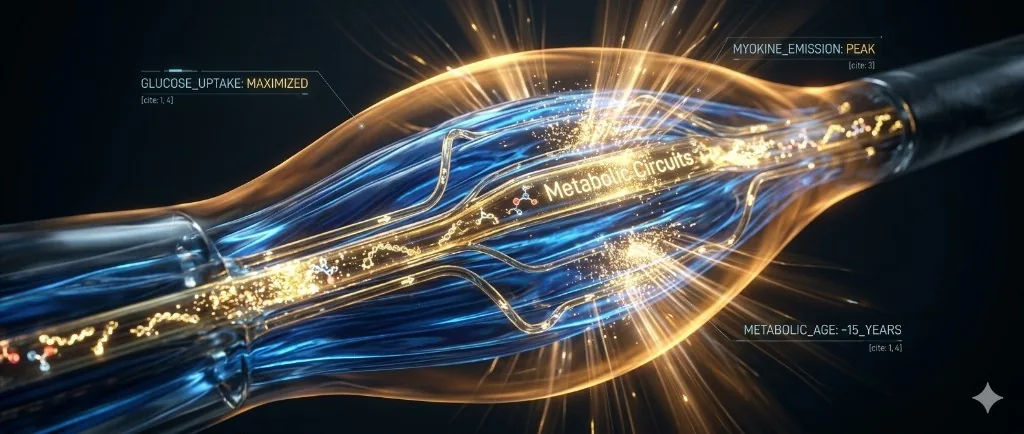
[ MUSCLE_AS_METABOLIC_MARKER ]
"In traditional biology, muscle is viewed merely as a tool for locomotion. In the ONDA system, muscle is your largest metabolic organ—your primary glucose 'accumulator' and the chief driver of hormonal youth.
Muscle functions as a Metabolic Buffer: the higher the quality of your tissue, the more stable your 'Energy Grid' (blood sugar levels, insulin sensitivity). A drop in muscle mass (sarcopenia) is the biological equivalent of battery degradation in your biocomputer. Defending that tissue through the GLP-1 era is its own protocol — see GLP-1 biology & muscle preservation. As of 2026, muscle strength is officially recognized as the single best predictor of biological age."
How does muscle exercise affect the brain?
Every load-bearing muscle contraction triggers the release of Myokines—signaling molecules (data packets) that communicate directly with your brain. One specific myokine, BDNF, directly stimulates the growth of new neurons. Thus, training your muscles is a direct firmware update for your cognitive Software.
[ SECTION 2: HORMESIS AND SYSTEMIC REPAIR ]
Integrating peptide protocols (such as BPC-157) with resistance-based stress allows for more than just hypertrophy—it enables Systemic Repair. Muscle tissue becomes a 'sponge,' absorbing systemic inflammation. Systemic repair like this depends on varied stress rather than repetition — see range fractionation.
[ EXECUTION_PROTOCOLS ]
PROTOCOL_01 > GRIP STRENGTH CALIBRATION
The Hack: Weekly measurement of grip strength using a digital dynamometer.
The Logic: Grip strength is a direct proxy for the state of your Central Nervous System (CNS) and overall 'Hardware' density. A drop of 10% or more signals the need to shift into System Recovery mode.
PROTOCOL_02 > METABOLIC OVERCLOCKING (HIIT)
The Hack: Short bursts of high-intensity stress (e.g., 4-minute Tabata intervals) twice per week.
The Logic: Hacking mitochondrial density within muscle fibers. This expands the system's bandwidth for glucose utilization, preventing the 'contamination' of vessels with excess sugar.
PROTOCOL_03 > RECOVERY FIRMWARE (PEPTIDE PATCH)
The Hack: Integration of BPC-157 / TB-500 protocols during periods of high-intensity training cycles.
The Logic: Accelerating angiogenesis (vascular growth) in tissues. This ensures rapid 'Fuel' delivery and 'Metabolic Waste' removal, allowing the Hardware to maintain peak intensity without risking structural failure.
[ HARDWARE_VALIDATION ]PRIMARY_DEVICE:[BIO_IMPEDANCE: INBODY / WITHINGS_BODY_SCAN]METRIC: Skeletal Muscle Mass (SMM). Tracks net 'Metabolic Hardware' volume, not gross body weight.SECONDARY_DEVICE:[DYNAMOMETER: DIGITAL_GRIP_TEST]METRIC: Grip Power. Correlation of strength to body mass as a marker of biological durability.SYSTEM_DATA:[BLOOD_PANEL: IGF-1 & HbA1c]METRIC: Average blood sugar (HbA1c) and growth-factor (IGF-1) trend.STATUS: TRACK_OVER_WEEKSIllustration — not a measurement
[ FINALIZE_ANALYSIS ]
System Integrity: Robust. Metabolic Throughput: High.