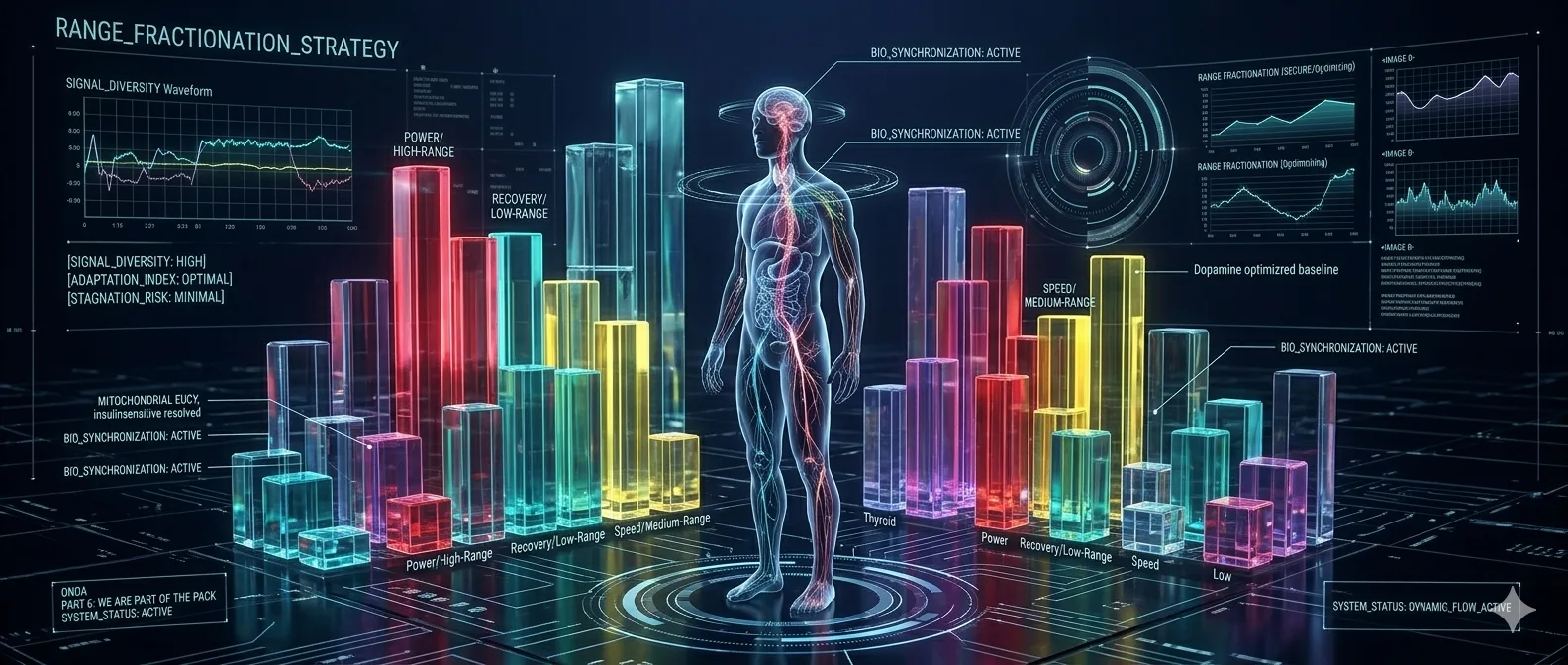
[ PROTOCOL ANALYSIS ]
"Range Fractionation is a method of distributing intensity or load types across different 'fractions' (ranges) instead of striking a single point. In the ONDA architecture, we utilize this to bypass homeostatic stagnation.
When you train or consume nutrients in a linear, repetitive mode, your receptors desensitize. Fractionation allows the system to receive signals of varying amplitudes and frequencies, forcing it to constantly recalibrate its internal resources."
[ MODULE-SPECIFIC IMPLEMENTATION ]
1. MODULE: PHYSICAL TRAINING (Mechanical Range)
Instead of performing standard 3×10 sets with a fixed weight, you fragment the load into three fractions: Ultra-Heavy (1–3 reps) for CNS activation and recruitment of high-threshold motor units, Moderate (8–12 reps) for hypertrophy and metabolic stress, and Light/High-Velocity for explosive power and capillary density optimization.
The Hack: Fragment the load: 1–3 reps ultra-heavy (CNS activation), 8–12 reps moderate (hypertrophy), light/high-velocity (explosive power). The system receives a composite signal to upgrade all fiber types simultaneously.
2. MODULE: NUTRITION & HORMONES (Nutritional Fractionation)
Some people alternate stricter eating days with fuller refeed days. Whether this changes appetite hormones in people is unproven — dieting lowers leptin either way — so treat it as a personal experiment, not a hormonal reset.
This prevents the metabolic downclocking that inevitably follows prolonged linear caloric deficits.
3. MODULE: THERMAL STRESS (Thermal Range)
The image here is hitting both extremes: cold narrows blood vessels, heat widens them. That alternating them trains vascular elasticity has not been shown — treat it as an idea, not a proven training effect.
The Hack: Cold, then sauna: vessels narrow in the cold and widen in the heat. "Training the vascular range" is an image, not a proven effect. Blood pressure drops after heat, so stand up slowly; never do it after alcohol.
[ EXECUTION_PROTOCOLS: FRACTIONATION_LOGIC ]
PROTOCOL_01 > AMPLITUDE SHIFT
The Hack: Never execute two identical days in a row. If today was 'High Load,' tomorrow must be 'Low Load/High Recovery.'
The Logic: Creating high contrast is the primary driver of biological adaptation.
PROTOCOL_02 > MICRO-FRACTIONATION
The Hack: Alternate between small daily stimulus doses and massive 'Impact' sessions once a week.
The Logic: Maintaining baseline tone while periodically subjecting the system to deep structural resets.
[ SYSTEM CORRECTION LOG ]
INPUT_SIGNAL: Progress Plateau / Stagnation
SYSTEM_STATE: Adaptation Threshold Reached
ACTION: PROTOCOL: RANGE_FRACTIONATION / SIGNAL_DIVERSIFICATION
INPUT_SIGNAL: Chronic Fatigue / Overtraining
SYSTEM_STATE: Range Overload (Excessive time in High-Range)
ACTION: PROTOCOL: COMPULSORY_LOW_RANGE_RECOVERY
[ HARDWARE_VALIDATION ]
METRIC: Heart Rate Variability (HRV) + Increase in load/endurance metrics.
STATUS: System pulled from stagnation. Adaptation protocols active.
[ FINALIZE_ANALYSIS ]
Range Fractionation is an Anti-fragility Strategy. Instead of attempting to be 'stably average,' you teach your system to be efficient across extreme ranges. This prepares you for any load while maintaining biological flexibility and resourcefulness.
[ SYSTEM_STATUS: DYNAMIC_FLOW_ACTIVE ]
Recommended tools
Range fractionation is about adaptation across cognitive states. No consumer headset can measure it directly; these give live EEG feedback, and their state scores are each maker’s own formula.
- •Neurosity Crown — developer EEG with raw-data access
- •Muse S Athena — consumer EEG with the app’s own calm/active labels
- •Emotiv Insight 2 — six proprietary performance scores