Heart, Fitness & Metabolism
Your cardiovascular and metabolic health is built over years. These guides cover blood pressure and slow breathing, VO2 max and Zone 2 training, heart rate recovery, overtraining, nutrition basics, hormones and metabolic flexibility — including what yoga and breathing research shows for blood sugar and metabolic syndrome.
Start here

The Pressure Valve: What Slow Breathing Actually Does to Blood Pressure
A short investigation into the one drug-free lever with real evidence for blood pressure — slow, paced breathing — how it works through the baroreflex, how big the effect honestly is, and where its limits are.
Read the guide →All Heart, Fitness & Metabolism guides (24)

Heart-Rate Recovery: The Fitness Marker Hiding in Your Data
How fast your heart rate falls in the minute after effort is one of the most telling fitness signals you own — a direct read on parasympathetic reactivation. Why a fast drop is fitness, a slow drop a flag, and how to track it.

Overtraining Has a Number: When Your Recovery Signals Turn
More training isn’t more progress — recovery decides. When load outruns recovery, resting heart rate creeps up and HRV drops. Why the fitness gain lives in the rest, and how to read the turn before it costs you.

Can Breathing Help Metabolic Syndrome? Research in Young Adults
Metabolic syndrome is rising in young, sedentary adults. Indian research found pranayama improved blood pressure, BMI-linked and metabolic risk markers in medical students — a low-cost lifestyle lever.

Yoga and Breathing for Type 2 Diabetes: What Indian Research Shows
Structured yoga and pranayama, added to standard care, improved blood sugar, HRV and cardiometabolic risk in Indian trials of type 2 diabetes. The evidence, and how it fits alongside treatment.

Fascial Tensegrity Protocol: Clearing Myofascial Noise
Release physical compression, clear myofascial noise and recalibrate the tensegrity matrix. ONDA protocol pairing trapezius release with vagal activation.
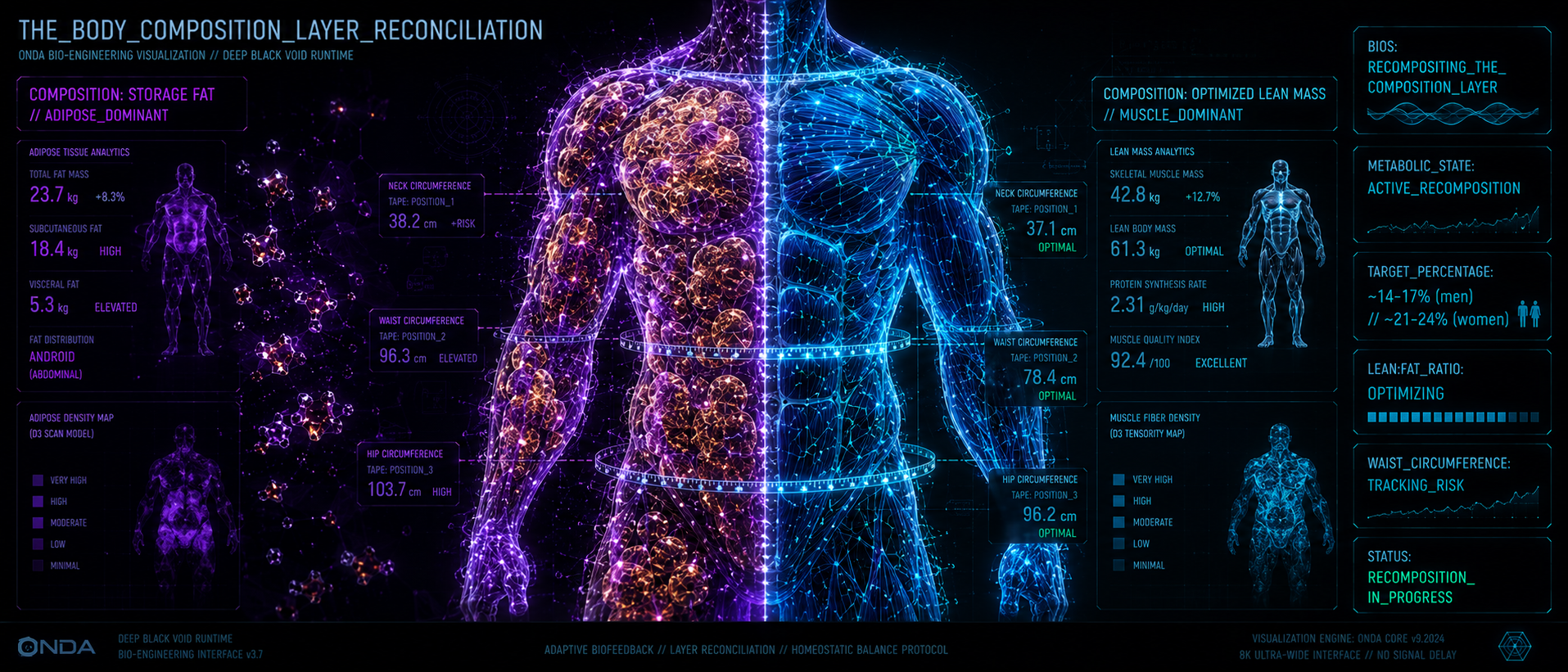
Body Fat %: Reading Your Composition Layer
What is a healthy body-fat percentage, and how do you measure it accurately? Essential vs storage fat, the ranges by sex, and why composition beats the scale.

GLP-1 Biology & Muscle Preservation
Natural GLP-1 activation protocols using Berberine and Protein Leverage to optimize metabolism without muscle loss.
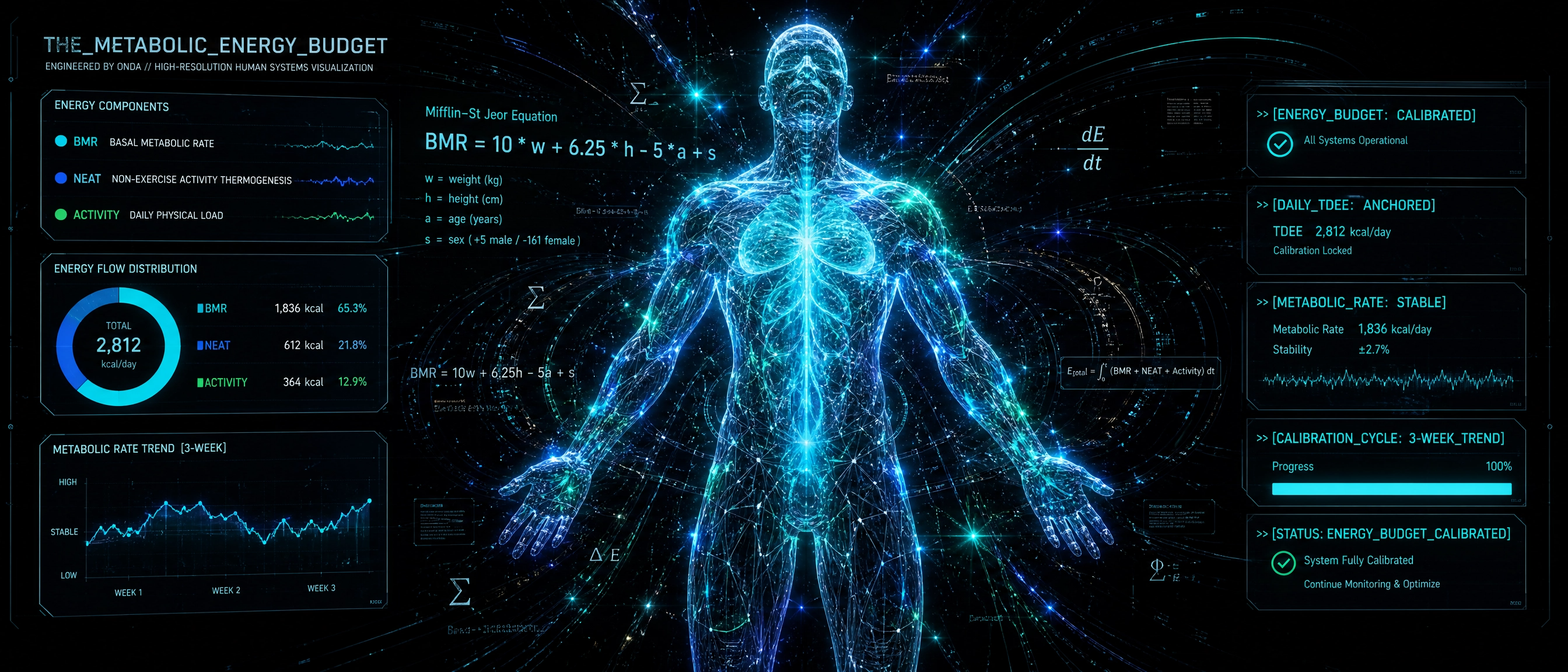
How to Calculate Your Maintenance Calories (TDEE)
How to find your maintenance calories: the Mifflin–St Jeor equation, the activity multiplier, and why your real number is the 2–3 week weight trend.
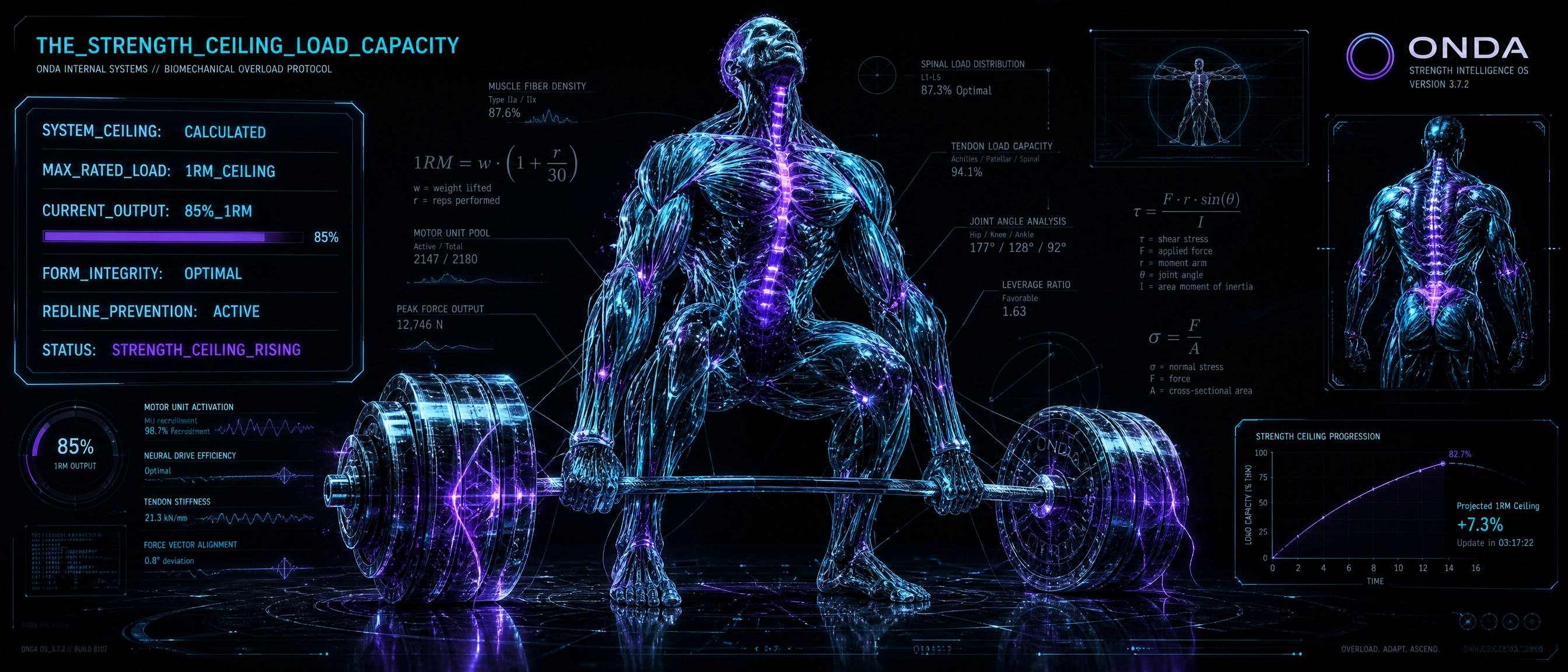
How to Calculate Your One-Rep Max (1RM)
How to estimate your one-rep max without testing it: the Epley and Brzycki formulas, why a heavy set of ≤6 reps is most accurate, and how to program from it.

Hydraulic Viscosity and the ONDA Transport Bus
Blood viscosity as the resistance of the cerebral transport bus. Hagen–Poiseuille mechanics, thermal control and the ONDA logic for zero-impedance delivery.

Protein: Provisioning the Build Queue
How much protein do you really need? Learn the evidence-based target in g/kg, the per-meal leucine threshold, and why distribution beats one big hit.

Vascular Tensegrity and Microvascular Mechanics
Vascular tensegrity as the structural integrity of the microcirculation. Hydraulics, fascial tension and zero-impedance delivery to the prefrontal cortex.

VO₂max: Overclocking Your Aerobic Engine
VO₂max is the single best marker of cardiorespiratory fitness and a top predictor of lifespan. Learn what it is, what is good for your age, and how to raise it.

Zone 2 Training: Installing Your Aerobic Base Layer
Zone 2 training builds the mitochondrial base layer that powers everything else. Learn what Zone 2 heart rate is, why it works, and how to program it.

Energy Governor: TSH
Learn how TSH regulates your metabolic speed. Discover how to optimize thyroid function, resolve brain fog, and manage stress-induced underclocking.

FEMTECH: Cyclical Architecture
The female organism is a Dynamic 28-day Architecture. Four unique work modes, phase synchronization, and metabolic flexibility — transform biology from chaos into a perfectly tuned machine.

Muscle as a Metabolic Marker
Your largest metabolic organ: muscle as glucose accumulator, myokine hub, and the best predictor of biological age.

Adaptation Hack: Range Fractionation
When you train in a linear, repetitive mode, receptors desensitize. Range Fractionation forces the system to constantly recalibrate by distributing signals across extreme ranges — bypassing homeostatic stagnation.

Oxytocin and Testosterone: What They Really Do in Social Life
Oxytocin is not a simple trust hormone and testosterone is not a simple aggression hormone. What studies show, which findings failed, and what shapes both.

The Fuel Switch: What Metabolic Flexibility Really Is — and How to Tell If You Have It
Metabolic flexibility is your ability to shift between burning fat and carbs. How it is measured, why it is not ketosis, and which habits actually improve it.

Estrogen and the Brain: Is Perimenopause Brain Fog Real — and What Helps?
Brain fog in perimenopause is real but usually temporary. How estrogen affects the brain, what hormone therapy can and cannot do, and other options that work.

How Different Yoga Poses Affect Your Heart Rate and Blood Pressure
Not all yoga poses affect your heart the same way — inversions, backbends and relaxation poses each shift heart rate and blood pressure differently. What research measured, and how to use poses deliberately.

The Hunger Signal: Why Leptin Stops Working — and Why a Short Night Makes You Hungrier
Leptin tells your brain how much fat you store. Why high leptin does not stop hunger, why dieting lowers it, how short sleep cuts it, and what actually helps.
The science behind this topic
Common questions about Heart, Fitness & Metabolism
What is a good VO2 max for my age?
It depends on age and sex. For men in their 30s, a good VO2 max is roughly 41–47 ml/kg/min; for women the same age, about 34–39. Without training it falls about 10% per decade after 30. The most reliable way to raise it is intervals: 4 × 4 minutes near 90–95% of max heart rate, with 3 easy minutes between, once or twice a week.
VO₂max: Overclocking Your Aerobic Engine →VO₂max estimator →
What heart rate is zone 2?
Zone 2 sits at about 60–70% of your maximum heart rate. The simple test: you can still hold a full conversation, but you would rather not. Aim for 150–180 minutes a week in blocks of 30–60 minutes, kept almost boringly easy — that is what builds the aerobic base.
Zone 2 Training: Installing Your Aerobic Base Layer →Zone 2 heart rate calculator →
How much protein do I need per day to build muscle?
About 1.6 g per kg of body weight per day, the point where muscle gains plateau in a large meta-analysis. The official 0.8 g/kg is only the floor for avoiding deficiency. In a calorie deficit, going toward ~2.2 g/kg better protects lean mass, and splitting protein across 3–4 meals works better than one or two big ones.
How do I calculate my maintenance calories?
Estimate your resting burn with a predictive equation, then multiply by an activity factor to get your TDEE — the calories that keep your weight stable. These equations are accurate to about ±10% for most people, so treat the result as a starting point and adjust after two weeks of real weight data. To lose, eat about 15–20% below it.
How to Calculate Your Maintenance Calories (TDEE) →TDEE calculator →
Can breathing exercises lower blood pressure?
Yes, modestly. Slow breathing at about six breaths per minute trains the baroreflex, the system that steadies blood pressure, and reduces sympathetic drive. A practical dose is ten minutes once a day. It supports, but does not replace, treatment — if you have high blood pressure, keep working with your doctor.
What Slow Breathing Actually Does to Blood Pressure →Resonance breathing →